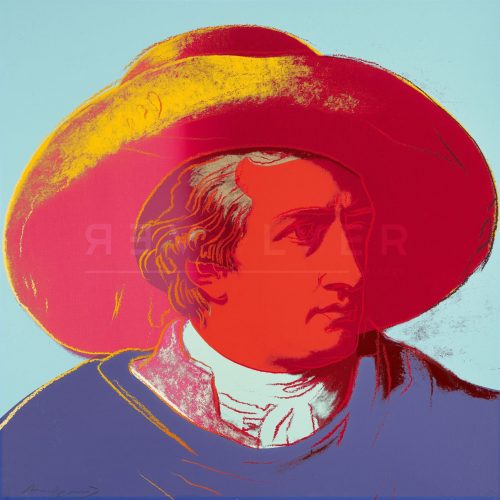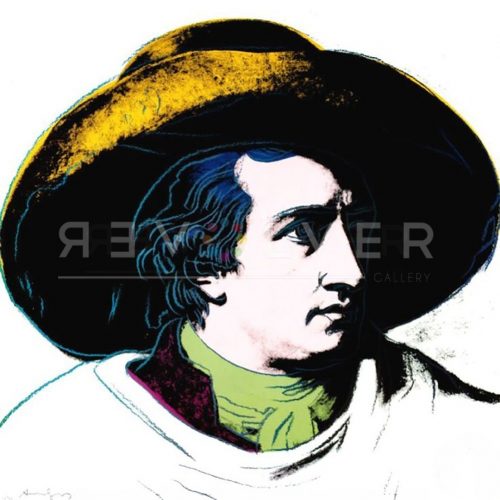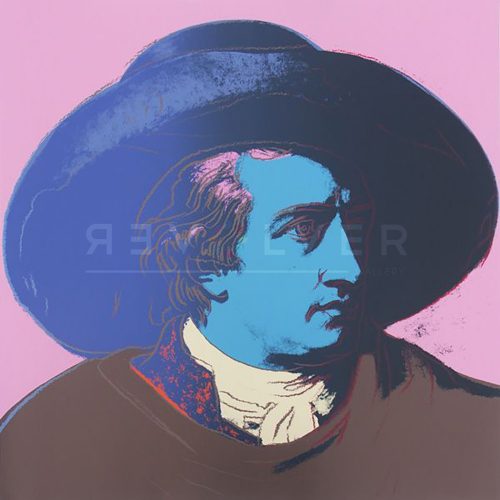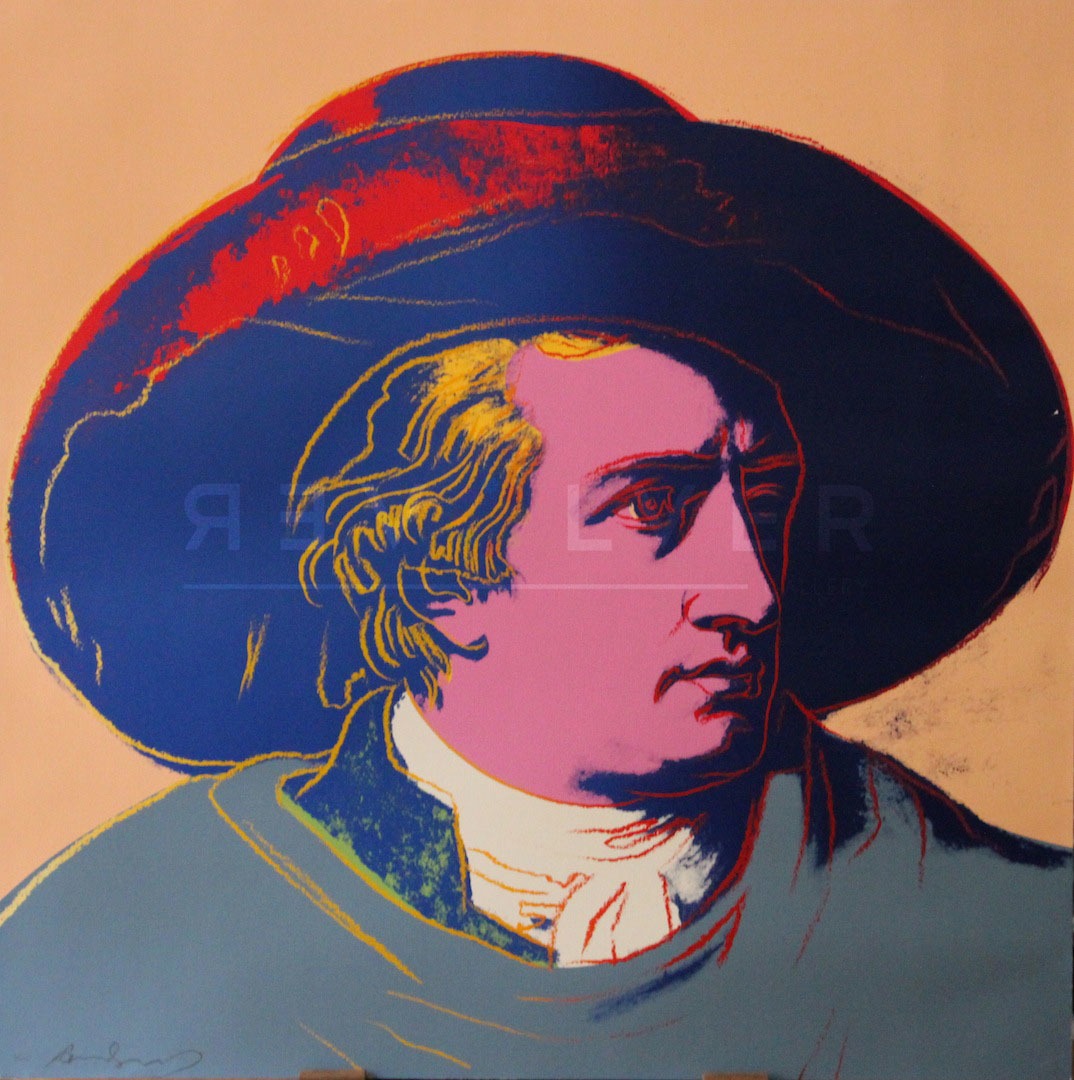
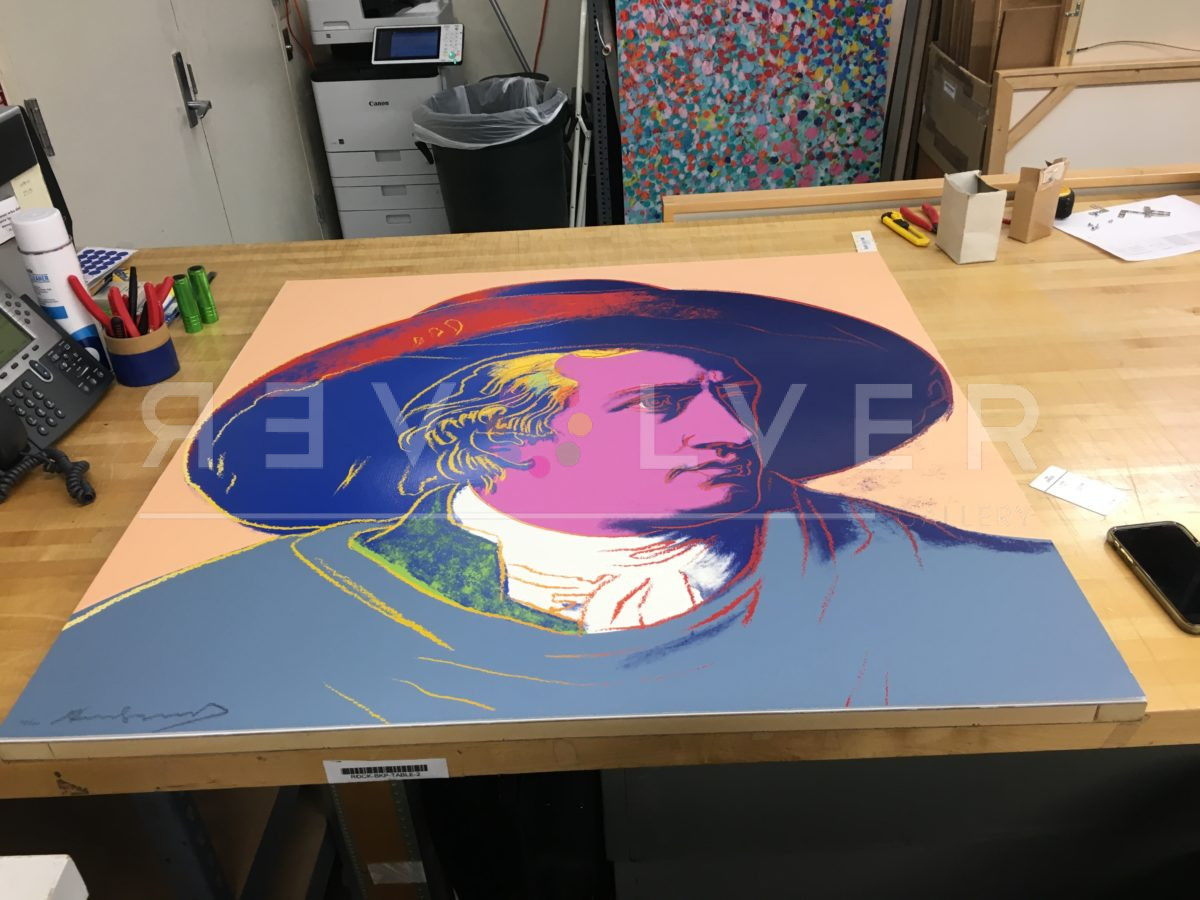
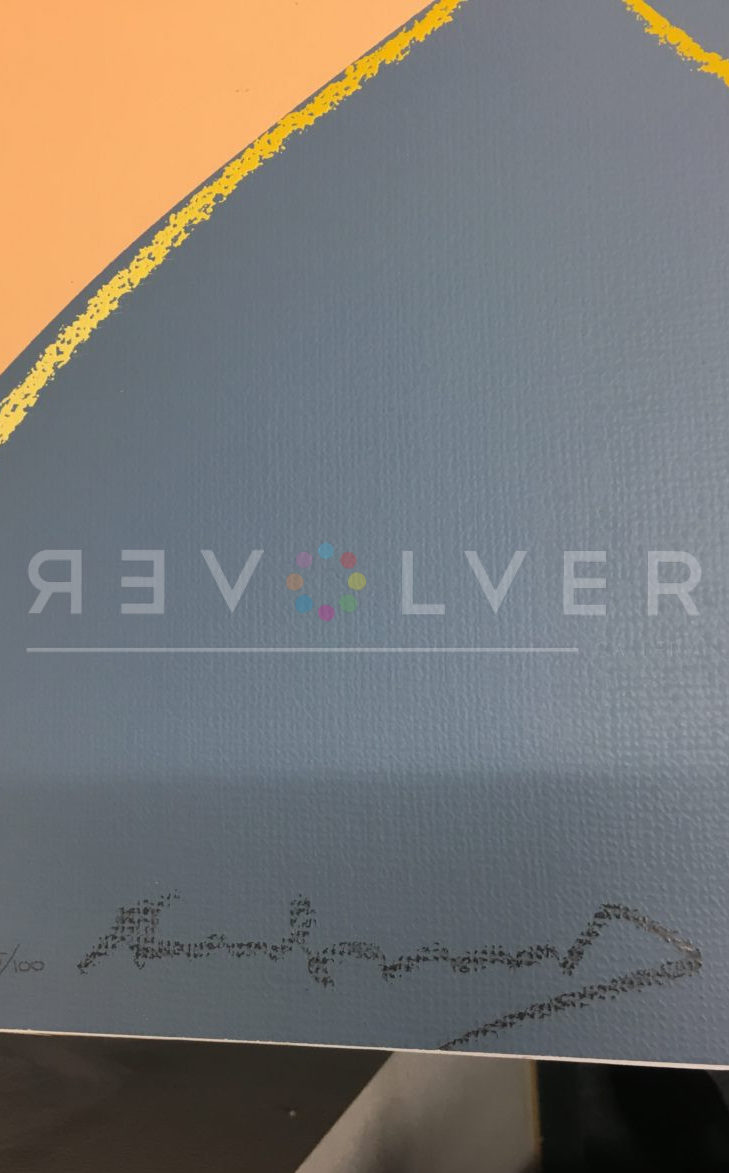
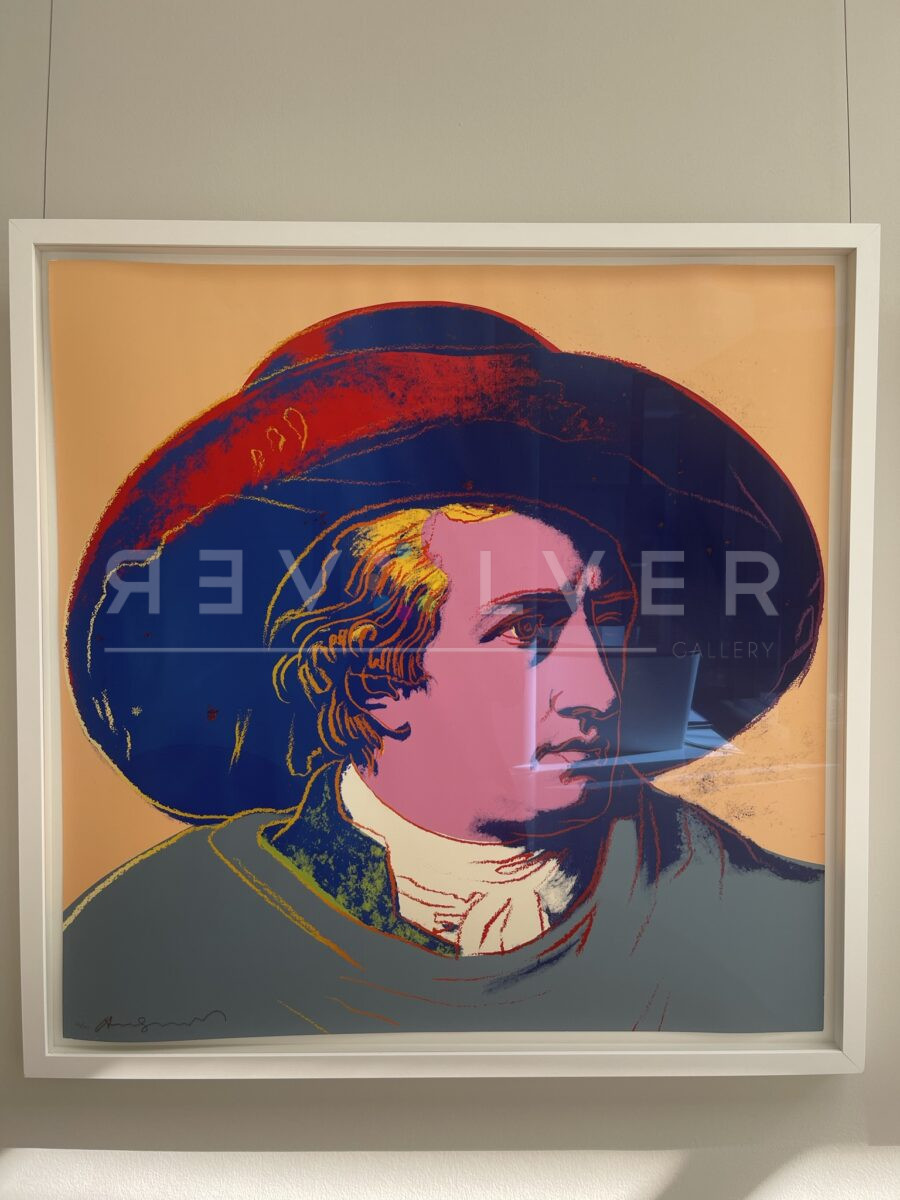
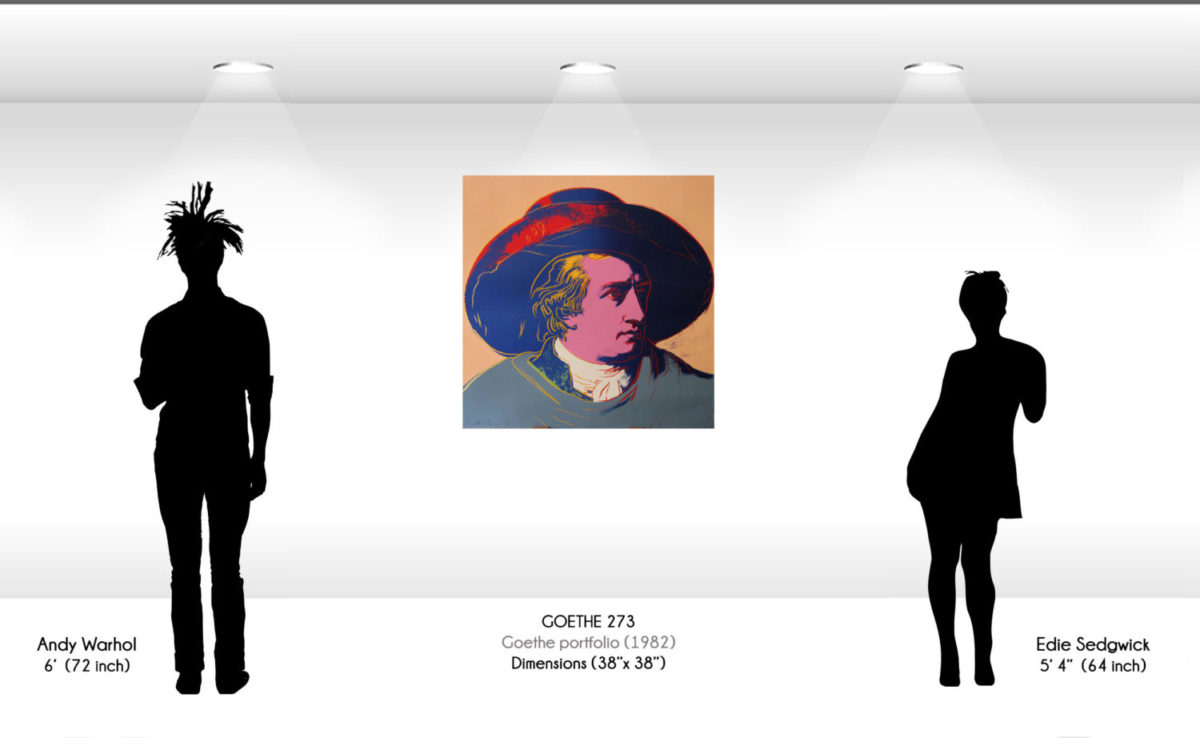
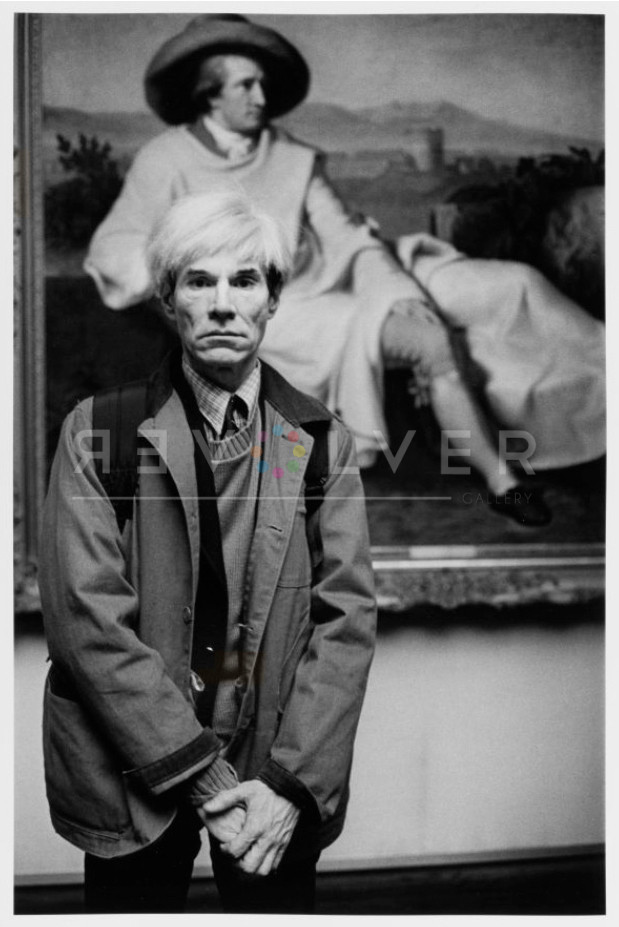
Goethe 273 by Andy Warhol is the fourth and final print in the Goethe complete portfolio, a series of portraits Warhol made in 1982 of the 18th century German literary icon, Johan Wolfgang von Goethe. Warhol chose to render Goethe in his inimitable style after seeing a renowned painting of him by Johann Heinrich Wilhelm Tischbein at Germany’s famed Städel art museum. Likewise, in Germany, the prints themselves were published by Editions Schellmann & Klüser and Galerie Hans Mayer. The former (now Edition Schellmann) was a notable publisher of Warhol works abroad, having previously produced his series of portraits of artist and theoretician, Joseph Beuys, and later going on to distribute Warhol’s Details of Renaissance Paintings series. The latter was responsible for exposing Warhol to the Düsseldorf art scene, showing his work in 1969 as part of an effort to publicize the then-growing number of popular American Pop artists.
Like other prints in the Goethe portfolio, Goethe 273 is an exploration and celebration of color. It’s appropriate that Warhol would take such an approach with a figure like Goethe, who published an influential treatise on color in 1810. The series as a whole is characterized by bright and unorthodox color choices; Goethe 273 is no exception. In it, Goethe’s face sits in a pale plum, outlined by hand drawn lines of a fierce red. That same red highlights Goethe’s wide-brimmed hat, which otherwise is colored with a gradient of near navy blue that transitions to black as it moves from left to right. A complementary yellow defines Goethe’s hair, a nice interplay of primary colors visible in other prints from the series. Behind sits a light sandy orange for background, made to “pop” a little more by the grey of Goethe’s duster coat and the white of his cravat.
As a fitting counterpart to how Goethe’s ideas have made it to the current era, Goethe 273 stands as a contemporary reimagining of the figure in the modern (and perhaps postmodern) art paradigm. Revolver currently owns all screenprints from the Goethe series, which includes Goethe 270, Goethe 271, Goethe 272, and Goethe 273.
Photo credit: Portrait of Andy Warhol at the Städelmuseum in Frankfurt posing with Johann Tischbein’s Goethe in the Roman Campagna 1786-87.” Photo by Barbara Klemm, 1981.