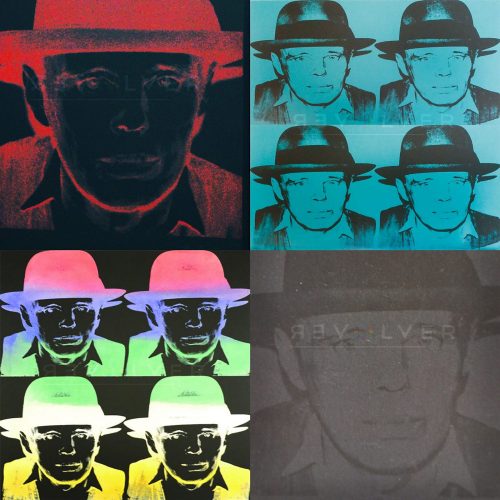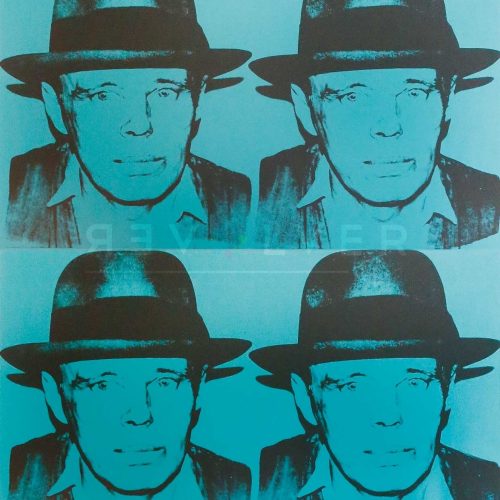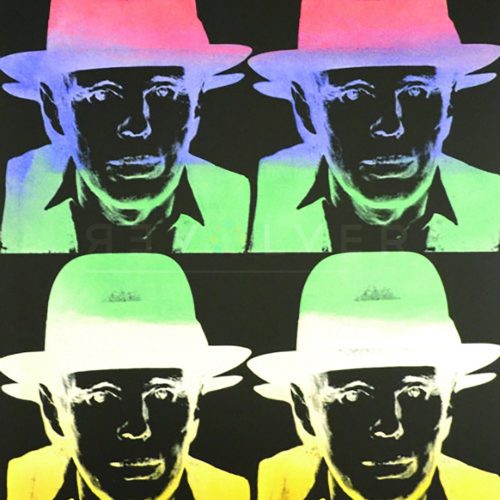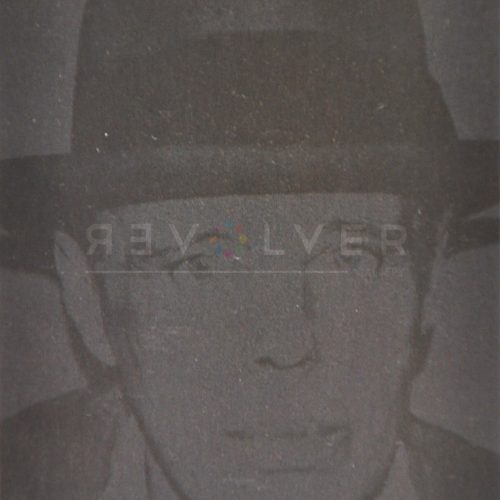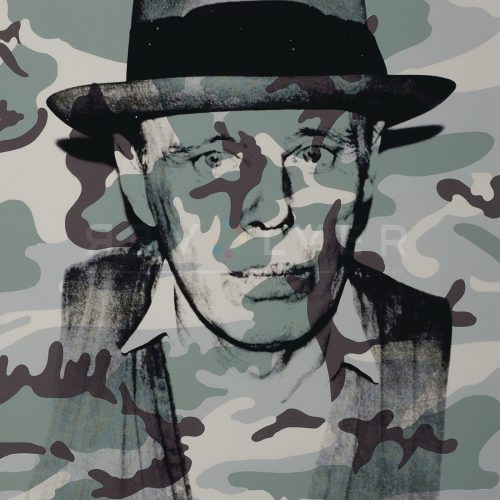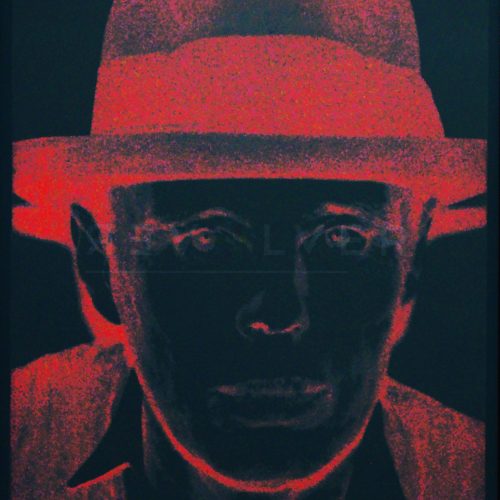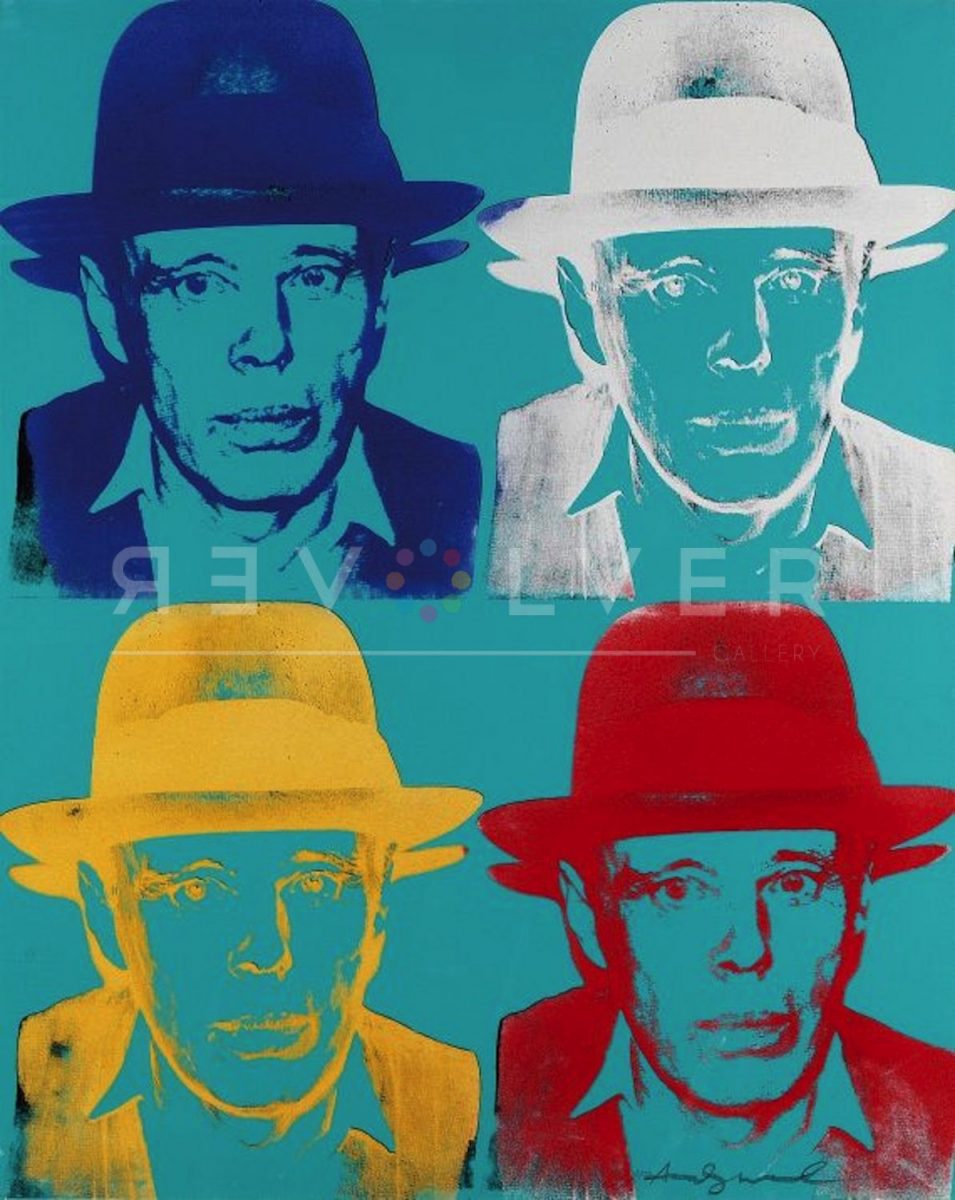
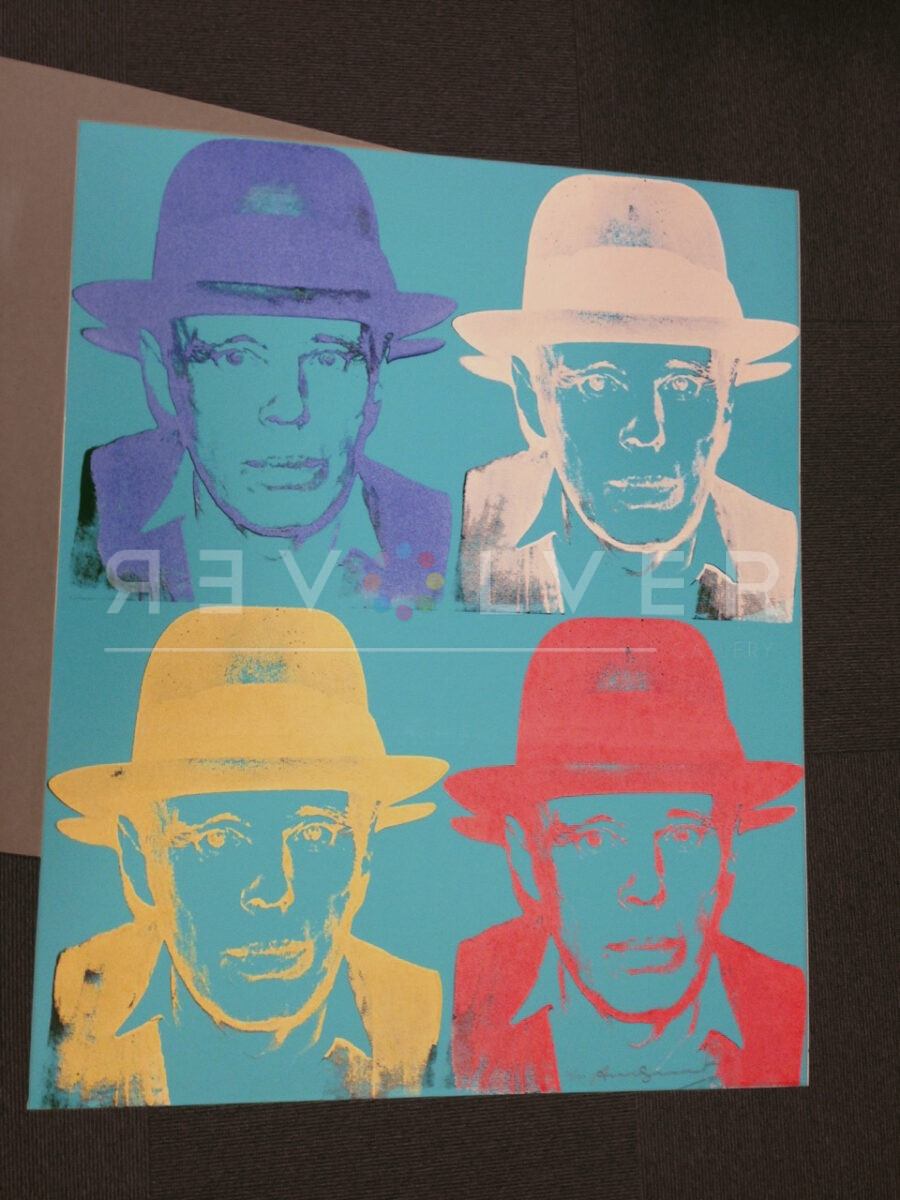
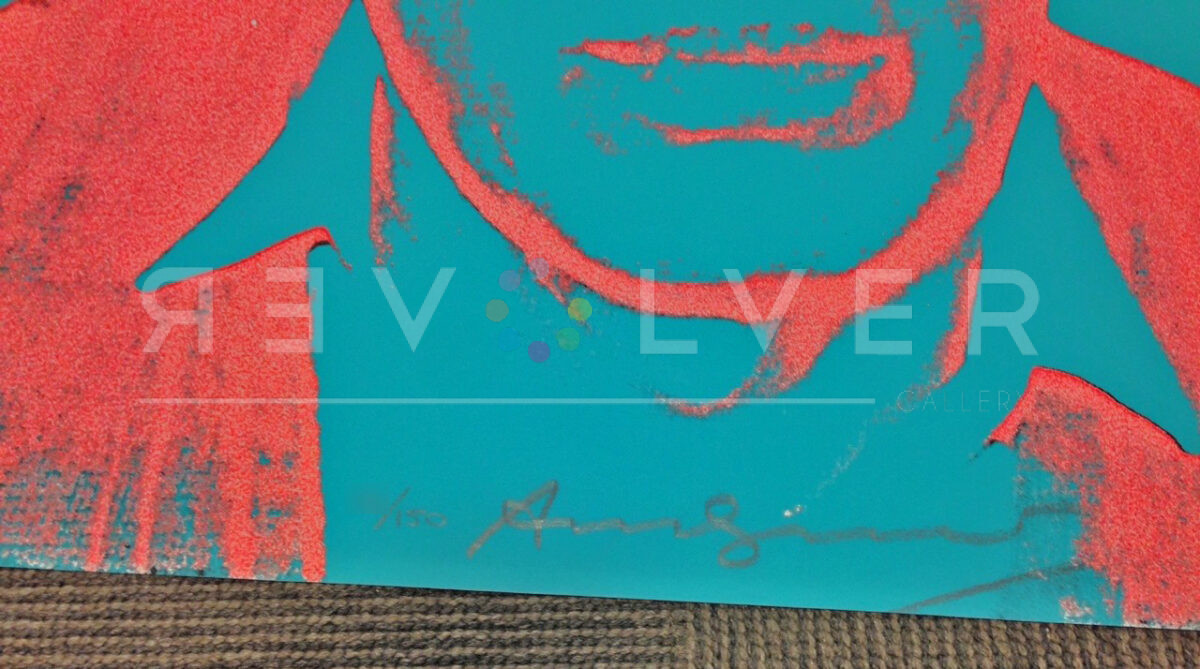
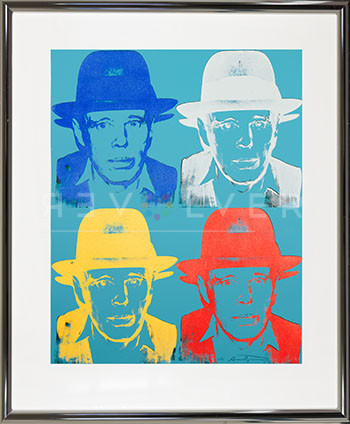
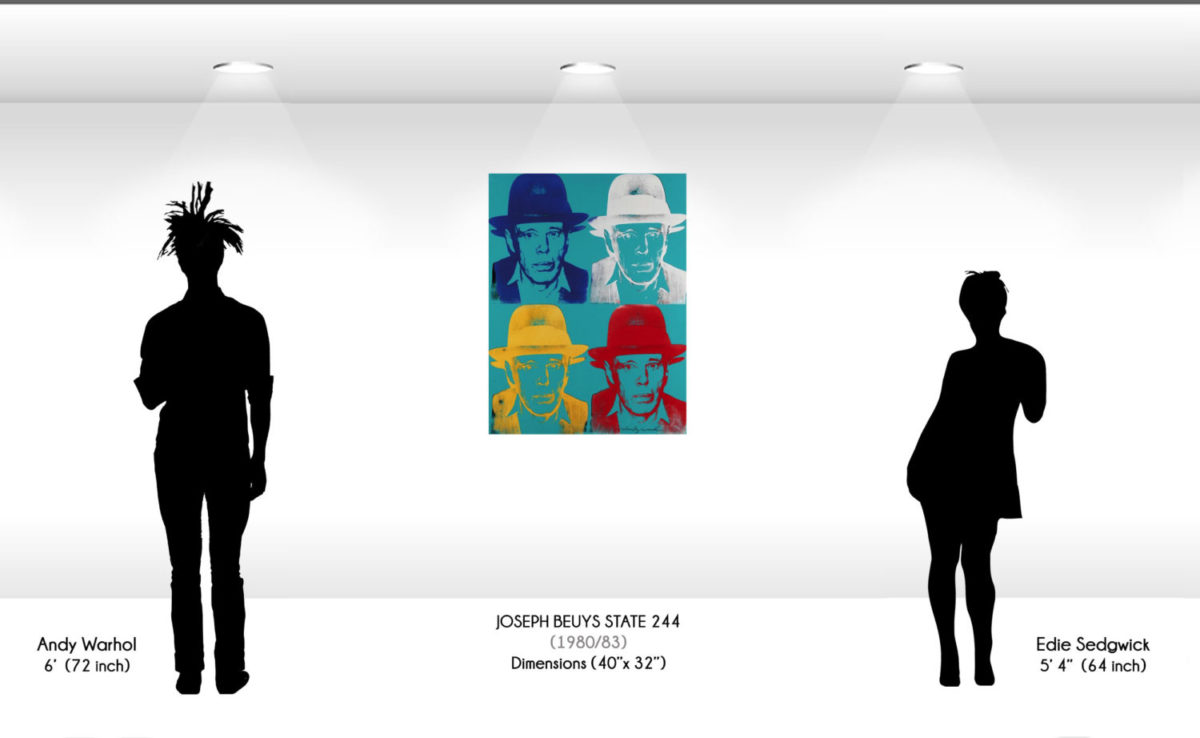
Joseph Beuys 244 by Andy Warhol is a screenprint from the artist’s Joseph Beuys complete portfolio. The work is a tribute to the great Joseph Beuys, who was considered one of the most powerful and influential post-war art figures of the 1960s. In addition to being a sculptor, graphic and installation artist, Beuys was also an art theorist and performing artist. His art was celebrated for its revolutionarily modern themes. One of his installation pieces was a piano that did not make sound, covered in red felt with a cross on its side. It was a visual piece that represented silence as a danger to society. This series is an example of how his artwork initiated discussion about societal issues and made people think. Joseph Beuys 244 is a more colorful take on the series, with Beuys’ picture repeated four times on the board, each outlined in a different color on top of a turquoise background. The blue, white, red and yellow outlines of Beuys each emphasize a different facet of the picture, suggesting a depth to the subject that is brought out by the form of art.
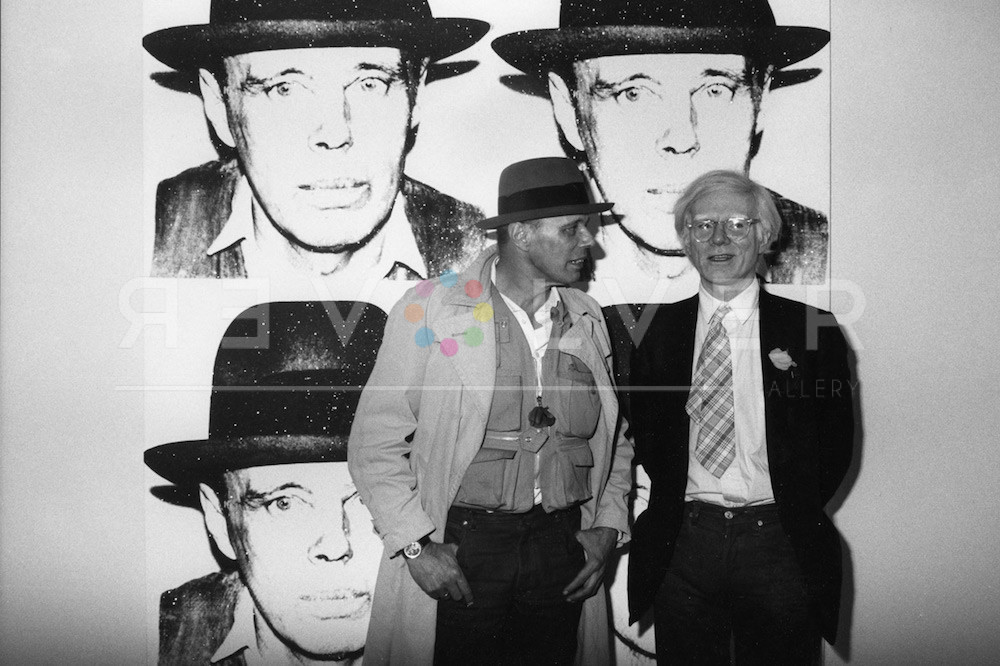
Joseph Beuys and Andy Warhol were not close friends, per se, but met on several occasions, most notably in 1979 at the Hans Mayer gallery in Dusseldorf. There, Warhol took the polaroid of Beuys that would for the basis of Joseph Beuys 244 and his other Beuys works. As artists, one may consider them an unlikely coupling; Beuys with his highly interpretational sculptures, performance art pieces, and desire to proliferate an understanding of “art” that goes beyond the material and the visual realms, and Warhol with his Pop Art masterpieces, depicting the objective reality of celebrities, commodities, and highly familiar symbols.
Despite this, both held admiration for one another, and its no doubt Beuys fascinated Warhol. Once, he said of Beuys: “I like the politics of Beuys. He should come to the US and be politically active there. That would be great… He should be President.” Regardless of Warhol’s wavering sincerity and droll sense of humor, the act of immortalizing Beuys via portraiture shows that Warhol understood the magnitude of Beuys contributions to modern (and post-modern) art and intellectualism. Beuys also made commissions and requests of Warhol, such as the poster Warhol did for the German Green Party (Die Grünen).
Video: Joseph Beuys meets Andy Warhol (1979, Hans Mayer gallery in Dusseldorf).
Video: Joseph Beuys – How to Explain Pictures to a Dead Hair (1965, at the Galerie Schmela in Düsseldorf).
Photo of Warhol and Beuys courtesy of Schellmannart.com.