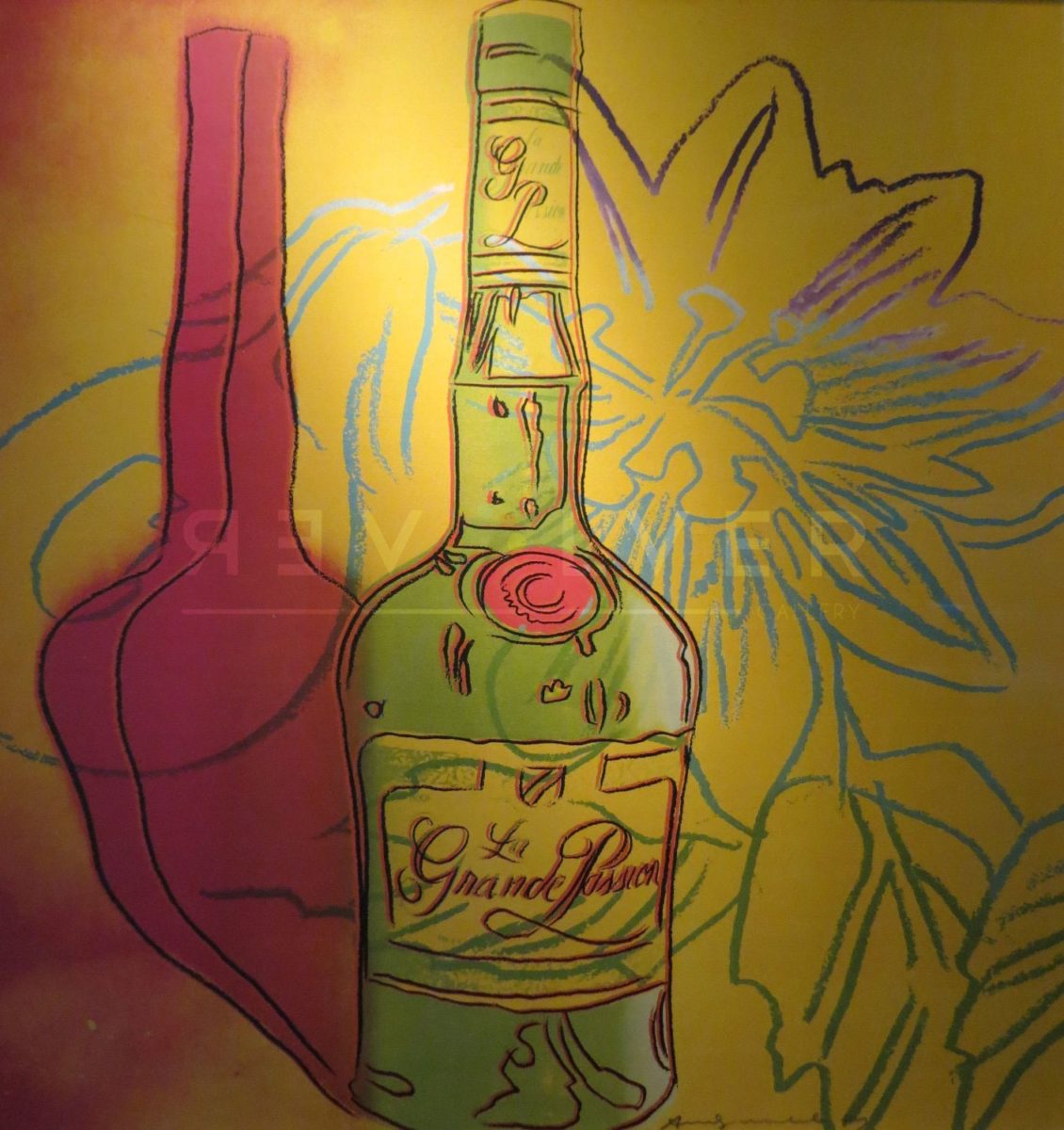
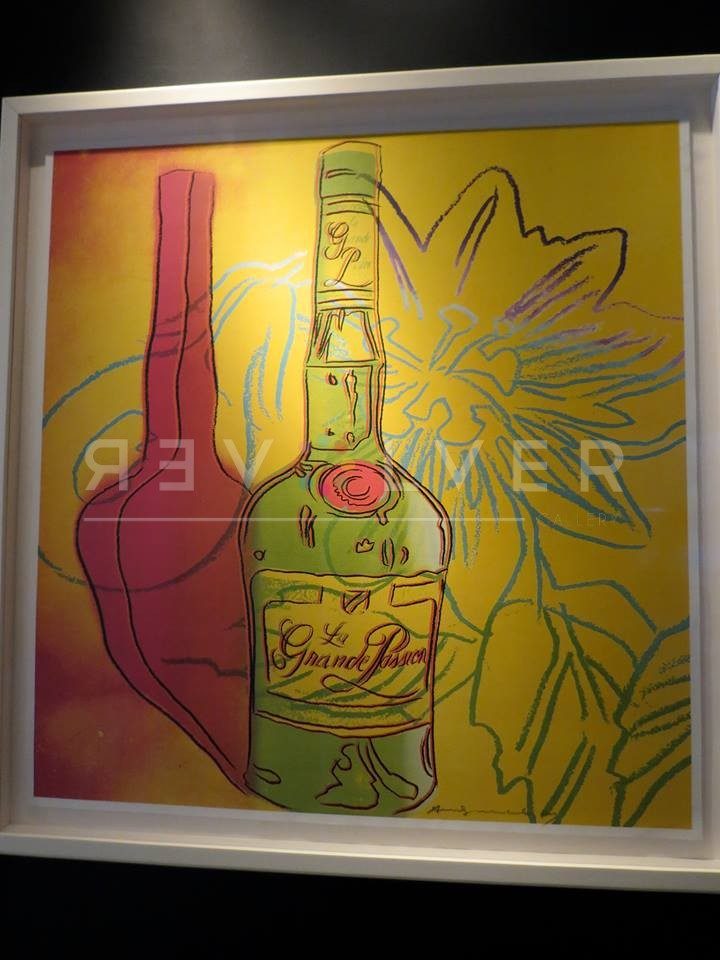

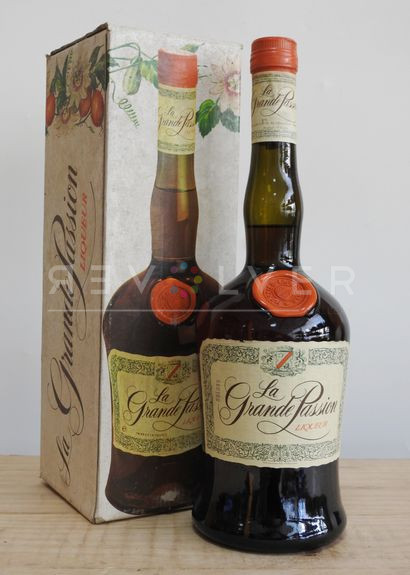
La Grande Passion by Andy Warhol presents a tall bottle of passionfruit liqueur set against a vivid yellow ground, its form outlined in loose, colored-pencil strokes that shift from hot pink to cool blue. A deep magenta shadow stretches behind the bottle, while a large passionflower blooms in the background in electric lines that hover between drawing and illumination. Warhol’s hurried contours, shifting color layers, and bold contrasts create an image that feels energetic, commercial, and unmistakably hand-touched—an ideal entry point into the world of Warhol’s Advertisement projects.
La Grande Passion by Andy Warhol and His Approach to Advertising
Warhol created La Grande Passion in 1984 for Carillon Importers, Ltd. The liqueur itself has an unusual history within the spirits market, as detailed in contemporary accounts of Grand Marnier’s La Grande Passion brand. Although Warhol built his reputation on fine art, he never abandoned his roots in commercial illustration. By the early 1980s he returned, quite deliberately, to the language of advertising. Moreover, he embraced corporate commissions as a way to merge high art, consumer culture, and mass visibility. This screenprint forms part of Warhol’s Advertisement portfolio, a series that celebrates—and gently satirizes—the marketing imagery that shaped modern consumption.
Warhol’s energetic linework in La Grande Passion echoes his early 1950s drawings created during his years as a commercial illustrator. Yet the print also reflects his mature sensibility. He exaggerates the bottle’s shadow, uses bright synthetic colors, and places the passionflower behind the bottle like a surreal emblem. As a result, the work feels both promotional and poetic. Warhol based the image on his own photograph, reinforcing the print’s link to real-world advertising while still transforming the bottle into a Pop object with its own personality.
Colorways, Technique, and Warhol’s 1980s Work
Warhol produced La Grande Passion in several colorways. Some feature cool sea-glass greens and burgundy tones, while the most recognized version uses bright yellows, pinks, and neon greens. These palettes underscore the liqueur’s tropical origins and give the print a punchy, high-energy presence. Furthermore, the colored-pencil effect—created through layered screens—mirrors the varicolored leads loved by fashion illustrators in the mid-century period. Warhol adapted that look into a Pop vocabulary that feels fast, glamorous, and contemporary.
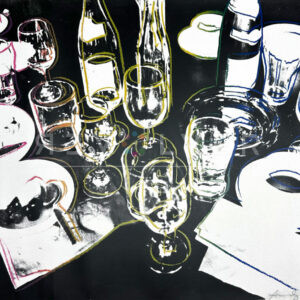
In the context of Warhol’s 1980s output, La Grande Passion aligns with his renewed interest in commercial imagery, as seen in Apple 359 and other works from the Ads portfolio. These prints blur the boundary between advertising and fine art, inviting viewers to reconsider how desire forms around products. They reveal Warhol’s lifelong habit of transforming everyday objects—whether soup cans, flowers, or liquor bottles—into cultural icons.
La Grande Passion in Warhol’s Larger Body of Work
La Grande Passion holds a distinct place in Warhol’s late career. It recalls his commercial beginnings and embraces his fascination with branding. At the same time, it uses color with a boldness typical of his 1980s work. Collectors value the print for its mix of advertising aesthetics, vibrant palette, and unmistakable Warholian attitude. It captures how Warhol could elevate even a simple liqueur bottle into something memorable, stylish, and visually charged.