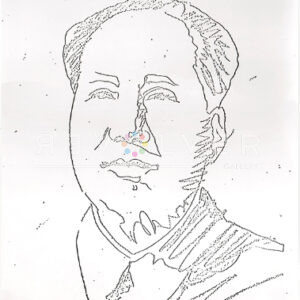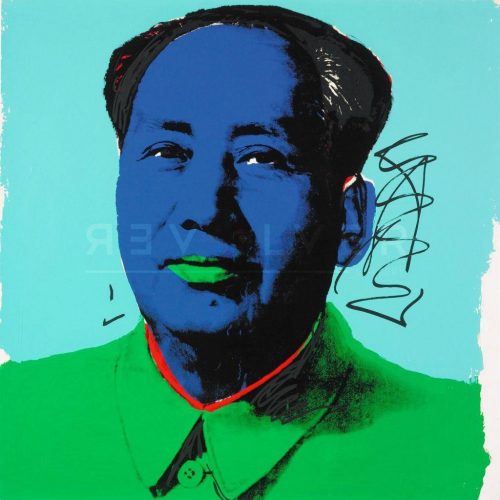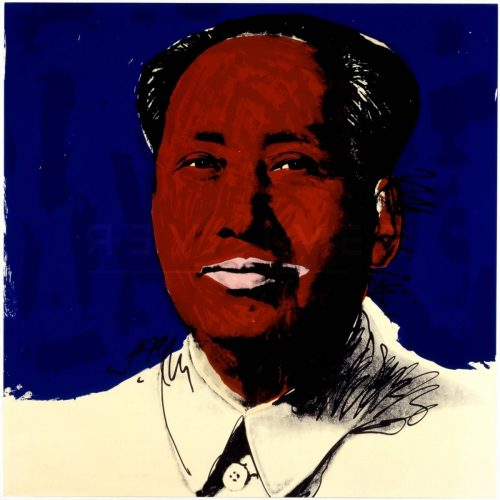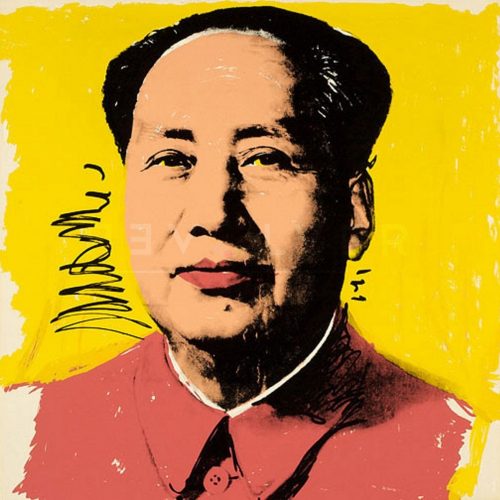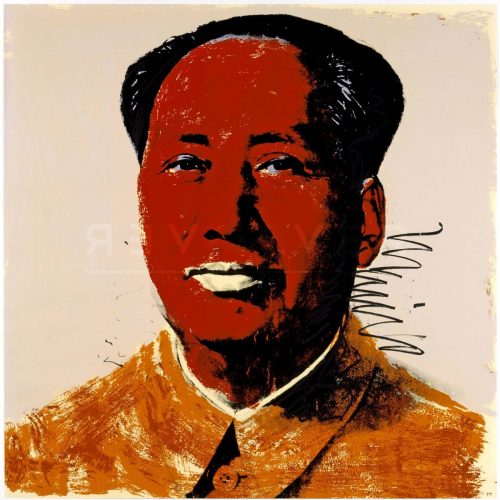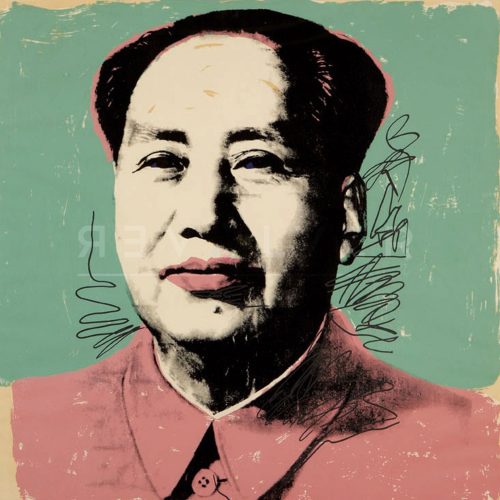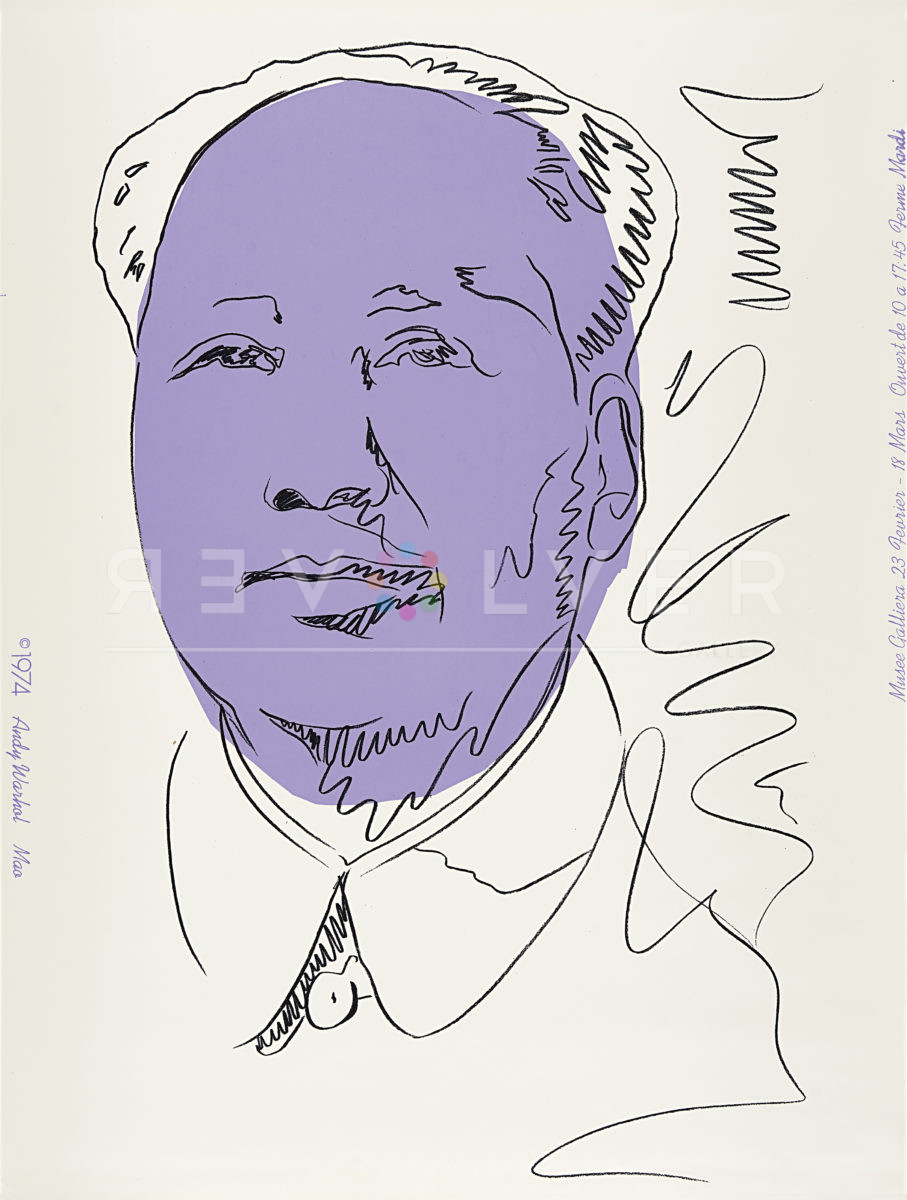
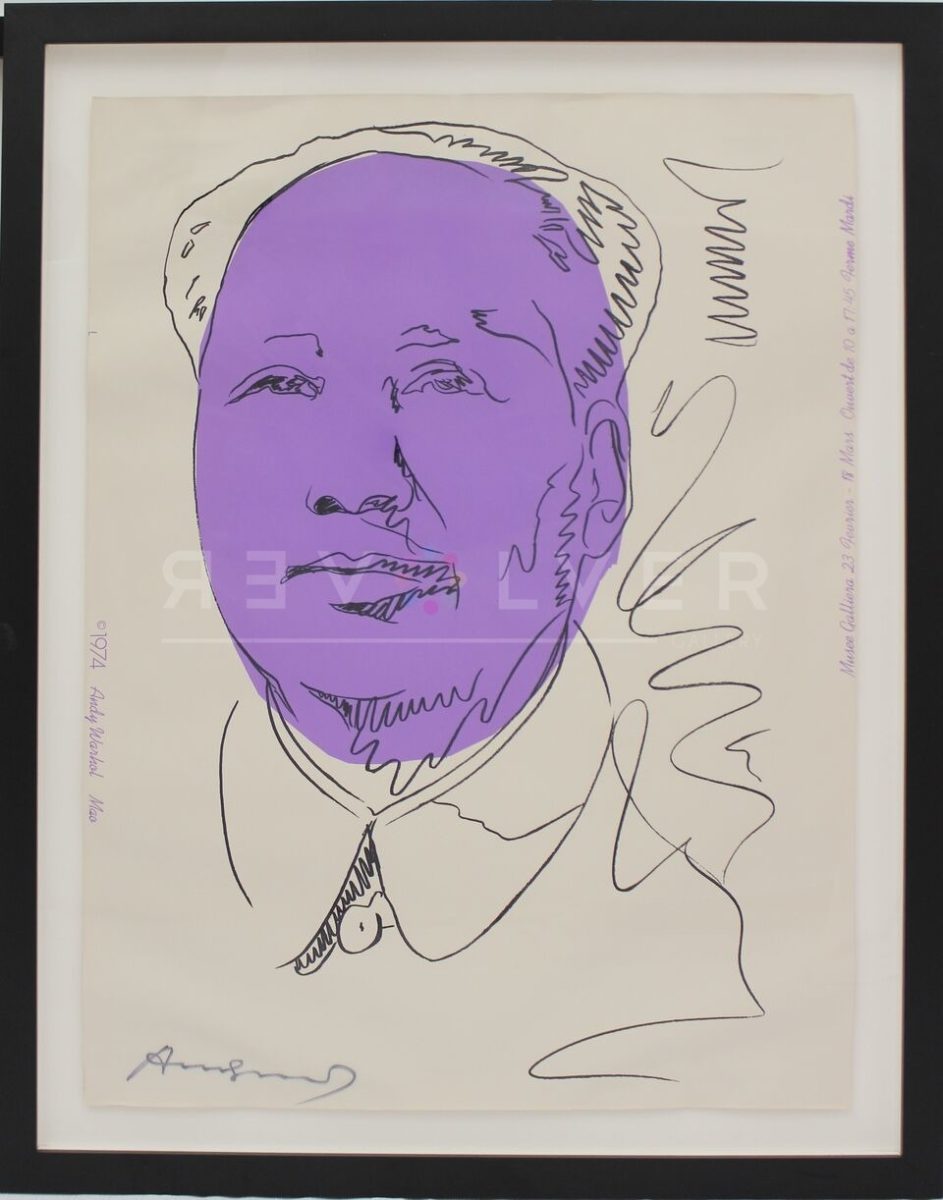
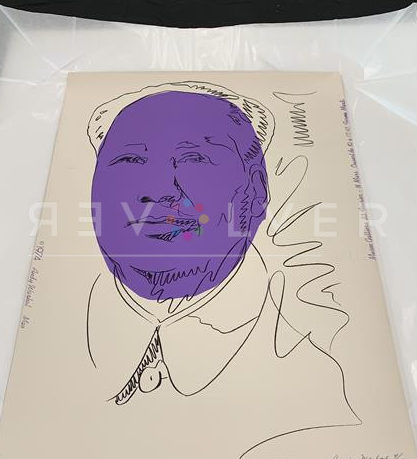
Mao 125A by Andy Warhol presents Mao Zedong’s face rendered in thin black line against a pale ground, overlaid with a restrained wash of indigo that settles across the cheeks and forehead. The portrait feels light and open, with large areas of unprinted space that allow the linework to breathe. Mao’s features remain immediately recognizable, yet softened by the decorative format. The repetition implied by wallpaper transforms the image from a singular portrait into a pattern, flattening hierarchy and encouraging continuous visual consumption.
Mao 125A and the Use of Wallpaper
Unlike Warhol’s Mao silkscreens, Mao 125A employs wallpaper as its medium, shifting the image from the realm of fine art into domestic and architectural space. Wallpaper is inherently repetitive, designed to cover walls endlessly rather than command attention as a single focal object. As a result, Mao’s face becomes ambient. It surrounds rather than confronts the viewer. This choice subtly echoes the omnipresence of Mao’s image in Communist China, where his portrait appeared in homes, schools, and public institutions.
Historical Context and the Image of Mao
The image of Mao Zedong was among the most widely reproduced portraits of the twentieth century. As the founding leader of the People’s Republic of China in 1949, Mao cultivated a carefully constructed cult of personality that relied on visual repetition and strict control of imagery. Warhol recognized this immediately. He saw parallels between Chinese propaganda and Western celebrity culture, where repetition generates authority, recognition, and desire. Consequently, Mao became a natural subject for Warhol’s ongoing investigation into power and visibility.
From Celebrity Portraits to Political Icons
After President Richard Nixon’s visit to China in 1972 brought Mao into American media focus, Warhol responded by extending his portrait practice beyond Hollywood stars. He treated Mao much as he had treated Marilyn Monroe or Elvis Presley, translating political authority into a visual language shaped by repetition and surface. However, wallpaper introduces an additional layer. Moreover, it removes spectacle and replaces it with saturation. Mao’s image no longer demands attention. Instead, it becomes part of the environment.
Mao 125A in Warhol’s Larger Body of Work
Mao 125A expands Warhol’s exploration of how images operate when they cross from art into everyday life. By placing Mao on wallpaper, Warhol collapses distinctions between propaganda, decoration, and fine art. The work demonstrates how authority persists through visibility rather than uniqueness. In this context, Mao’s face functions less as a portrait and more as a visual system. Ultimately, it reinforces Warhol’s broader insight that power, fame, and repetition ultimately rely on the same mechanisms.
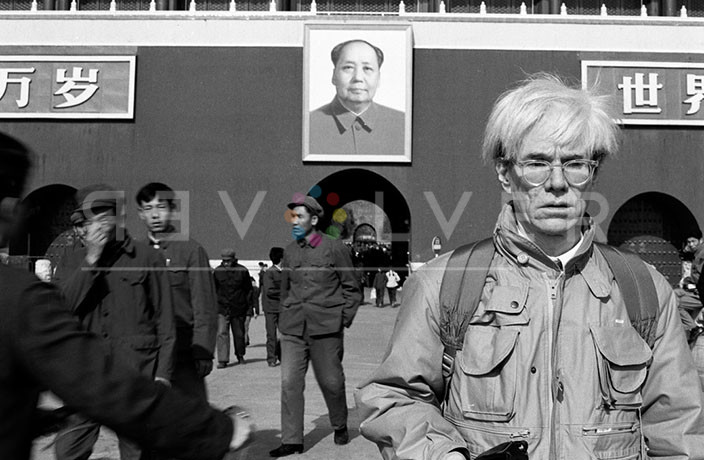
Photo Credit: Andy Warhol in front of Tiananmen Square, Beijing, 1982. Image © Christopher Makos, 1982.