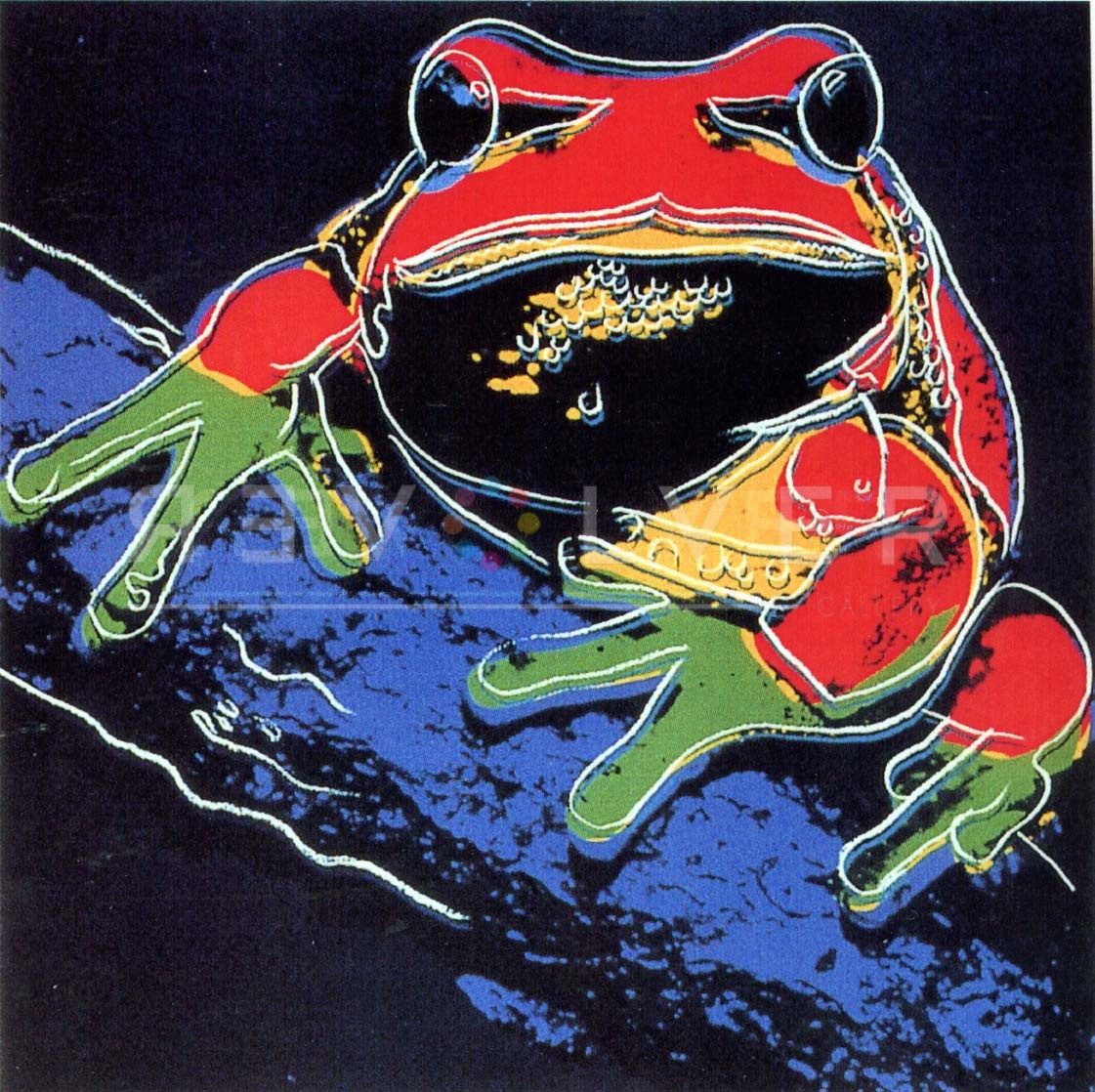
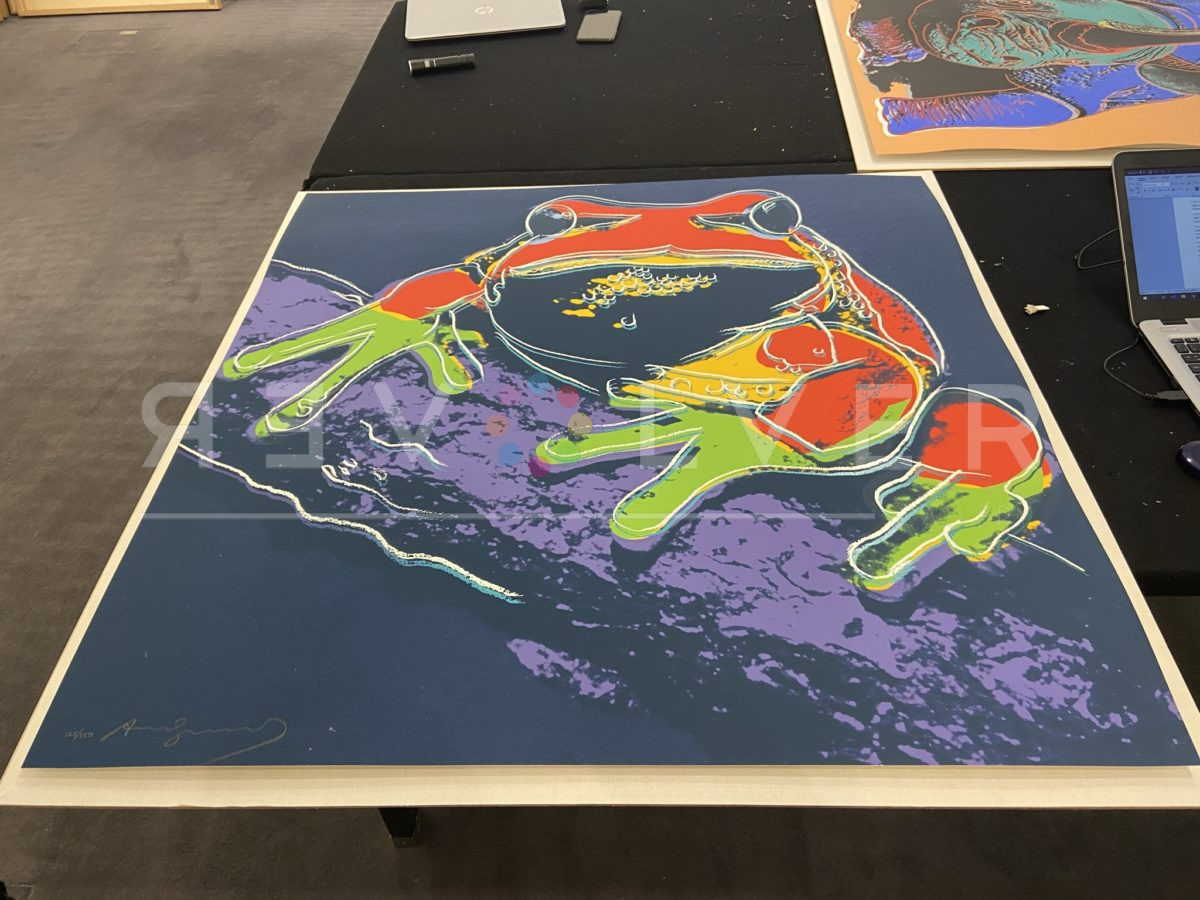
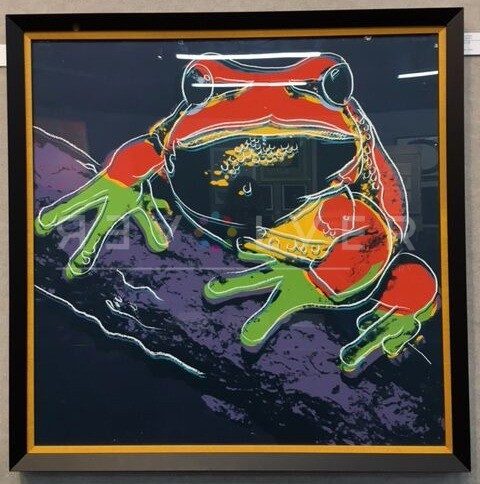
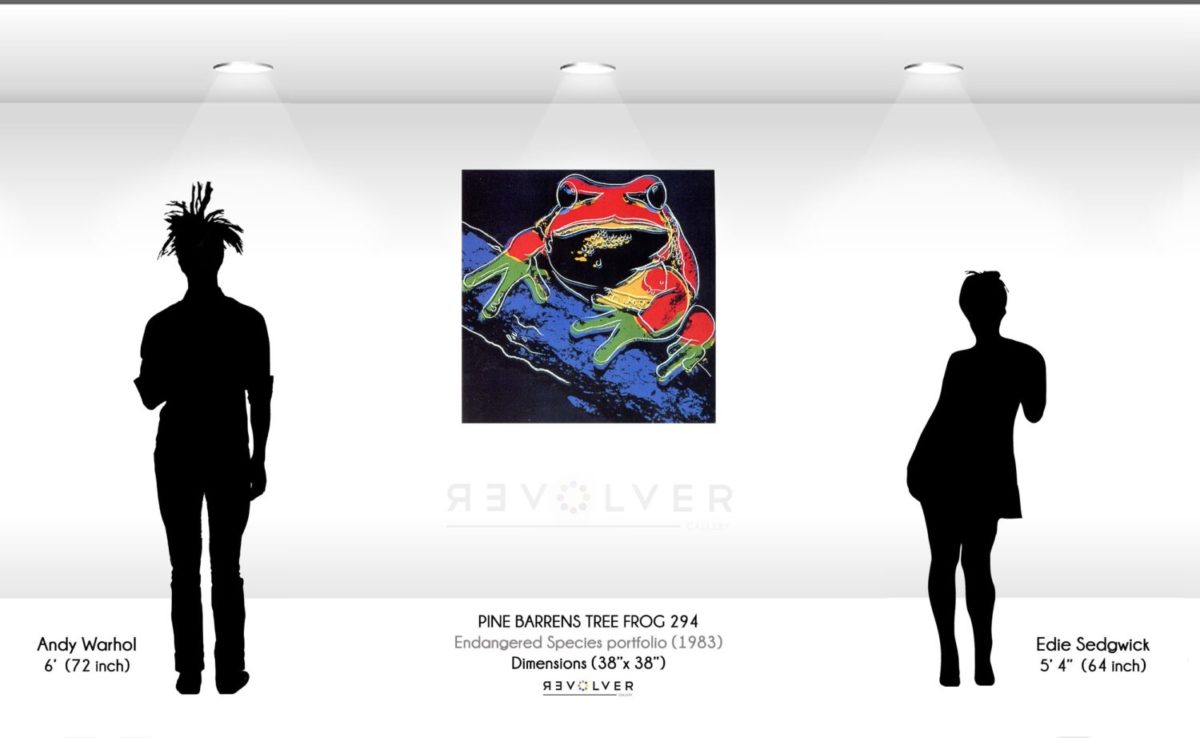
Pine Barrens Tree Frog 294 by Andy Warhol is a work included in the artist’s 1983 Endangered Species complete portfolio. It depicts the amphibious Dryophytes andersonii, a tree frog indigenous to three distinct regions of the United States: New Jersey, specifically the Pinelands or Pine Barrens from which it gets its name, the Sandhills of North and South Carolina, and parts of lower Alabama and the Florida panhandle. It’s notable for being one of the four animals included in the Endangered Species series that is no longer considered endangered or vulnerable. The tree frog was considered threatened between 1977 and 1983; however, its status was changed after stable populations were found in the aforementioned areas in Florida.
True to the animal, Warhol gives the Pine Barrens Tree Frog his version of disruptive coloration, a method of camouflage certain organisms use to evade predators. However, not even the environment escapes Warhol’s eye, who covers the tree branch the frog sits on in a deep blue, slightly outlined by hand-drawn white lines along its contours. The background is draped in an even darker blue, bordering on black, suggesting a night scene. The frog sits confidently on the branch. Like the branch, it’s covered in striking if implausible colors. Its large toe pads that grip the branch retain a likely green but its body and head give way to a vibrant yellow and red pattern. If this were observed in the wild, one might mistake this tree frog for something poisonous. Here, alternatively, the colors may represent the caution and danger many considered the frog to be in at the time, considering its designation as an endangered animal. Again, like the branch, the frog is outlined in white lines. Even some of the bumpy features of its skin are rendered in white as well. And one can’t help but be drawn into eyes, convex spheres of blueish black surrounded by curves of white.
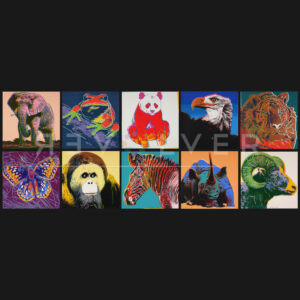
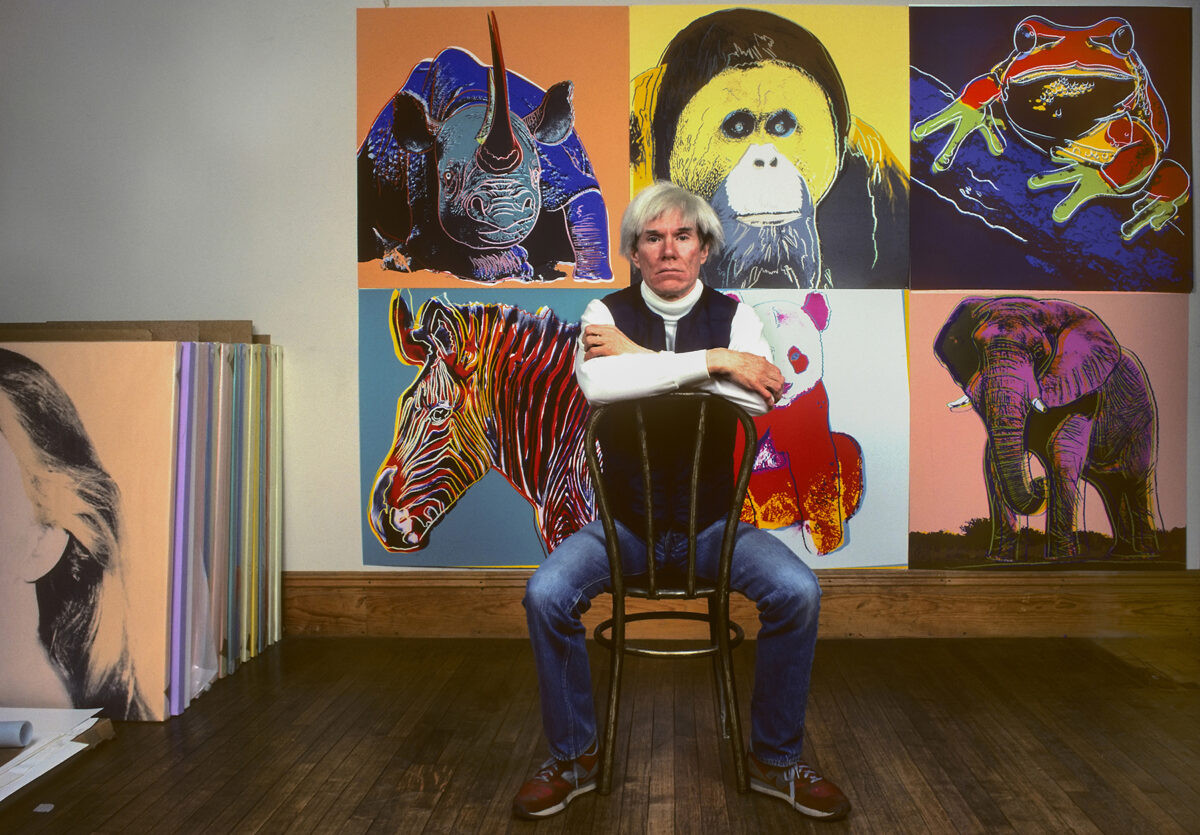
Warhol’s Pine Barrens Tree Frog 294 has risen drastically in popularity in 2021, along with the Endangered Species series itself, which includes prints like Giant Panda and Black Rhinoceros. The tree frog, as well as other prints from the portfolio, have become some of the most desirable Warhol prints, to even the most discriminating collectors. Endangered Species was commissioned by and inspired by talks with Ronald Feldman and wife Frayda Feldman in 1983. The Feldman’s are known for their environmental activism, and Ronald Feldman commissioned many other works from Warhol in the 1980s, such as Myths and Ads.
Photograph of Warhol with Endangered Species screen prints taken by Brownie Harris, 1982, The Factory, NYC.