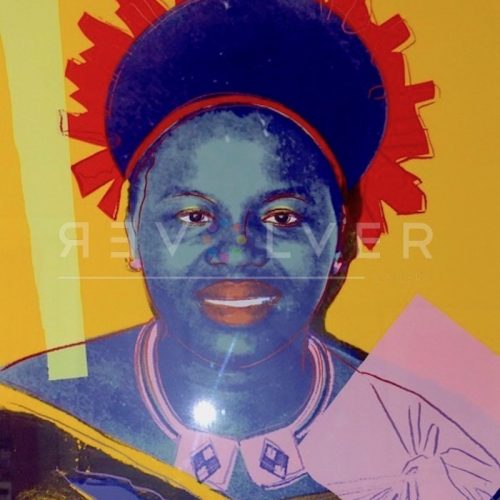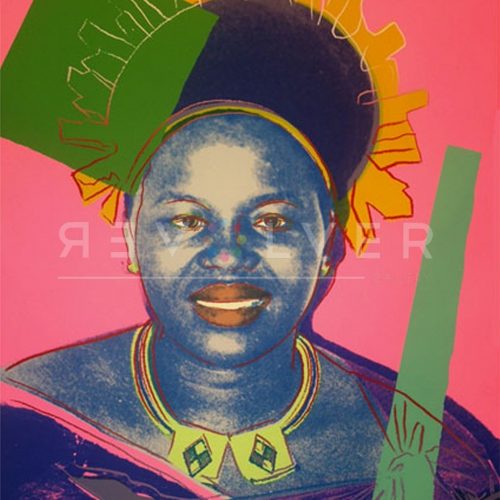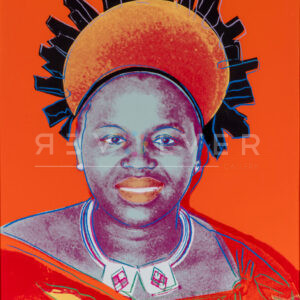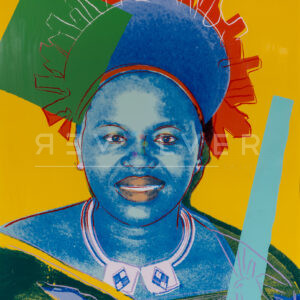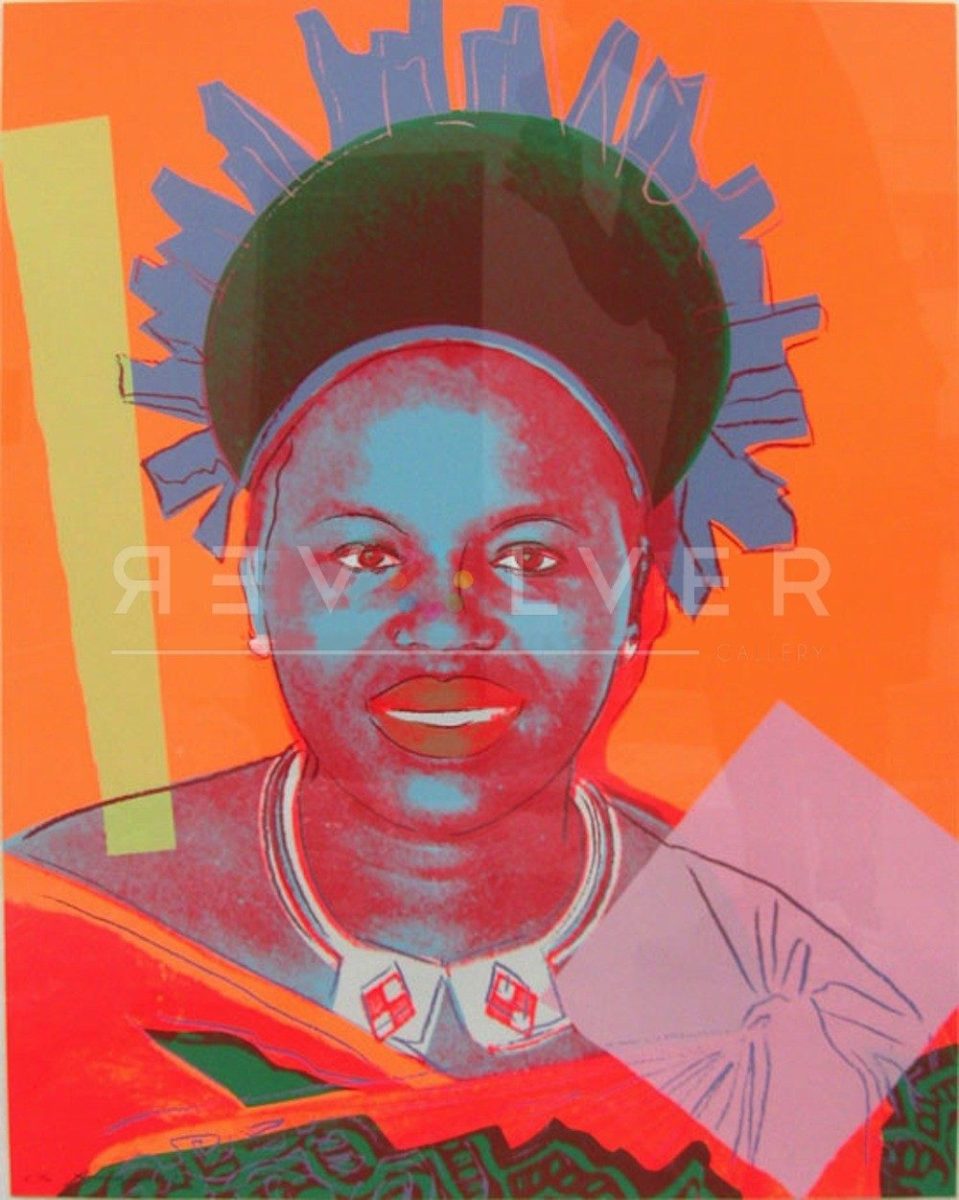
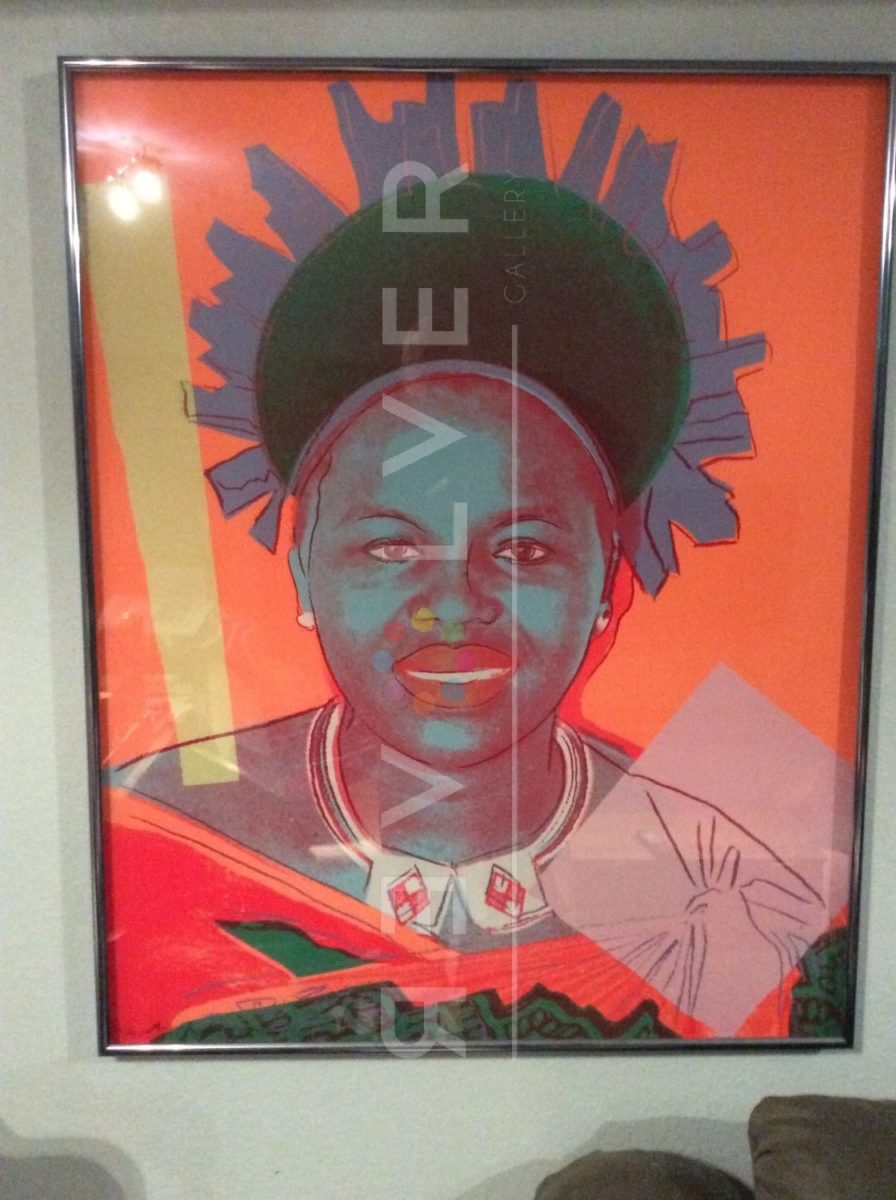
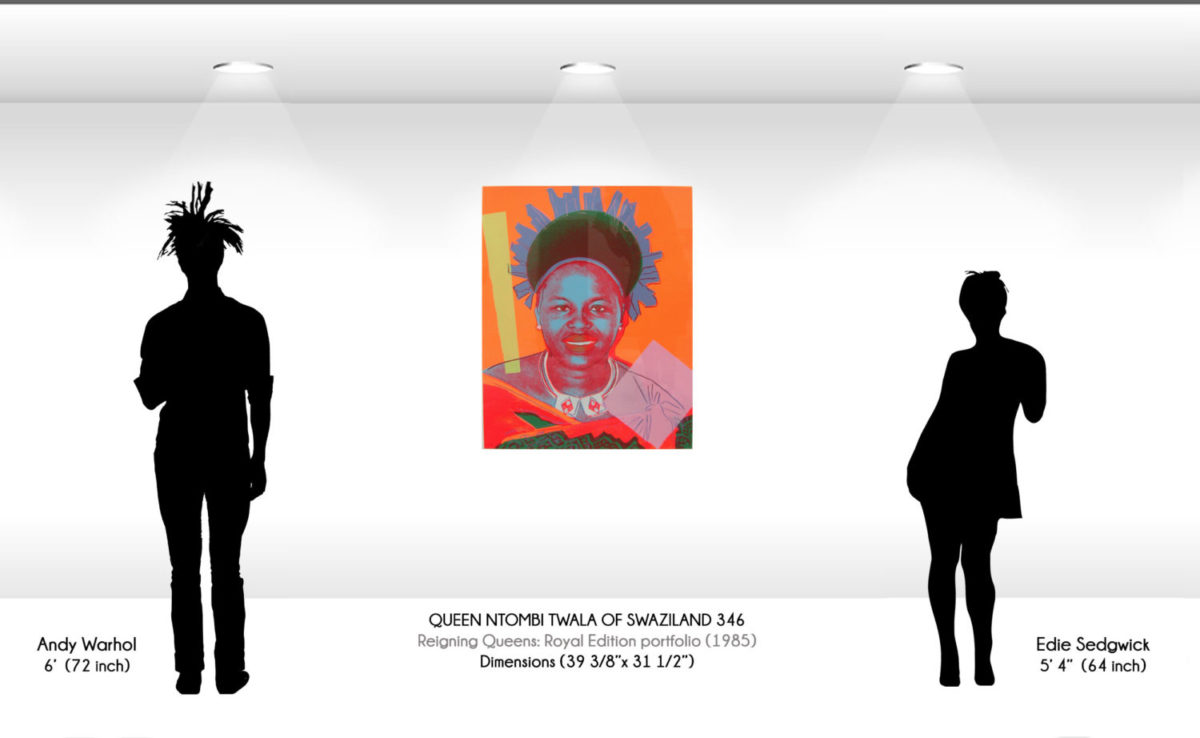

Queen Ntombi Twala: 346 is a screenprint by Andy Warhol included in his Reigning Queens series. Warhol released the portfolio in 1985, two years before his death. This collection is one of Warhol’s largest and most iconic portfolios, with sixteen silkscreen prints. Warhol used the silkscreen technique often, which allowed him to produce images repetitively, epitomized in his Campbell Soup works. Warhol uses bold contrasting colors in almost all of his prints. The blue, orange and yellow in this particular portrait softens the subject’s facial features.
Warhol published the Reigning Queens series during the mid 1980s, which was arguably his most prolific period (partly due to his affiliations with collectors and younger artists). He depicts four queens from four different places in the world. Furthermore, Queen Ntombi Twala of Swaziland is an important attribute of the Reigning Queens collection. She is the only Queen of color in the series. The series also includes prints of Queen Margrethe II of Denmark, Queen Elizabeth II of the United Kingdom, and Queen Beatrix of The Netherlands.
When the portfolio debuted, each of the four queens were in power. All four Queens assumed the throne because of birthright, not marriage. This could be why Warhol chose these particular four royalties to recreate. In this series, Warhol evidently emphasizes female autonomy and potential.
Fame, royalty, and the concept of money all fascinated Warhol. He also had a keen fascination for mass production and media. These pictures were often produced on stamps and currency, further alluding to his interest in mass consumption and the repetitive nature of things. Moreover, his Reigning Queens collection expresses his interest in female icons.
Warhol had been turning ordinary portraits into colorful works of pop art for decades before this series. Prior to Reigning Queens, he created a wide variety of celebrity portraits, such as Marylin Monroe and Liz Taylor. But Warhol’s admiration for iconic women clearly did not stop at the boundaries of typical celebrities; as Reigning Queens shows, Warhol also held much interest in powerful global figures. In fact, Warhol’s art did much to expand our concept of celebrity itself, and ultimately, he championed the pop-art movement by re-imagining all kinds of objects, figures, and images in a way that added to their symbolic power.
The Reigning Queens series was produced in 1985 in four colorful prints of each queen for a total of 16 screen prints, plus trial proofs. This was one of his last collections before his death in 1987. Warhol displays his mastery of screen printing in this collection by incorporating intricate color blocking and outlining, which we see developed in its full form in his works from the 1980s. Queen Ntombi Twala 346 is a quintessential work of Warhol’s 1980s catalogue and his greater legacy.
Photo credit: Queen Ntombi Twala in 2016. Unknown photographer.