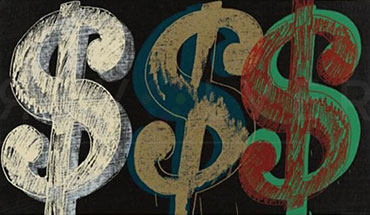
These three words are used interchangeably in the printmaking world and they all refer to the same process. Screenprinting is a stencil printmaking process in which ink is pushed through a fine screen onto a surface beneath. That surface could be almost anything, but let’s use fine art paper as a reference to fine art prints. Fine art screenprints are sometimes referred to as serigraphs to differentiate them from industrialized screenprinting processes like printing on t-shirts with an automated machine. In a fine art screenprinting process, a sheet of high quality archival paper is placed under a framed screen and thick, paint-like ink is poured along the edge of the frame. A squeegee is then drawn from back to front, dragging the ink across the stenciled surface and pushing the ink through the stencil onto the paper beneath. Each color in a screenprint requires a different screen.
The type of material used for the mesh of a screen is usually a fine silk bolting cloth (hence the name ‘silkscreen’), or more popularly a synthetic, like nylon or polyester (which is why the name ‘silkscreen’ is no longer accurate for most contemporary practices). The mesh is stretched onto a frame, which is then hinged to a table, which lets the artist maintain the alignment of his color layers. If there is an edition of 100 prints being made, each print in the entire edition is built one layer at a time, so that one color layer screen is used on all 100 before moving on to the next color.
Screenprinting itself has been a recognizable printing process for centuries, with some examples in China dating back to the Song Dynasty (960–1279 AD). The use of screenprinting as a modern artist medium began in 1938 when a group of artists in New York (known as the Federal Art Project) started working with the method of screenprinting and really developed its potential. They were the group that formally coined the term serigraphy and later formed the core of the National Serigraph Society, which actively promoted the art form for over twenty years.
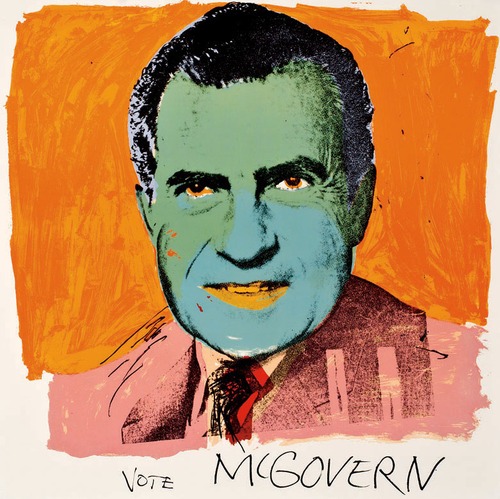
Andy Warhol – Vote McGovern 1972
The rise of Pop Art in the 1960s brought screenprinting to a whole new level. The artists of the time experimented with colors and textures that were not reproducible in other artistic mediums. Artists like Andy Warhol brought sophistication to the aesthetic of screenprinting that hadn’t been realized before the Pop Art movement. Today, screenprinting as an art form is making a comeback. With digital prints being the norm, artists and art collectors alike are reaching out for original prints once again. The quality and saturation of color as well as the screenprinting-specific characteristics are what bring people back to this exciting artistic medium.
Click here to see more of Andy Warhol’s colorful screenprints on paper!