

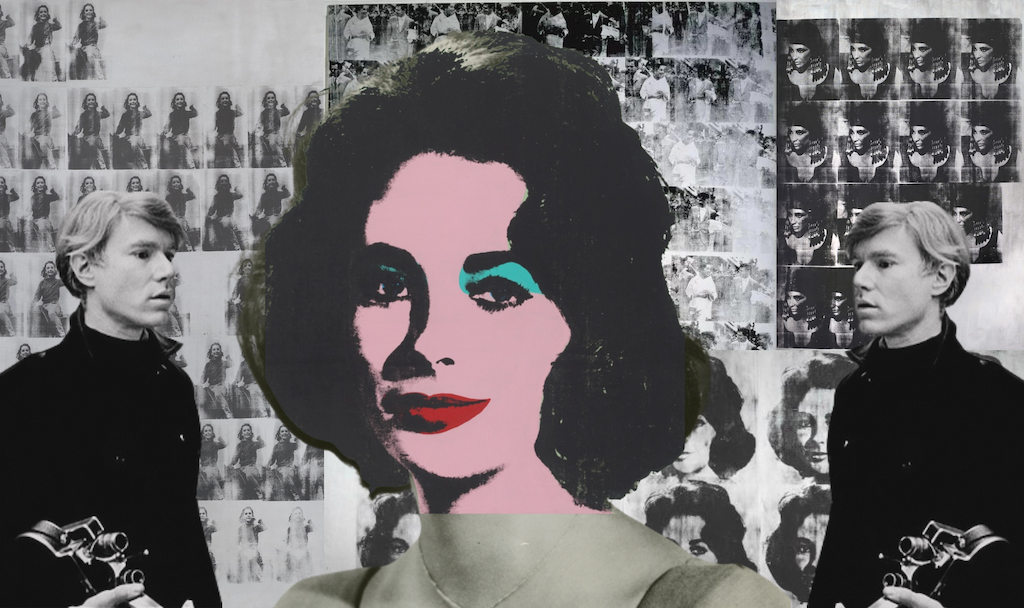


In sourcing multiple Elizabeth Taylor portraits from a single issue of Life magazine, Andy Warhol wasn’t merely borrowing celebrity imagery—he was commenting on the machinery that manufactured it.
The April 13, 1962 issue of Life was essentially an Elizabeth Taylor takeover of the popular weekly. Taylor appeared on the cover with Richard Burton in full Cleopatra costume, headlining a story about the scandal of their affair. Inside, the magazine ran a photo feature reviewing her past husbands. And even in the advertising section, Taylor’s influence popped up as the muse for a two-page Revlon cosmetics ad promoting the “Sphinx Eyes” look (a clear nod to her role as Cleopatra). In this issue of Life, the editors cast Elizabeth Taylor as ingénue, siren, devoted wife, widow, trendsetter, homewrecker, and Egyptian queen—each persona seamlessly flowing into the next. It wasn’t just journalism; it was myth-making in real time.
For Warhol, this Life magazine was a goldmine of imagery and an insight into how mass media constructs celebrity. He wasn’t merely clipping out photos of Liz for their glamour; he was diagnosing the machinery of fame that the magazine represented. Life at that time was a popular lens through which America viewed its idols. That single issue presented Taylor not as a contradictory figure, but as a composite one—complex and multifaceted, yet packaged for public consumption. Warhol saw in it not just pretty pictures but a cultural operating system for fame.
Warhol mined this issue of Life as a one-stop repository of Elizabeth Taylor’s identity in the public eye. He understood that the magazine’s editors had, in a sense, done the curating for him: they condensed Taylor’s tumultuous life into a series of images and narratives that the public could devour in one sitting. Warhol recognized that Taylor’s image was being manufactured by these very layouts, headlines, and ads. So he set out to turn that process itself into art.


At first glance, Andy Warhol’s Men in Her Life (1962) appears chaotic. It shows a dense cascade of repeated black-and-white photo-transfers arranged in rows across a towering canvas more than 7 feet tall. But its disorder is deliberate. The source image, drawn from the April 13, 1962 issue of Life magazine, captures Elizabeth Taylor walking with two men: her third husband, Mike Todd, and her future husband, Eddie Fisher. Warhol duplicates the image relentlessly across the surface, the forms distorting with each pass. Taylor is indeed present—dressed in pale tones that render her almost spectral—and increasingly fragmented by the mechanical erosion of the silkscreen process.
But to understand the artwork fully, it helps to return to Life itself.

The full two-page magazine spread from which Warhol sourced the image visualizes a complete media mythology. Across the pages, Taylor’s husbands—past, present, and future—appear like cast members in a serialized melodrama: from Nicky Hilton to Michael Wilding, Mike Todd, Eddie Fisher, and finally Richard Burton, on the set of Cleopatra. Taylor appears repeatedly in the spread, assuming a series of roles: bride, widow, homewrecker, siren. The layout doesn’t just report events—it assembles a narrative, framing her through men and marriages. She is always in relation, never independent. Even the magazine gutter—the visual seam where the pages fold—slices between Debbie Reynolds and her then-husband, Eddie Fisher, just as Taylor enters the frame. Whether or not the editors intended it, the seam creates a perfect metaphor for one woman’s erasure and another’s ascent.
Warhol doesn’t just borrow from this spread—he distills its structure onto the canvas. Men in Her Life echoes the magazine’s logic of accumulation, compression, and performance. It’s less a portrait than a reframing of a photographic editorial. This was not how Taylor saw herself, but how she was publicly narrated, headline by headline, spread by spread.

Unlike the direct, iconic focus of Andy Warhol’s Liz portraits—where Taylor is singular, glamorous, frozen—this work immerses her in visual noise. She is not front and center; she is enfolded into a system. Her pale figure bleeds into the dark suits of the men beside her. At times she vanishes into them—reduced to the folds of a coat, a gesture, a ghosted silhouette. In others, she briefly emerges again. She is central, poised, but pulled back into the repetition before we can fix her in place.
This act of visual entanglement becomes the portrait’s conceptual engine. Taylor is not erased. She is absorbed, rendered legible through relationships and reprinted through the optics of scandal. Warhol’s repetition isn’t passive: It mirrors the media machine that made her private life public, feeding off every twist in her romantic arc.
The monochromatic palette only sharpens the effect. There is no technicolor glamor, no eye-catching cosmetic. This is the tonality of surveillance, not celebration—high contrast, smudged blacks, washed-out whites. It feels more forensic than flattering. This isn’t portraiture in the traditional sense. It’s a media mosaic—one that reveals how Taylor was seen by the world rather than how she saw herself.
And unlike his more iconic single-image works, Men in Her Life doesn’t simplify. It complicates. Warhol’s cropping, layering, and uneven printing transform a single moment into a meditation on the entrapments of fame. Taylor, a woman of immense cultural presence, is repeatedly cast into a scene where her image fragments beneath the weight of its own circulation. As she moved from grieving widow to scandalized lover in the public eye, Warhol captures the slippage between being watched and being known.
This uncanny approach to celebrity portraiture is less about the icon and more about the system that produces it. The rigid rows are not just compositional—they’re ideological. This is the grid of publicity, the mechanics of myth. And within it, Men in Her Life becomes one of Warhol’s most unflinching portraits of celebrity culture.
And though it’s not one of Warhol’s most widely recognized Liz Taylor artworks, Men in Her Life resonated deeply on the art market in 2010, when it sold at auction for over $63 million. Its scale, rarity, and haunting complexity confirmed its status as one of Warhol’s most ambitious meditations on fame and fragmentation.

If Men in Her Life shows Taylor caught in the blur of public scrutiny—her image shaped and fractured by those around her—then Andy Warhol’s Liz as Cleopatra rebuilds her into myth. No longer the woman behind the headlines or the tabloid siren surrounded by suitors, Taylor emerges in these works as something else entirely: a cinematic deity, filtered through layers of artifice, history, and media fantasy
Based on the promotional stills from Cleopatra that appeared in the pages of Life Magazine, Warhol’s Cleopatra portraits show Taylor not as herself, but as an image compounded through cultural memory. She appears in full costume: braided wig, heavy kohl eyeliner eyeliner, sculptural gowns, regal posture. The visual cues are unmistakable—this is Taylor as Cleopatra, but also Cleopatra as Taylor. Glamour, history, and scandal collapse into one compressed surface.
But the transformation didn’t stop at the frame. As evidenced in the Life magazine issue that Warhol mined for source material, the Cleopatra look became a fashion movement: eyeliner, lipstick, even nail polish were sold to women eager to channel the star’s stylized power. In a double-page Revlon ad, a model in Cleopatra garb reclines with a black cat beneath the headline: “The New Cleopatra Look as Only Revlon Does It!” Warhol didn’t need to invent a metaphor—it was already there, laid out in full color, and he could see it on the streets of New York:
“The girls that summer in Brooklyn looked really great. It was the summer of the Liz-Taylor-in-Cleopatra look—long, straight, dark, shiny hair with bangs and Egyptian-looking eye makeup.”
— Andy Warhol, Pat Hackett. Popism: The Warhol Sixties.
Even in his immediate surroundings, the actress had become an aesthetic. A queen of Egypt, reissued in lipstick. This fusion of film, fashion, and commerce is what Liz as Cleopatra crystallizes: the surface of the fashion icon—elaborately constructed, widely circulated, and impossible to separate from the systems that produced her.
Her story during the making of Cleopatra only deepens this reading. It was the most expensive film ever made at the time—a bloated epic whose production nearly bankrupted 20th Century Fox. Taylor fell gravely ill with pneumonia during production, underwent a tracheotomy, and nearly died. After recovering, she began an affair with co-star Richard Burton, igniting a media storm that overshadowed the film itself. Lawsuits, gossip, and moral outrage followed. The movie became a commercial paradox—both a blockbuster and a near-catastrophe.

But Warhol doesn’t illustrate this backstory—he refracts it. In Blue Liz as Cleopatra, Taylor is elevated, yet immobile. Her face is masklike, her beauty severe. She appears multiple times in a grid—suggesting coinage, poster, relic. Repetition drains the portrait of cinematic movement, leaving behind only the weight of performance. The theatrical makeup, the heavy-lidded eyes, the sculptural hairstyle: these aren’t just aesthetic flourishes—they’re armor. Andy Warhol’s Liz as Cleopatra paintings present her as icon—powerful, yes, but also petrified. The glamour is not seductive here so much as strategic. Taylor is no longer performing for the camera; she is surviving through it.
This mythic framing draws a sharp parallel between Taylor and the historical Cleopatra—both women portrayed as commanding, desirable, and ultimately tragic. Cleopatra’s downfall came through empire and love. Similarly, Taylor’s scandal-ridden persona was constructed by forces outside her control. Warhol fuses them not just visually, but thematically. Both figures are held responsible for the drama that swirled around them, both used their image as leverage, and both paid the price of that visibility.
Warhol, with characteristic coolness, allows these contradictions to coexist. Liz as Cleopatra is neither satire nor celebration. It is a meditation on the performance of power—and on the cost of that performance when the world demands more than a role can sustain. Taylor here is not simply captured; she is crystallized, rendered eternal but inert.
But within that surface is something sharp and solemn. It is the recognition that fame, once mythologized, becomes unlivable. In these portraits, Warhol shows us what it means to become larger than life—and how that transformation can harden into tragedy.

Before she was Cleopatra, before the tabloid headlines, the diamonds, or the Oscar-winning roles, Elizabeth Taylor was a child star. She was a girl with luminous violet eyes and a commanding presence that captivated the silver screen. In National Velvet (1944), she became a symbol of youthful determination, playing a girl who disguises herself as a boy to compete in the Grand National steeplechase. It was the role that made her a star—and it’s the image of Liz that the editors of Life Magazine chose to juxtapose in relation to her tragic, mythical Cleopatra.
Much like Men In Her Life in it’s composition of rows, National Velvet is also kinetic. Warhol’s black-and-white silkscreen repeats a single image of Taylor in motion—sitting upright, hand raised in what reads as either a wave or salute. Her youthful energy is palpable, but as the image repeats and fades across the canvas, something else begins to surface: deterioration, echo, entropy.
The repetition—a grid of fading Taylor figures cascading down the composition—mimics the cadence of memory itself. Each iteration varies in clarity, as if caught in the process of being remembered, reprinted, or slowly erased. This is not just a nostalgic nod to Taylor’s early career; it’s a visual meditation on the erosion of innocence and the mechanisms by which childhood is both idolized and consumed.
Warhol’s choice to revisit Taylor’s National Velvet persona is especially striking given his broader thematic concerns. Just as he reproduced images of car crashes and electric chairs in his Death and Disasters series, here he takes an image of joy and promise and subjects it to the same visual logic of repetition and decay. Fame, even in its most wholesome form, is never safe from time or overexposure.
The scale of the work matters, too. At over seven feet tall, the canvas evokes a cinematic screen—a fitting nod to the movie that launched Taylor’s mythos. Yet as the image degrades row by row, what was once heroic becomes spectral. The bold, beaming girl in the top row dissolves into increasingly ghostly impressions, until the bottom edge holds only faint traces of her presence. The effect is haunting, and profoundly elegiac.
In this work, Warhol doesn’t flatten Elizabeth Taylor into an icon; he fractures her into memory. It is, in its own way, a prequel to the later portraits—an origin story tinged with melancholy. The child star becomes the prototype for the woman she would become: radiant, commodified, repeated until myth supplants the person.

If the works derived from Life magazine revealed the fragmentation of Elizabeth Taylor’s image—splintered across roles, headlines, and public scrutiny—Warhol’s next phase took a different approach. Rather than borrow the magazine’s editorial collage, he turned to a single, tightly framed publicity photograph, repeating it until it became its own mythology.
Warhol based these portraits on a 1960 promotional photograph for Butterfield 8—a film Elizabeth Taylor only agreed to make under contractual obligation to MGM. Adapted from a 1935 novel about a troubled woman leading a double life, the film mirrored the tabloid narrative that had formed around Taylor herself: seductive, tragic, scandalous, and emotionally volatile. Taylor herself later described it as one of her worst films. “I hated that film,” she said in a 2007 Interview magazine conversation. And yet, she won an Oscar for it. She attributed the award to a “sympathy vote” having recently survived a near-fatal illness.
The photograph shows Taylor in a fitted satin dress, her hair perfectly sculpted, her eyes softly lined. She is luminous—a vision of idealized femininity, poised and composed, the camera catching only light—but as Warhol understood, also exhausted, publicly wounded, and fighting for control over her image.
Warhol, ever attuned to the gap between media image and human vulnerability, seized on this photo not just for its elegance but for the contradiction it embodied. He cropped the image to focus only on her head—mirroring the treatment he gave to Marilyn Monroe, whose Marilyn paintings were also based on a studio still promoting a film. As with Monroe, Warhol wasn’t interested in narrative. He wanted the face—the surface that held it all: desire, artifice, resilience, and fame.
By 1963, when he began his first major silkscreens using the image, Warhol was moving beyond the sensational media narratives that framed Taylor. This was something else entirely: the construction of a secular icon. Taylor, like Monroe, was no longer a celebrity reacting to public life; she was a symbol, curated and multiplied into permanence.

Warhol began transforming this image into art in the summer of 1963. On the recommendation of his friend Charles Henri Ford, he hired Gerard Malanga—then a recent college graduate with silkscreen experience—as his studio assistant. The two began work on what would become the Silver Liz paintings: square, 40-by-40 inch canvases with silver-painted backgrounds, over which Taylor’s face was silkscreened in black. Her features—delicately modulated with hand-painted hues of pink, red, and green—floated in the metallic ether. Malanga recalled these early sessions vividly:
“He [Andy Warhol] familiarizes me with how he’s been working with silkscreens. A simple method, less complicated then when I was screening 30 yards of fabric for a textile firm four summers. The image – a portrait of Elizabeth Taylor, pink face, red lips, green eye shadow, painted in by hand with liquitex over a hand-painted silver background. The silkscreen is applied, laid down over the abstract colour shapes that Andy remarks look like Alex Katz paintings. Black silkscreen paint squeegeed across the entire screen in one motion and then pulled back again. The paint seeps through the tiny openings in the screen. The complete image is registered at last. A painting, simply titled Liz, 1963 (40 x 40 inches), the first of hundreds of paintings we were to silkscreen together.” — Gerard Malanga, Archiving Warhol: Writings and Photographs (NY: Creation Books, 2002)
This moment marked not just the start of Andy Warhol’s most recognizable Liz paintings—it launched one of the most productive partnerships of his career. Malanga would remain a key collaborator for years, appearing in Warhol’s films, helping launch Interview magazine, and assisting on projects from the Screen Tests to The Exploding Plastic Inevitable.
Despite the vividness of the cosmetic color—bubblegum pink skin, turquoise eyeshadow, crimson lips—the effect of Silver Liz is strangely hushed. The color doesn’t announce itself; it hovers. Against the cool shimmer of the silver field, her features seem to emerge and recede, suspended between image and afterimage. It’s not theatrical, but contemplative. And that contemplation begins with the silver itself.
To Warhol, silver was a color charged with meaning. In Popism, his memoir of the 1960s, he wrote: “Silver was the future, it was spacey… the astronauts wore silver suits… And silver was also the past—the silver screen.” The background in Silver Liz holds all of this in tension: the cold futurism of artificial surfaces, the nostalgic shimmer of Hollywood, and the luminous sheen of commodity. Enveloping Taylor in this chromatic ether, Warhol wasn’t merely aestheticizing her—he was elevating her.

The Silver Liz paintings made their public debut at the Ferus Gallery in Los Angeles in September 1963, exhibited alongside Warhol’s Elvis paintings. Andy and his assistant printed both series on metallic grounds, evoking the silver screen not just as a literal backdrop but as a cultural condition—a surface where image and desire meet, blur, and multiply. Warhol was less interested in portraiture than in projection: how stars like Taylor and Presley became flickering, omnipresent phantoms of modern life.
The Silver Liz paintings also signaled a key moment in Warhol’s art. The 40-by-40-inch square canvas became his new format of choice—symmetrical, confrontational, and devotional. Like the gold-leaf panels of Byzantine icons, the square became a stage for secular saints. Taylor is centered like a Madonna: isolated, glowing, meant to be gazed upon. The result is not so much a likeness as a modern relic—an image designed for ritual looking.
That ritual becomes more explicit in Silver Liz (Diptych), when a second—blank, but silver coated—panel was added in 1965 for the Institute of Contemporary Art exhibition in Philadelphia. This addition did extend the original, but rather, reframed it. Suddenly, Liz wasn’t just a subject; she was half of a conceptual equation. Presence and absence. Print and void. Image and reflection.

The format invokes religious art as much as Pop. The diptych—a structure traditionally used in altarpieces—suggests not just looking, but devotion. In this context, Taylor becomes more than a subject. She becomes an apparition. The blank panel beside her is not empty but charged: with meaning withheld, with afterimage, with the ghost of glamor.
And that is where the power of Silver Liz lies—not in spectacle, but in suspension. Taylor is fixed in time, yet hovering. The portrait no longer asserts; it waits. It shimmers, it fades, it invites return.
Warhol produced only a handful of Silver Liz diptychs, and their rarity mirrors their silence. If the brightly colored Liz portraits speak in the language of publicity, this one speaks in the language of reverence. It is neither satire nor tribute, but something stranger and more tender: he gives her space. Space to shimmer, space to fade, space to exist as both icon and absence.
In the fall of 1963, Warhol took Elizabeth Taylor’s image and made it sing in color. From the same publicity photo, he created thirteen square canvases, each with the same image: Taylor’s face framed in black hair, set against vibrant, jewel-toned backgrounds—cerulean blue, acid yellow, mint green. In each version, Warhol paints her skin a uniform pale pink, her lips a luminous red, and her eye shadow a synthetic turquoise or emerald hue. These are not portraits in the traditional sense; they are variations on a theme, like icons reinterpreted by a high priest of pop.

Collectively known as the Early Colored Liz series, these works mark Warhol’s confident turn toward the serial format that would come to define his celebrity portraiture. He had already done this with Marilyn—but with Liz, Warhol was not memorializing a tragic figure. He was depicting a woman still battling through scandal, illness, and the media’s gaze—a living symbol of fame as performance.

In Liz #1, one of the most dazzling examples from the series, her face floats on a shocking yellow field, her features sculpted by subtle modulations of ink. In Liz #5, she appears set against a cool turquoise background, her expression poised and polished, her face framed in inky black hair that seems to dissolve at the edges. Though created using a mechanical silkscreen process, he carefully hand-painted each work; a reminder that even within mass production, Warhol maintained a painter’s eye. The makeup-like colorations—the heavy eye shadow, the sharply lined lips—heighten her femininity while also calling attention to its artifice.

And that’s the point. This is not the muted, ghostly Liz of the Silver Liz paintings or Ten Lizes. This is Taylor as screen goddess and mass-produced myth. But the saturation is not celebration alone—it’s overcompensation. Warhol’s colors exaggerate her beauty to the brink of absurdity, revealing the emotional instability beneath the image.
Warhol’s goal wasn’t realism. It was transformation. As with his portraits of Marilyn Monroe and Jackie Kennedy, he distilled Taylor into a set of formal attributes: the hair, the eyes, the lips. What resulted was not a biography, but a visual vocabulary—an embodiment of the modern feminine icon.
In these works, he captures something astonishing—not the woman herself, but her afterimage, refracted through cinema, cosmetics, and cultural desire. With their vivid colors and standardized format, these portraits show us the mechanics of myth-making. But they also hum with a kind of reverence. Through color and repetition, each canvas delivers a love letter to beauty, to stardom, and to the face that could carry it all.

Also created in 1963, Ten Lizes (1963) amplifies the image of Liz Taylor into a monumental procession of fame. In this large-scale silkscreen painting, Warhol repeats the same Butterfield 8 portrait ten times across a wide canvas—five in the top row, five in the bottom—all in black ink over a silver background.
At first glance, Ten Lizes reads like a strip of celluloid film or a contact sheet—echoing the visual language of cinema. The silver ground glints like a theater screen, while the serial images conjure the flickering movement of film stills. The repeated portraits are degraded, ghostly, and uneven. Ink smudges, pooling shadows, and incomplete transfers interrupt the uniformity. The images don’t accumulate meaning so much as they dissolve under the weight of their repetition.
This decay is intentional. It reflects Warhol’s growing fascination not only with fame, but with its erosion. The more an image is seen, the less it seems to mean—and yet the compulsion to see it again remains. In Ten Lizes, Taylor becomes both ubiquitous and unknowable—a face stripped of context, magnified into abstraction. The scale of the work commands attention; the repetition dehumanizes and deifies. Taylor is no longer a person here. She is a surface, a pattern, a legend caught in an endless loop.
This iteration of Andy Warhol’s Liz portraits also signals the artist’s deeper dive into seriality as an emotional device. Repetition, in Ten Lizes, doesn’t just reference mass production—it becomes a visual experience of obsession and loss. The more Taylor is printed, the more she disappears into the process.
In the context of Butterfield 8, this feels especially poignant. A film she despised, a role she disavowed—yet from this, Warhol extracted her most mythic iconography. In Ten Lizes, Taylor is luminous, unreachable, and already fading. A star not just on the screen, but part of it.

In 1964, Andy Warhol returned to the same publicity photo from Butterfield 8 that had anchored his earlier Liz paintings. But this time, instead of one-of-a-kind canvases, he created an offset lithograph on paper—Liz (II.7)—in a signed edition of 300. This move wasn’t just technical; it was philosophical. Warhol was bringing his art to a wider audience, embracing the reproducibility of printmaking as a Pop strategy and a democratic gesture. As he famously put it:
“What’s great about this country is America started the tradition where the richest consumers buy essentially the same things as the poorest. You can be watching TV and see Coca-Cola, and you can know that the President drinks Coke, Liz Taylor drinks Coke, and just think, you can drink Coke, too. A Coke is a Coke and no amount of money can get you a better Coke than the one the bum on the corner is drinking. All the Cokes are the same and all the Cokes are good.”
Before unpacking the implications of this quote, it’s telling that Taylor herself appears in it alongside the President and “the bum on the corner.” She wasn’t simply a celebrity; she was a benchmark of shared cultural currency. And with Liz (II.7), Warhol extended that same logic to art. Collectors no longer needed gallery access or elite connections to own a Warhol portrait of Elizabeth Taylor—a small piece of glamor could hang in the homes of many. By turning her into a print, Warhol wasn’t diminishing her status. He was reaffirming her place in a new kind of American pantheon—one where beauty, fame, and even art were flattened into mass experience.

Visually, the image is as electrifying as any of his Early Colored Liz paintings. Taylor’s face explodes against a flat red background. Her skin glows with a chalky porcelain pink; her lips pulse with saturated fuchsia; a vivid teal crowns her eyes. It’s a face that radiates artificial, painted-on perfection—more mask than flesh, more icon than woman.
The offset lithograph, like the silkscreen paintings before it, embraces the flaws of mechanical reproduction: uneven inking, slight misalignments, soft edges. These imperfections become part of the emotional architecture. Warhol’s prints don’t just depict fame—they reenact it, showing how repetition creates distance, how glamor fossilizes into iconography.
In this way, Andy Warhol’s Liz (II.7) becomes not just a portrait of Elizabeth Taylor, but a portrait of fame itself: alluring and empty, dazzling and estranged, widely distributed and yet deeply isolating. Through repetition and artifice, Warhol doesn’t strip away Liz’s identity—he shows how it was built, image by image, until the woman and the picture became indistinguishable.