


Andy Warhol made fame his medium. His bold screenprint portraits turned popular culture into high art, and among the most coveted of these are his “double-signed” prints. These are artworks autographed not only by Warhol but also by the famous subjects he portrayed. Warhol had already revolutionized portraiture in the early 60s with his Pop Art style, but his double signed works emerged from a new approach that coincided with his own rise as a media icon in popular culture. The intimate, collaborative artworks bearing signatures of both artist and subject are historic imprints reflecting a personal connection and mutual recognition between Warhol and the icons of his era. Each double-signed piece represents a snapshot of cultural legacy signed by both the artist and the star, blending the worlds of art and celebrity in a truly unique way.
By the 1960s, Warhol had already reshaped celebrity portraiture. His iconic early portraits were all drawn from existing, mass-media images, crystallizing fame at arm’s length. He took familiar faces—Marilyn Monroe, Elizabeth Taylor, Elvis Presley, Marlon Brando—and presented them with flat colors, repetitive patterns and produced them in great numbers. These early portraits weren’t personal. They were distant, idealized, and intentionally flat, like the images he borrowed.
But by the mid-1970s, the balance shifted. Warhol was no longer just watching fame; he was inside it. No longer merely reflecting on the vicissitudes of fame, he was managing his own image and navigating the realities of his own celebrity status. No longer drawing from movie stills and press photos, he now photographed his subjects himself. Celebrities came to the Factory not to be mythologized from afar, but to be seen by Warhol; to connect and collaborate with the Pop Art icon. Warhol was the original “influencer” in the sense that we give that word in the age of social media.
Another notable aspect of these artworks is that, by the 1970s, Warhol had shifted to using his own Polaroid photographs as the basis for portraits. This practice ensured originality and attested to his direct engagement with his subjects. And perhaps these collaborative encounter might not have come about if not for reactions to his use of found images in the sixties. Early criticism took on a new urgency after the much publicized lawsuit brought by Patricia Caufiled against his use of one of her photos for the Flowers series. After this moment, Warhol embraced the Polaroid as his “pen and paper,” personally photographing celebrities in his studio before silkscreening their likenesses onto paper. It gave him control. It also brought the artist and subject into direct exchange.
That didn’t mean Warhol abandoned found imagery entirely. In the 1980s, he would be sued again—this time by Lynn Goldsmith, for using a photo of Prince. But by and large, Warhol shifted toward images he had taken himself. The portraits from this later period feel more immediate. They show the artist as host, not just interpreter.
The resulting prints show high-contrast imagery, vibrant color blocks, and loose, expressive linework. The style remains unmistakeable: a mix of formal portraiture and pop art flair. But to have the sitter later sign these prints alongside Warhol, whether at their publication, or even is some rare cases posthumously, was often the final touch that elevated them from art objects into historic memorabilia. Signing sessions were usually limited, making double-signed editions exceedingly rare. For collectors and aficionados, these works carry an added aura of authenticity and prestige, capturing the moment when Warhol the artist and the celebrity subject literally left their mark together.
In this article, we highlight nine of these portraits–arranged in chronological order–that bear both Warhol’s signature and the autograph of his famous sitter. Each example reveals a fascinating story of collaboration, from rock-and-roll royalty and political figures to sports legends and fellow artists. While in themselves they are striking images, they are also tangible intersections of art, fame, and personal connection.
The Power of Warhol’s Signature
 Before looking at the double-signed portraits, it’s worth considering the unique and multifaceted allure of Warhol’s signature on its own. Beyond confirming authenticity, his autograph is itself a cultural icon, instantly recognizable and inherently valuable. Warhol’s name, stamped or scribbled effortlessly yet stylishly in pencil or pen, is a piece of Pop Art itself. To collectors and aficionados, it confirms authenticity and also functions as art. His signature acted as the artwork’s final stroke, a concept Warhol thoroughly understood and often playfully exploited. He treated his name as an image, a brand, and a powerful symbol.
Interestingly, many works signed by Warhol were not directly created by his own hand but by assistants in his studio. This practice blurred traditional notions of authorship and raised provocative questions about what defines an “authentic” Warhol. Such ambiguity is a critical part of his legacy and continues to intrigue collectors and critics alike. By signing these studio-produced pieces, Warhol transformed the very act of signing into a deliberate and meaningful artistic gesture, conferring both artistic and monetary value.
One notable example is his habit, starting in the late 1970s, of signing U.S. currency, demonstrating his intuitive grasp of how a signature alone could define and elevate something as art. Taking ordinary one-, two-, or five-dollar bills, Warhol would add his signature, transforming these everyday items from legal tender into provocative statements on art, commerce, and celebrity. Of course, Warhol was no stranger to elevating mundane objects into art; his iconic representations of Campbell’s Soup Cans, Coke bottles, and earlier depictions of dollar bills attest to that. Yet by simply adding his signature, Warhol elevated an everyday dollar bill—selected from among millions circulating daily—into an ironic statement about value, fame, and the artist’s transformative mark.

Yet upon closer inspection, these signed dollar bills reveal themselves as miniature triple-signed portraits. Each dollar bill already bears the portrait of George Washington, the first president of the United States (or Thomas Jefferson or Abraham Lincoln, depending on the denomination), and the printed signatures of the Treasurer and the Secretary of the Treasury. Warhol’s addition of his signature across this iconic image adds a new layer of cultural and monetary significance. Today, these signed dollar bills, while perhaps less valuable than Warhol’s elaborate prints and paintings, still command prices significantly higher than their face value—often fetching hundreds or even thousands of dollars.
The double-signed portraits, however, take this concept even further. By inviting his celebrity subjects to sign these works alongside his own signature, Warhol transcended traditional artistic boundaries. These collaborative pieces merge fine art, celebrity memorabilia, and historical artifacts into one, each embodying not only the physical meeting between Warhol and his famous sitters but also the symbolic merging of two iconic signatures. The resulting artworks are thus twice as legendary, capturing a moment of intersection between artist and icon.
The double-signed portraits, however, take this concept further. When Warhol invited his celebrity sitters to add their signatures alongside his, these works transcended traditional art boundaries. They became collaborative pieces, merging fine art, celebrity memorabilia, and historic document into one. Each double-signed print thus embodies a moment of intersection between two icons—Warhol the artist and his celebrity subject—creating an artwork twice as legendary.
1. Mick Jagger (1975): Rock & Roll on Canvas, Signed in Stardom
Warhol’s Mick Jagger portfolio (1975) features 10 edgy portraits of the Rolling Stones frontman. Warhol had Jagger sign each print, fusing art and celebrity autograph into one .
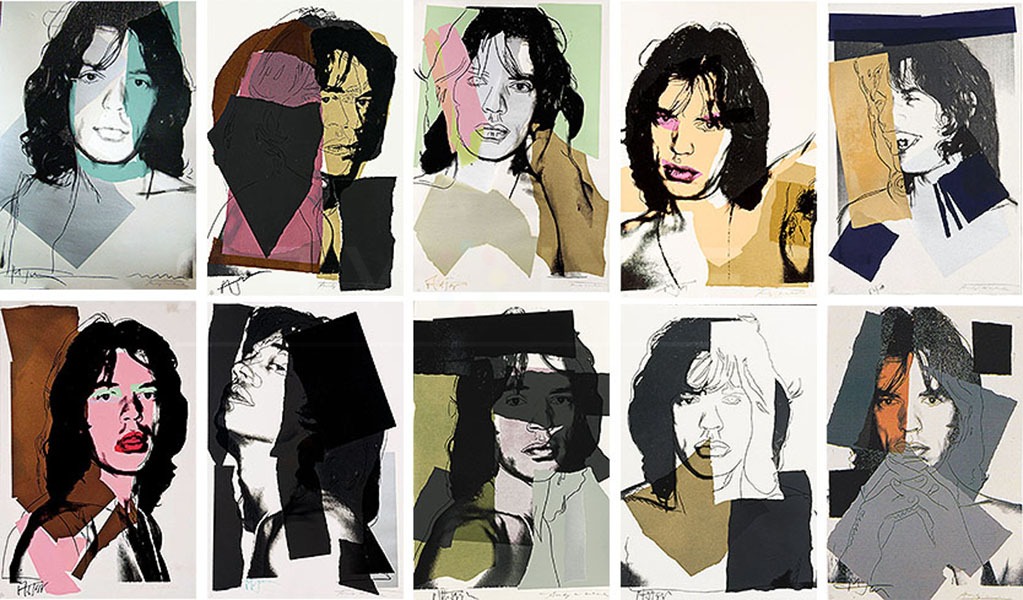
In the summer of 1975, at the height of both of their fame, Andy Warhol created a portfolio of silkscreen portraits of Mick Jagger. Warhol and Jagger were friends who first met in the 1960s, and Warhol famously designed the cover for the Rolling Stones’ 1971 album Sticky Fingers. (That album’s provocative zipper cover–a close-up of a jeans-clad crotch–showed Warhol’s and Jagger’s shared flair for turning pop culture into bold art.) For the Mick Jagger print series, Warhol personally photographed Jagger at his home in Long Island, capturing the rock star shirtless in various poses. He then transferred these images to screens, layered with vivid blocks of color and sharp line drawings in a collage-like style. The result was a set of portraits that mixed glamour with grit, often obscuring parts of Jagger’s face with abstract shapes while highlighting his iconic pout and flowing hair.

What makes the Mick Jagger prints especially sought-after is that Warhol invited Jagger to co-sign the edition. As a result, the prints now bear the rock-and-roll star’s signature in black, green, or red felt pen. Warhol’s decision to have Jagger hand-sign each of the 250 prints was both a savvy business move and an artistic statement. It added cachet and value to the works, while also underscoring the theme of celebrity commercialization.
Each print carries the pencil signature “Andy Warhol” and the bold felt-tip autograph “Mick Jagger” – a double validation of the image’s cultural significance. This gesture turned the art itself into a commentary on fame . For collectors, a Mick Jagger print isn’t just a portrait by Warhol; it’s a tangible piece of 1970s rock history, personally endorsed by the rock legend. Jagger later reflected on Warhol’s gift for capturing his era, saying “He could capture society… pretty accurately. That’s one of the things artists do – show people later on what it was like.” This portfolio, boldly signed by artist and rock star, certainly does just that.
2. Jimmy Carter I & II (1976): Campaign Art with a Presidential Autograph
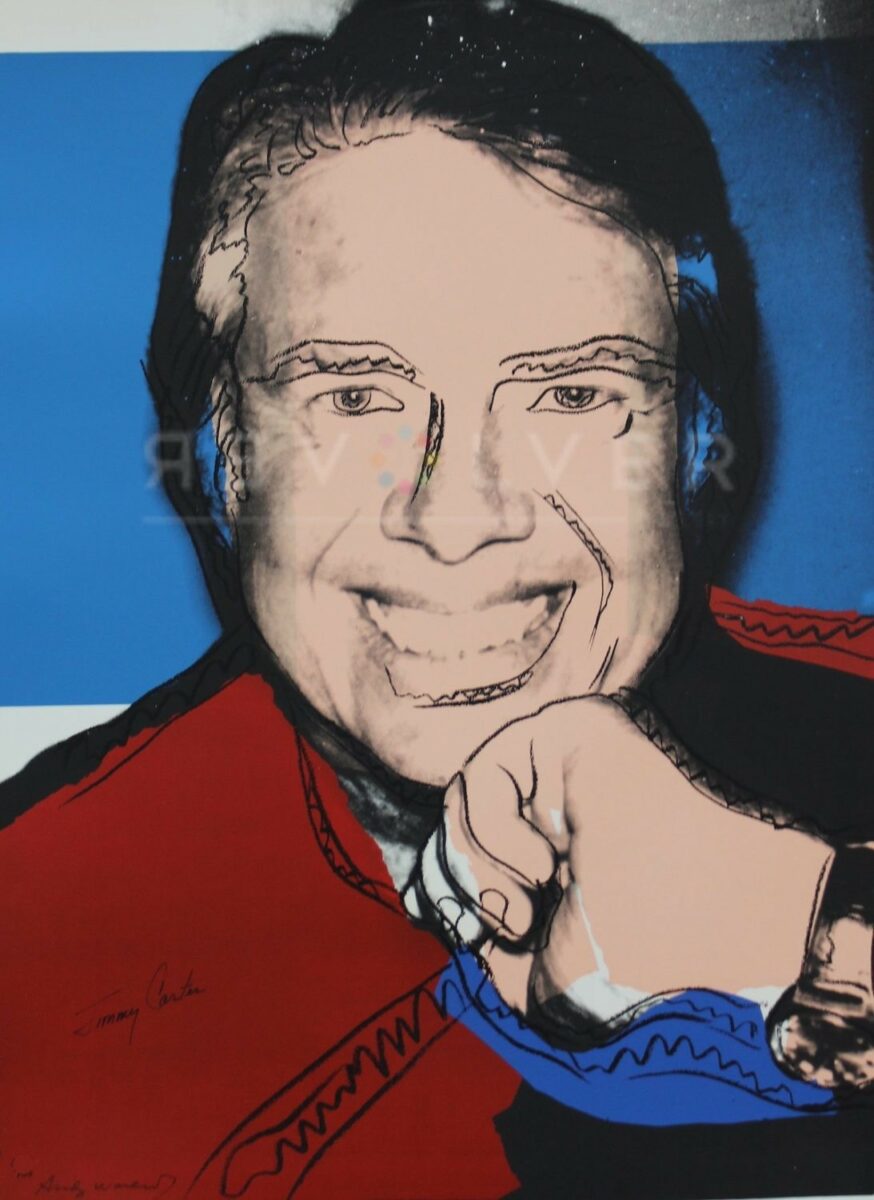
In 1976, as America headed into a presidential election, Andy Warhol ventured into politics by creating portraits of Jimmy Carter – and even got the future U.S. President to sign some of them. Warhol was commissioned by the Democratic National Committee to design artwork for Carter’s campaign. By enlisting Warhol, Carter’s team hoped to tap into the Pop Art icon’s youthful appeal and cultural cachet, positioning Carter as a forward-thinking candidate.
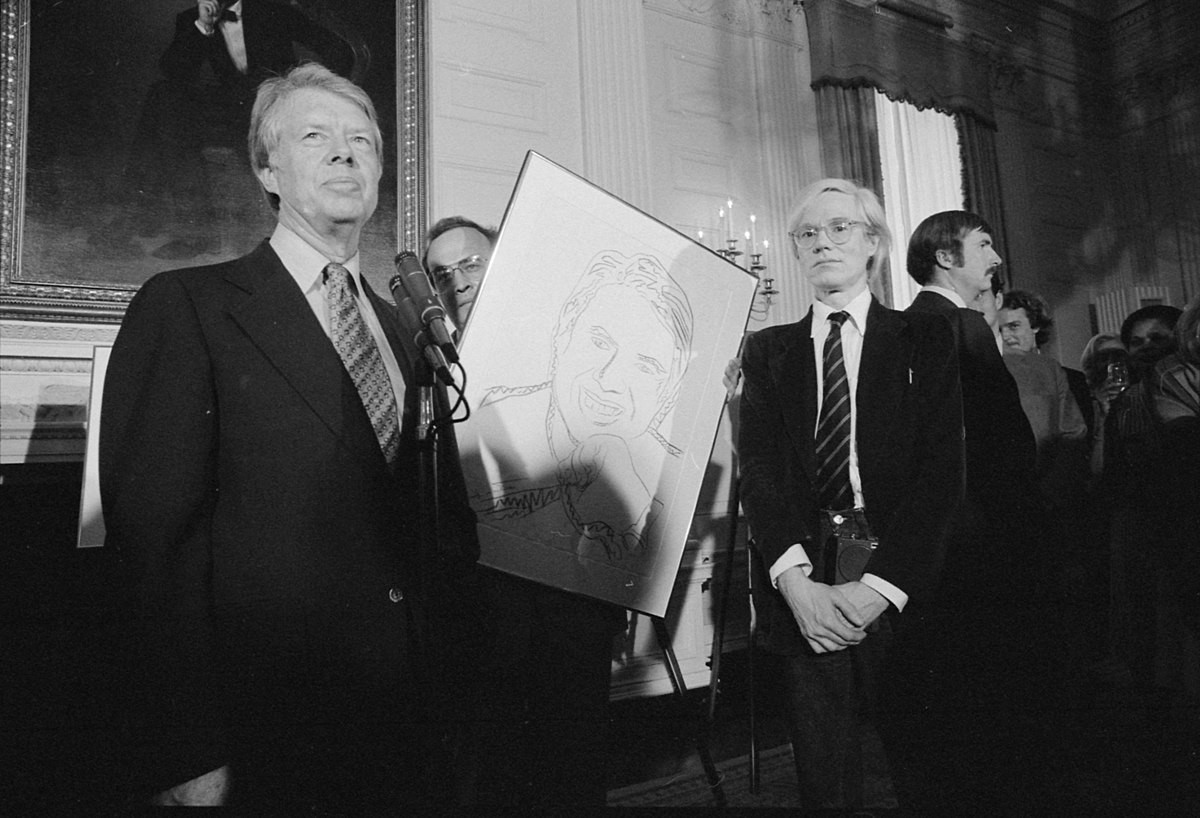
Warhol produced two screenprints of Carter that year, known as Jimmy Carter I (FS II.150) and Jimmy Carter II (FS II.151). They were printed in New York by Gem Screens and published by the DNC as limited editions (each 50, plus artist’s proofs). Uniquely, some prints were also signed by Jimmy Carter himself, likely as a thank-you to major donors. Notably, they were signed in ink by Carter, while Warhol stayed with his preferred graphite.
The two versions of Carter’s portrait present contrasting moods. Jimmy Carter I depicts the then-candidate with a broad, gleaming smile. It’s a warm, charismatic image intended to charm voters. Warhol accented this print with patriotic touches of red and blue, subtly invoking the American flag and optimism of the campaign. In Jimmy Carter II, which he created around Carter’s inauguration, Warhol showed a more serious and pensive side of the President. Carter’s expression in the second portrait is thoughtful and reserved, with richer colors (hints of deep peach, red, and blue) and a statesmanlike composure. Together, the pair captures Carter in two lights: as the approachable candidate and as the sober commander-in-chief.

Stylistically, Warhol stayed relatively faithful to Carter’s photographic likeness, applying only mild color embellishments and his trademark sketched linework. This was intentional, as Warhol understood the sensitivity of political imagery. Still, he couldn’t resist blurring politics with pop culture: by treating Carter like a celebrity subject, Warhol injected a bit of star power into the campaign. It sparked debate at the time about the mix of politics and pop, but it also presaged today’s era where politicians curate their image as carefully as Hollywood actors. For collectors, a Jimmy Carter print signed by both Warhol and the president himself is a rare prize–a piece of political history and art history combined. It’s also a testament to Warhol’s reach: even a future President of the United States found value in autographing a Warhol print, sealing the union of art, fame, and politics on paper.
3. Lillian Carter (1977): A First Mother’s Portrait

One of the rarest Warhol prints of all is the portrait of Lillian Carter, President Carter’s mother–made unique by the only known copy signed by both Warhol and Lillian Carter. Warhol created this screenprint in 1977, likely as a complement to the Carter campaign images. The edition was just 50 prints, published to help raise funds during Jimmy Carter’s presidency. While most were simply signed by Warhol, one special impression was autographed by Lillian Carter herself, and it resided in the personal collection of Warhol’s business manager Fred Hughes.

The choice of Lillian Carter as a subject shows Warhol’s fascination with the celebrity of politics–extending even to family members of the famous. Lillian, often affectionately called “Miss Lillian,” was not a Hollywood star or athlete, but her status as the President’s mother made her a public figure in the late 1970s. Warhol’s portrait transforms the 79-year-old Southern matriarch into a Pop Art icon. And an unlikely friendship emerged between them. Andy Warhol even took Lillian Carter to Studio 54 in 1977. Lillian reportedly told Andy she hadn’t known “if I was in heaven or hell, but I enjoyed it.” She also didn’t understand why the boys danced together with so many pretty girls around.
Unlike the relatively straight-on approach of Jimmy Carter’s portrait, Warhol rendered Lillian in a more abstract, stylized manner. He layered bold blocks of color–teals, pinks, purples, yellows–that sometimes obscure her features. Thin black lines sketch out the contours of her face and her attire, but much of the image is swathed in vibrant, almost playful hues. This abstraction was so pronounced that without context one might not even recognize the subject, if not for one telling detail: on her lapel Warhol printed a small campaign pin bearing Jimmy Carter’s smiling face. It’s a charming portrait-within-a-portrait, with the proud mother literally wearing her son’s image over her heart.
Warhol’s print of Lillian Carter thus operates on multiple levels. It’s a portrait of a presidential family member, a political fundraising piece, and a Pop Art commentary on how anyone connected to fame can become a cultural icon. Having both artist and subject sign the piece elevates it even further. Consider the scene: Warhol, the king of cool downtown art, meeting Lillian Carter, a nurse from Plains, Georgia, to jointly sign her portrait. It underscores the theme of worlds colliding–the realm of art, celebrity, and politics merging in one object. For Warhol, who once said “everybody will be famous for 15 minutes,” even the President’s mom deserved a moment on center stage. Today, the double-signed Lillian Carter print stands as a one-of-a-kind treasure for collectors, embodying an unlikely but heartfelt connection between Warhol and the First Mother.
4. Muhammad Ali Portfolio (1978): The Greatest Meets the Pop Art King

In 1978, Andy Warhol turned his attention to sports. He was commissioned to paint athletes, which marked a departure from his usual movie stars and socialites. Muhammad Ali, as a world-famous boxer and three-time heavyweight champion, was a star of stars–and Warhol was eager to capture his likeness.
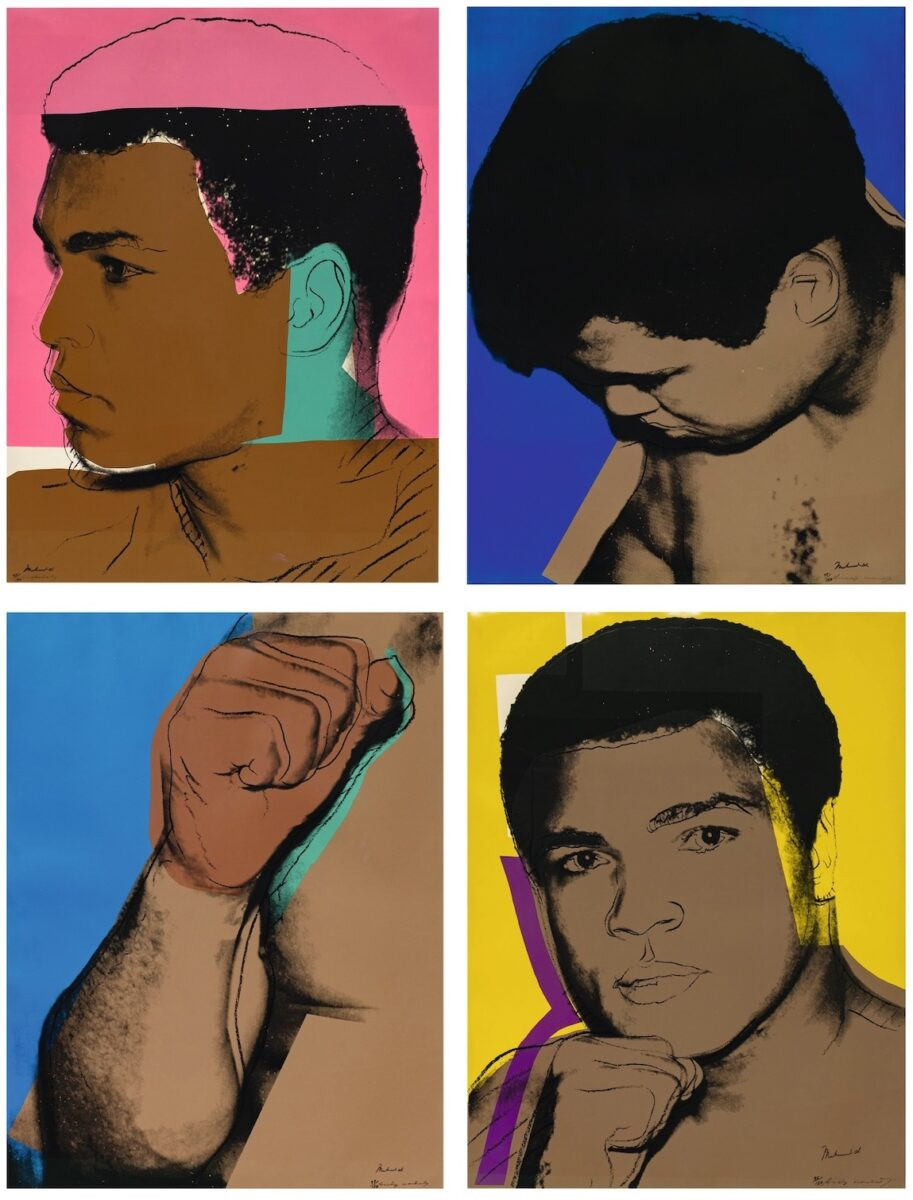
Warhol traveled to Ali’s training camp in Pennsylvania (nicknamed “Fighter’s Heaven”) to take Polaroid photographs of the fighter in action. From these, he created the Muhammad Ali portfolio in 1978, a set of four screenprints (FS II.179-182) that mark Warhol’s first printed series devoted to a sports figure.
The Muhammad Ali prints are dynamic and intense, much like their subject. Each of the four images shows Ali in a different pose: in profile with fists up, looking downward mid-spar, a close-up of Ali’s gloved fist and torso, and a frontal view with Ali’s hands guarding his face. Warhol applied warm blocks of brown to depict Ali’s skin and musculature, overlaid with vivid backgrounds of orange, purple, turquoise and green. Thin black contour lines and shadowy smudges add definition to Ali’s face and fists.
The compositions range from fragmented (one print literally crops out Ali’s face to focus on his punching fist) to confrontational (Ali staring straight at the viewer, ready to strike). Through these variations, Warhol presents Ali as both an athlete in motion and an almost mythic hero–each print highlighting a different facet of his strength and charisma.
While Warhol typically had his celebrity subjects sign prints during the print release, Muhammad Ali did not sign the edition in 1978. However, years later an opportunity arose. According to Ali’s longtime memorabilia agent, Harlan Werner, in 1999 Ali signed only six complete sets of the Warhol prints, alongside Warhol’s own signature. These were signed at a special session in Los Angeles, making those particular portfolios extraordinarily rare. (Individual prints here and there were also signed by Ali on separate occasions, but a full matched set of four with both signatures is the ultimate prize.) Owning one of those double-signed portfolios is like owning a piece of art history and sports history simultaneously.
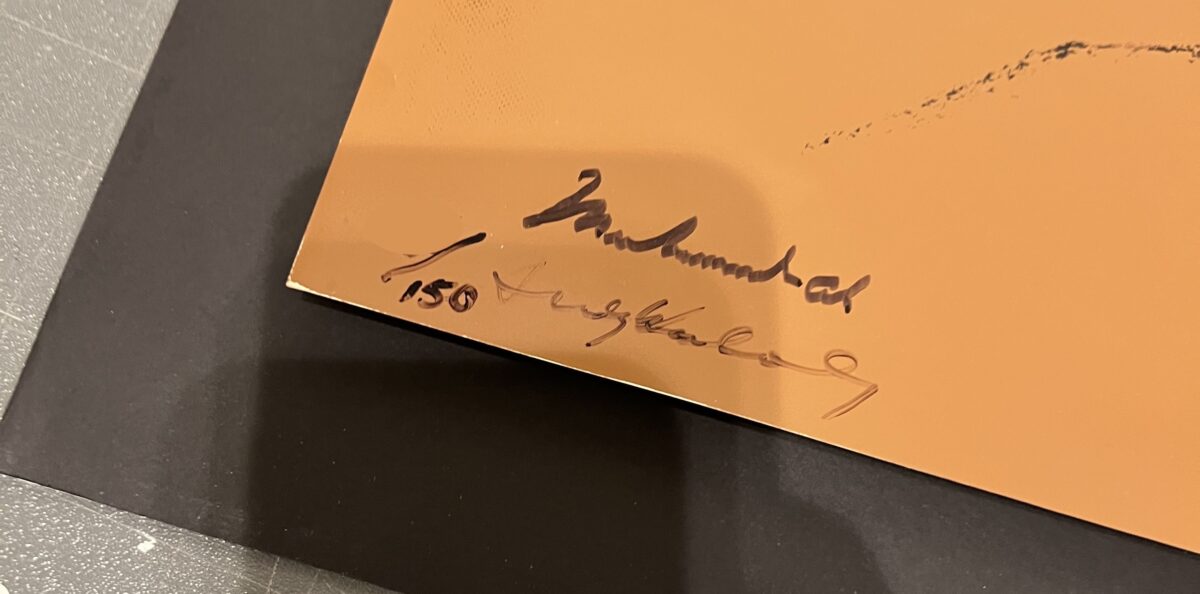
Warhol himself came to admire athletes as a new kind of superstar. “I really got to love the athletes because they are the really big stars,” he famously said. In Muhammad Ali–brash, photogenic, outspoken–Warhol found an ideal subject to explore the overlap of fame, media, and hero worship. Ali, for his part, was initially a bit shy during the photo shoot (not as used to posing for art as he was for sports cameras), but Warhol’s images capture his power and presence. Each signed print in the Ali series carries the gravitas of two legends. For a collector, a print signed by Andy Warhol and Muhammad Ali isn’t just about ownership–it’s about being a caretaker of cultural legend, holding a moment when the worlds of art and sport converged; two different kinds of celebrity, meeting through image.
5. Edward “Ted” Kennedy (1980): Politics, Polaroids, and Patriotism

In 1980, Andy Warhol turned his silkscreen skills toward another member of America’s political dynasty: Senator Edward “Ted” Kennedy. Kennedy was running for the Democratic presidential nomination, and Warhol produced a portrait print to support the campaign. Titled Edward Kennedy 240 (FS II.240), this screenprint was part of a limited edition of 300 created as a fundraising incentive for Kennedy’s campaign donors. Uniting art and politics again, as he had done for the Jimmy Carter campaign, Warhol not only signed the prints but also had Ted Kennedy himself co-sign a special batch as an exclusive thank-you to top donors. This gave the work a dual provenance–both a Warhol artwork and as a piece of political memorabilia.
Warhol’s image of Ted Kennedy is restrained yet striking. Unlike the neon colors of many Warhol celebrity portraits, Edward Kennedy 240 is rendered largely in somber black and white tones . Warhol based it on a Polaroid he personally took of Kennedy, rather than relying on press photos as he had for earlier Kennedy family works.
Warhol’s long-standing fascination with the Kennedy family is well documented. Back in the 1960s he had made the Flash (November 22, 1963) portfolio about JFK’s assassination and a series of prints of Jackie Kennedy, exploring the media iconography of Camelot. With Ted Kennedy’s 1980 portrait, Warhol came full circle to engage with Kennedy charisma once again – this time in a direct, participatory way. Created to raise funds for Edward ‘Ted’ Kennedy’s 1980 presidential campaign, the work is indicative of Warhol’s willingness to wade into philanthropy and politics.
In the print, Ted Kennedy’s face emerges from deep shadows, lit from one side, conveying a sense of gravity and focus. Warhol retains much of the original quality of the photograph, opting not to mask the Senator’s features with heavy color blocks. Instead, the artistic flourishes come in the form of electric blue and crimson red hand-drawn outlines tracing Kennedy’s hair, jawline, and the folds of his suit. These subtle streaks of color add a patriotic aura (red, white, and blue are all present) and inject a quiet energy into an otherwise formal composition. The contrast of the bold outlines against the grayscale portrait creates a quiet tension–an interplay between pop art style and statesmanlike solemnity.

By using his own photograph of Ted, Warhol ensured the image was both authentic and composed to his liking. He portrayed Kennedy not as a flashy pop figure, but as a serious contender, “a sympathetic portrayal” left largely in black and white. The decision to keep it monochromatic, with only those red and blue highlights, imbued the portrait with a sense of gravitas–befitting a man often called the “Lion of the Senate.”
The double signatures make Edward Kennedy 240 especially noteworthy. Each signed “Andy Warhol” and “Edward M. Kennedy” in flowing script, these prints became coveted political art hybrids. They embody a moment when Warhol the artist and Kennedy the politician intersected in purpose – using art to influence and record history. Though Ted Kennedy ultimately did not win the nomination in 1980, he remained an influential figure for decades. Warhol’s portrait, co-signed by the Senator, stands as an enduring tribute to that era’s hopes and legacy, a piece that collectors treasure for its story as much as its visuals.
6. Karen Kain (1980): Ballerina in Blue with Diamond Dust

Not all of Warhol’s muses were globally famous superstars. Some, like Karen Kain, were celebrated in their own realms and came to Warhol’s attention through circumstance and admiration.
Karen Kain was a prima ballerina with the National Ballet of Canada, renowned for her grace on stage. In 1980, Warhol created Karen Kain (FS II.236), a dazzling screenprint embellished with diamond dust that captures the dancer’s poise and intensity. The print was published as an edition of 200, and interestingly, each is signed by both Andy Warhol and Karen Kain in pencil. This double-signing session was likely arranged by the Canadian art publisher, William Hechter, who commissioned Warhol’s portrait of Kain, making her one of the few Warhol subjects outside the entertainment/political sphere to co-sign her prints.
Warhol’s portrait of Kain is visually stunning and layered. Based on a Polaroid photo taken at Warhol’s Factory studio, it presents Kain’s face in soft, natural tones at the center, while bold swaths of vibrant color electrify the space around her. Warhol screened blocks of sunshine yellow, deep violet, tangerine orange, and icy blue that splash across the composition almost like stage lighting. These colors form an abstract halo around Kain’s face, giving the piece a dynamic, collage-like feel. Over parts of the image, Warhol added his drawn linework: delicate black outlines emphasize Kain’s eyes, nose, and mouth, as well as the contours of her hair and shoulders. The combination of realistic features and surrounding color bursts creates a push-pull effect for the viewer’s gaze. It’s as if Kain is emerging from an aura of pure color and light–much like a ballerina stepping into a spotlight.

Adding to the glamour, Warhol used diamond dust–fine particles of glittering material–in the silkscreen ink, which gives the print a subtle sparkle when it catches the light. Diamond dust, pioneered by his assistant and master printer, Rupert Jasen Smith, had become one of Warhol’s favorite techniques around that time to literally make his prints shine. In Karen Kain, the diamond dust lends a jewel-like finish befitting a celebrated performer.
Reportedly, Karen Kain didn’t immediately embrace her Warhol portrait. Accustomed to more traditional images of ballerinas, she was initially surprised by Warhol’s pop-art interpretation of her features. Years later, however, Kain grew to appreciate the portrait’s boldness and now proudly displays her own artist’s proof in her home. “Over the years, I’ve come to see Warhol’s portrait as bold and striking,” Kain reflected, and indeed the print has become a cherished piece of her personal collection (it reportedly hangs in her dining room).
For Warhol, meeting Kain and capturing her image was another example of his interest in diverse celebrities, from rock stars to royalty of the ballet world. The double signature on each print, “Andy Warhol” and “Karen Kain,” signifies not just authenticity but also Kain’s eventual approval of Warhol’s vision. It’s a delightful union of high art and high culture: the Pop Art maestro and the prima ballerina, together creating–and signing–an artwork that bridges their two worlds.
7. Jane Fonda (1982): Hollywood Glamour with an Activist’s Autograph

Jane Fonda wasn’t just a movie star. By the early 1980s, she was also a political figure, an exercise icon, and a media lightning rod. That made her an ideal subject for Warhol, who returned to her image more than once. The most widely known is his 1982 screenprint Jane Fonda (FS II.268), a portrait that blends his Pop style with her public force.

Warhol’s first take on Fonda came earlier. In 1970, Time magazine asked him to design a cover featuring the Fonda family. He created a collage of Jane, Henry, and Peter. Jane’s face was the focal point—layered in pinks, greens, and orange, her smile caught mid-flash. It was bright and theatrical, but already hinted at her place in a shifting culture.
Their circles overlapped. Around this time, Fonda became close to Warhol Superstar Candy Darling. In 1971, Fonda helped Candy land a small role in Klute—not for visibility, but so Candy could join the Screen Actors Guild and access health insurance. “I wanted her in it so she would have some health insurance,” Fonda later said. That same year, Candy appeared in Women in Revolt, produced by Warhol. These personal ties deepened the connection between artist and actress.
The Jane Fonda print came a decade later. Warhol used a saturated, cobalt-blue background and emphasized her hair and lips in cherry red. Warhol chose a sultry, glamorous pose; Fonda’s head tilted back slightly, her long, voluminous hair cascading around her face, echoed by red highlights that Warhol streaked along her hair and cheek. Warhol’s palette for this print is both elegant and attention-grabbing–the contrast of Fonda’s fair skin against that saturated blue, and the interplay of red, blue, and black linework, create a poster-like intensity. Fonda’s gaze is direct and confident, projecting the charisma that made her a Hollywood star. Warhol’s linework is sharp and graphic, pushing the portrait toward a stylized realism. This stylistic touch was common in Warhol’s 1970s–80s portraits, adding graphic punch to the silkscreen’s flat areas of color. It shares elements with his earlier celebrity prints but feels cooler, more composed.
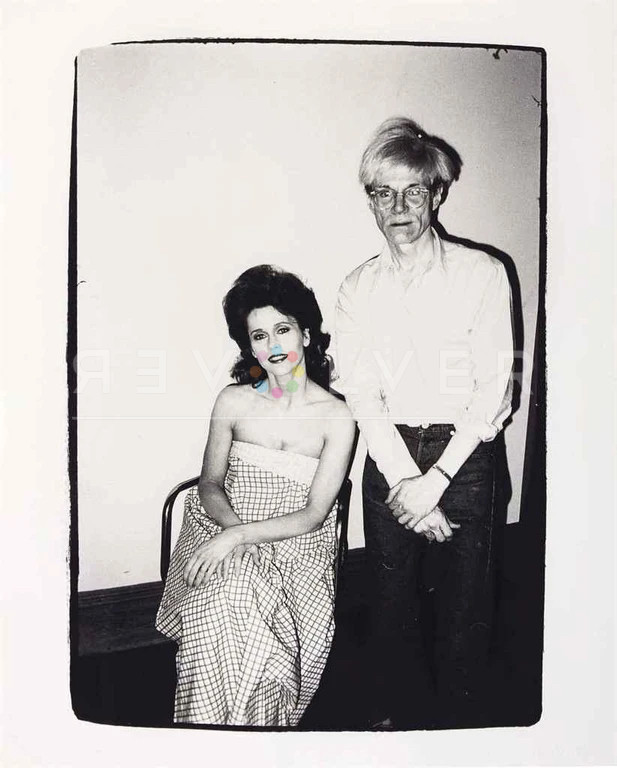 These prints were part of a fundraiser for her then-husband Tom Hayden, tying the artwork directly to her political life, and the edition included 100 signed prints. But what makes this piece even more special is not only that Jane Fonda herself signed a number of the prints—she added a personal inscription of her own. With just one word added before her name, “Peace, Jane Fonda” the signature evokes her well-known anti-war activism. And Warhol, savvy as ever, taps into Fonda’s public image beyond Hollywood: Jane Fonda was a polarizing figure due to her outspoken political stances (Vietnam War protests, advocacy for peace and women’s rights). By allowing Fonda’s own voice to appear on the artwork, it effectively turned each signed piece into a resonant statement, blending Warhol’s pop style with Fonda’s activism.
Collectors who acquire a Jane Fonda print signed by Warhol and Fonda are getting a canvas of dual legacies. It’s Hollywood glam and 20th-century political history in one. Warhol himself admired Fonda’s celebrity aura, as he was drawn to stars who commanded media attention. Between her exercise videos and her arrests at protests, Jane Fonda certainly did.
In this portrait, Warhol freeze-frames that aura: Jane Fonda, eyes forward, red-lipped and confident, simultaneously a screen siren and a voice for change. The double signatures seal the collaboration: Warhol the observer of fame, and Fonda the embodiment of it. Each print is a timeless souvenir of their intersecting fame, and as part of Warhol’s broader body of work, Jane Fonda 268 stands out as a piece where the celebrity actively participated in the art, quite literally signing off on Warhol’s vision of her.
8. Wayne Gretzky (1984): The Great One Gets the Warhol Treatment
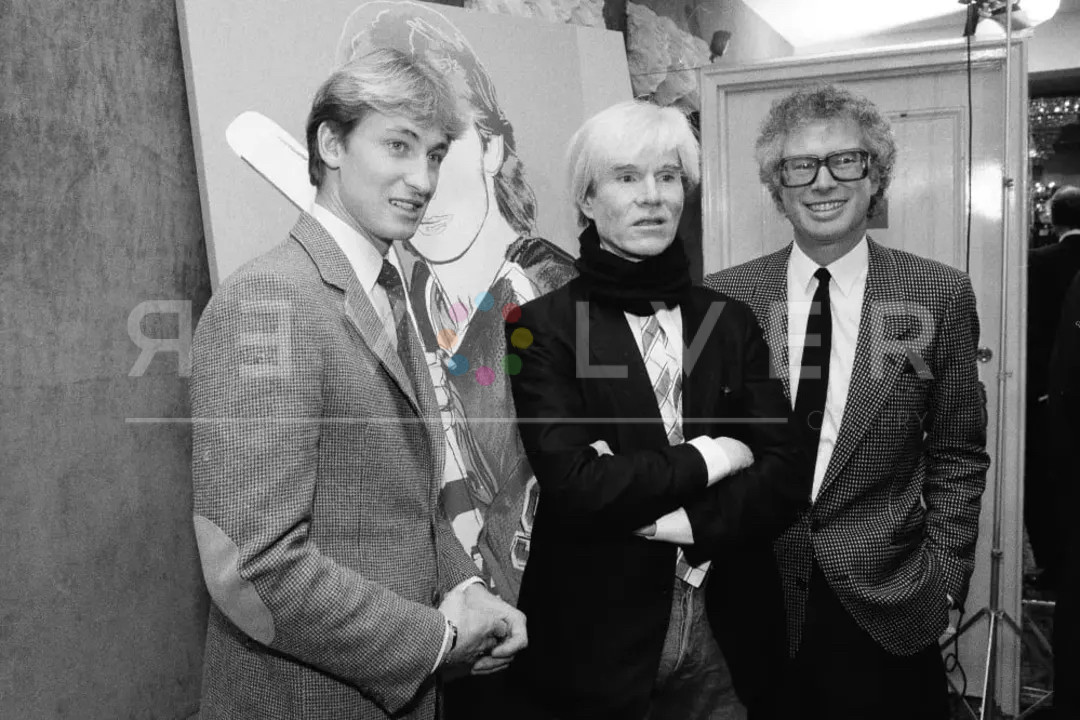
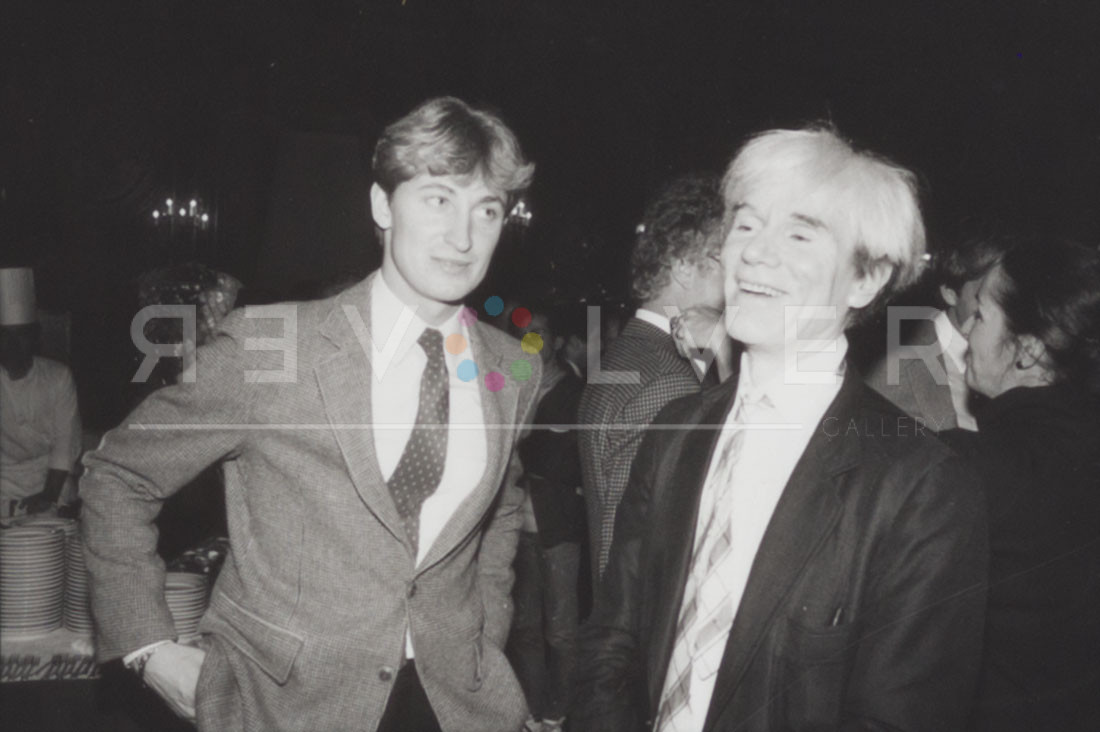
By the mid-1980s, Andy Warhol had proven that athletes could be icons in his art just as much as Hollywood stars. His 1978 Muhammad Ali portfolio was a hit, and in 1984 Warhol turned his eye to a sporting legend north of the border: Wayne Gretzky, hockey’s “Great One.” The resulting print, Wayne Gretzky (FS II.306), is a dynamic portrait of the young Canadian NHL superstar, and it became a cross-cultural sensation. Warhol’s Gretzky print was published in an edition of 300, and notably many were signed by both Warhol and Gretzky. Gretzky’s graceful autograph (often with his jersey number 99 inscribed) alongside Warhol’s signature made these prints instant collectibles, blurring the line between a fine art edition and a piece of signed sports memorabilia.
The story behind the portrait is a charming meeting of two worlds. A Canadian art dealer, Frans Wynans, arranged the commission as a way to inject contemporary art into a client’s collection (and perhaps to celebrate Canada’s hockey hero in high art form). In June 1983, Gretzky—just 22 years old at the time and already a multiple Stanley Cup winner—met Warhol at the Factory in New York for a photoshoot.
There’s a famous anecdote: Gretzky arrived hours late due to traffic, and he hadn’t brought a hockey stick. Scrambling for a prop, Warhol’s team dashed to a sporting goods store across the street to buy a stick, even convincing the incredulous shop clerk that it truly was for Wayne Gretzky. Armed with the stick, Gretzky posed for Warhol’s Polaroid camera, and the artist snapped away, capturing the athlete’s easy smile and boyish charm (Gretzky was a fan of Warhol, which likely put him at ease).

Warhol’s finished print of Wayne Gretzky is bright, playful, and unmistakably Warholian. He depicted Gretzky in profile from the chest up, color-blocking his face and form in gentle tones of peach and brown. He then overlaid the portrait with fine green and yellow contour lines giving additional detail to his features. Warhol chose accents of neon blue and orange–coincidentally (or perhaps intentionally) the colors of Gretzky’s Edmonton Oilers team–streaking them across Gretzky’s hair and jersey. These vivid patches of color, combined with splashes of hot pink with green linework, create a sense of movement and energy, as if echoing the fast pace of hockey.
In the print’s composition, Gretzky’s head is toward the upper left, while below, an outline of his gloved hand gripping a hockey stick spans the width. The stick grounds the portrait, an attribute unique to an athlete’s image. Warhol’s signature style of superimposing graphic elements (as seen in his earlier Mick Jagger or Reigning Queens portraits) works perfectly here. Gretzky’s gloved hand and stick form a diagonal that balances his visage above.
The youthful Gretzky appears not as a rugged sportsman but almost as a pop culture teen idol–his expression soft and his pose informal. This aligns with Warhol’s view of sports stars as the new celebrities. Warhol himself commented on Gretzky, “he’s more than a hockey player, he’s an entertainer, an entertaining hockey player.” It was Warhol’s nod to the fact that by the 1980s, star athletes had mass appeal and media presence rivaling movie stars. In Gretzky’s case, here was a Canadian kid who dominated his sport and charmed the public, making him prime Warhol material.

The double signing of the Gretzky prints added a special touch. Gretzky, ever gracious, signed many of the prints during release, often in pencil or paint pen, adding his famous “99”. This means a collector lucky enough to have a Gretzky print might see Andy Warhol’s penciled signature on one corner and Wayne Gretzky’s signature on the other, a delightful convergence. It’s reported that Warhol and Gretzky got along splendidly; Gretzky even purchased some of Warhol’s artwork for himself. That mutual respect is symbolized in the print both men signed. For fans of either of the two co-signers, the print is a prized piece–capturing the greatest hockey player of all time through the eyes of the pop art master, with each lending their famed name to the final product.
9. Andy Mouse (1986): Haring’s Tribute to Warhol, Signed by Both Artist and Muse
Our final entry entirely flips the script: instead of Andy Warhol portraying a celebrity, here Andy Warhol is the subject portrayed by another artist–yet it still results in a double-signed pop art gem.

Andy Mouse is a portfolio of four silkscreen prints created in 1986 by street-art wunderkind Keith Haring, in collaboration with Warhol. In this playful series, Haring depicted Warhol as a Mickey Mouse-esque cartoon figure–Andy Mouse–complete with Mickey’s red shorts and Warhol’s trademark glasses and shock of hair. The prints were a loving homage from Haring to his friend and mentor Warhol, fusing two pop culture icons (Disney’s cartoon and Warhol) into one. Fittingly, Haring signed all four prints as the artist and Warhol countersigned as the inspiration, effectively endorsing Haring’s portrayal of him.
The Andy Mouse images are bold, colorful, and full of symbolism. Each print (measuring about 38 x 38 inches) features the cartooned Warhol-Mouse figure in different vibrant color schemes (for example, one in green, one in yellow, etc.), often surrounded by Haring’s familiar energetic line motifs—stars, dollar signs, and motion lines. By portraying Warhol with Mickey’s round ears and a mischievous grin, Haring elevated Warhol to the level of an American pop icon as ubiquitous as Mickey Mouse. This wasn’t random: Haring had grown up loving Disney characters, and Warhol famously adored them too (Warhol once quipped that he wanted to be “as famous as Disney,” and that his favorite character was Minnie Mouse “because she can get me closer to Mickey”!).
The Andy Mouse figure is shown standing on a pile of money in some prints, and the presence of dollar bill imagery in these works wittily nods to Warhol’s embrace of art-as-business and his status as a commercial art superstar. Warhol himself had made art featuring currency and had said, “good business is the best art.” Here, Haring cheekily reflects that back by making Warhol literally a Pop art character with cash underfoot.
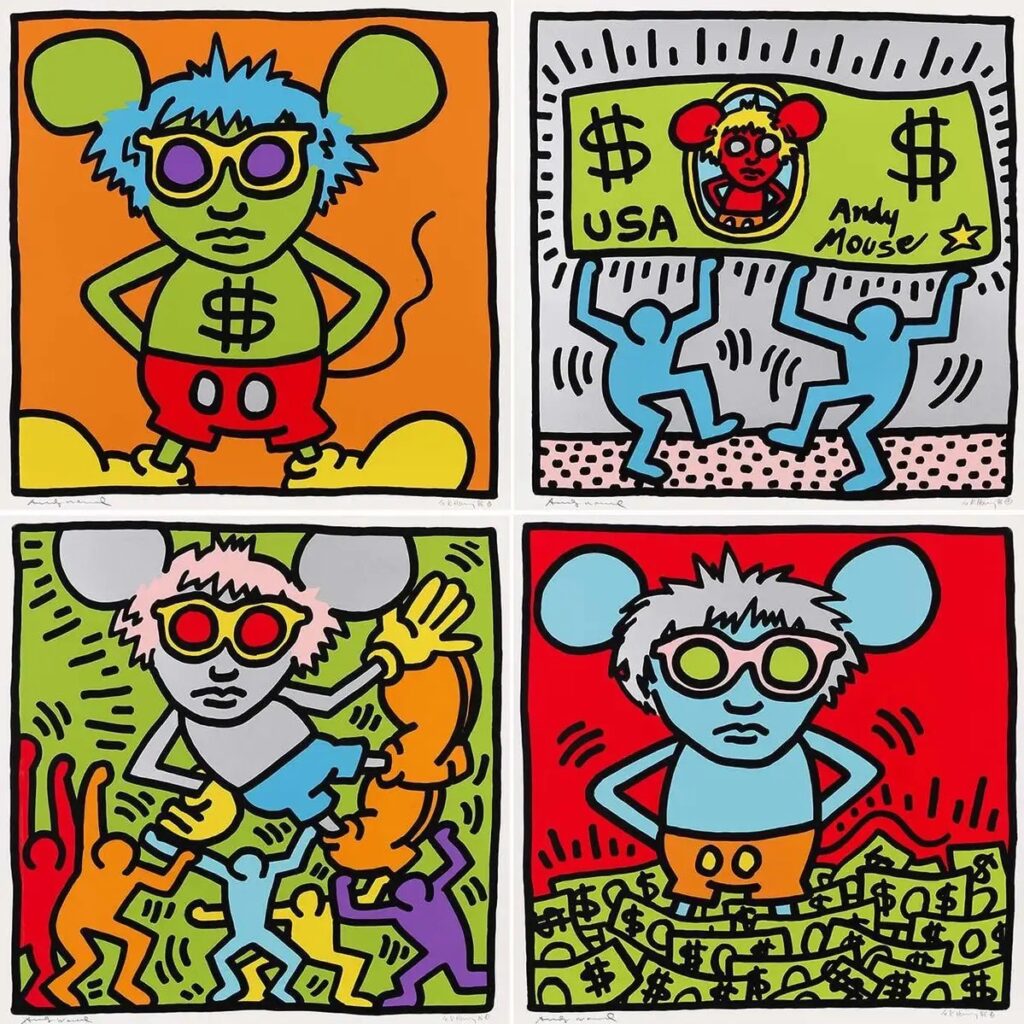
The collaborative spirit of Andy Mouse was strong. Haring and Warhol were close in Warhol’s final years; Warhol would drop by Haring’s SoHo Pop Shop and they frequented the same NYC club scene (like Studio 54). Warhol deeply supported Haring’s career–he even helped convince a nervous Haring to open the Pop Shop, and contributed a custom T-shirt design for it. In turn, Haring hero-worshipped Warhol as the pioneer of Pop. So Andy Mouse can be seen as Haring’s grand “thank you” to Warhol, while Warhol’s co-signature is a powerful endorsement of his depicted image; almost an official approval of his cartoon alter ego. These four prints, each part of a limited edition of 30, are particularly valuable as complete sets.
Tragically, within a year of Andy Mouse’s creation, Warhol passed away (in early 1987), and a few years later Haring would also pass (1990). This portfolio thus became an even more poignant capsule of a special relationship in art. For collectors, an Andy Mouse print double-signed by Haring and Warhol is like holding a piece of pop art lore: two generational talents united on one artwork.

And the joyful image of Andy Warhol as a larger-than-life, goofy mouse is a reminder that Warhol had become a pop icon in his own right, as recognizable as any Campbell’s Soup can or Mickey silhouette. In Haring’s bright colors and bold lines, Warhol found himself on the other side of the canvas, immortalized with a wink and a smile. And by signing the prints, he joined in on the fun. Andy Mouse stands as a celebratory coda to Warhol’s career and a testament to how his persona inspired the next wave of pop artists.
Collecting Warhol’s Double-Signed Prints: Why They Matter
Each of the works above exemplifies a convergence of creative worlds—fine art, celebrity, politics, sports–distilled into a single image bearing two famous signatures. Beyond their immediate visual appeal, these double-signed prints carry compelling provenance and stories: a rock star and an artist turning a print into a joint canvas, a politician and a painter coming together for a campaign, an athlete and an artist signing in mutual admiration, or two artists signing off on a homage. For collectors and Warhol enthusiasts, that dual autograph imbues an artwork with a special aura. It’s a handshake across time–you can almost picture Warhol and his subject side by side, signing away and smiling.
From an art-historical perspective, these prints are also markers of Warhol’s unique role in late 20th-century culture. No other artist navigated the overlap of art, fame, and commerce as masterfully as Warhol, and the very act of having celebrities co-sign his work speaks to that. He understood the value of the autograph, the allure of the “real,” and he wasn’t afraid to merge the commercial and the artistic. In doing so, Warhol not only elevated the status of the print as a collectible object, but he also left us a legacy of works that are, in a sense, time capsules of his connections. Mick Jagger’s scrawl or Muhammad Ali’s signature on a Warhol print is more than ink; it’s evidence of an encounter, a partnership in pop culture. What unites them all is Warhol’s instinct to formalize these encounters.
Today, these double-signed celebrity portraits are among the most sought-after Warhol works in circulation. They inspire confidence and excitement in collectors not just because of their rarity, but because they encapsulate stories that transcend the canvas; anecdotes of Warhol’s world and the luminaries who orbited it. Each one is an exchange, a gesture, a brief alignment of two figures at the center of their respective worlds. Ever the conversationalist, Warhol might have loved to know that these prints keep people talking. In the end, a double-signed Warhol portrait is more than an artwork; it’s a piece of cultural legacy, carrying the marks of two icons who, for a moment, met over the same canvas with a pen in hand.