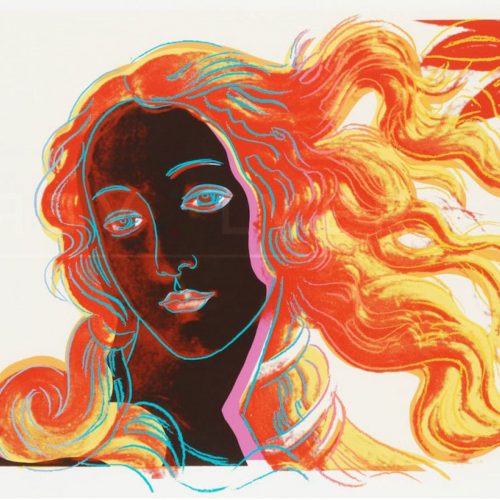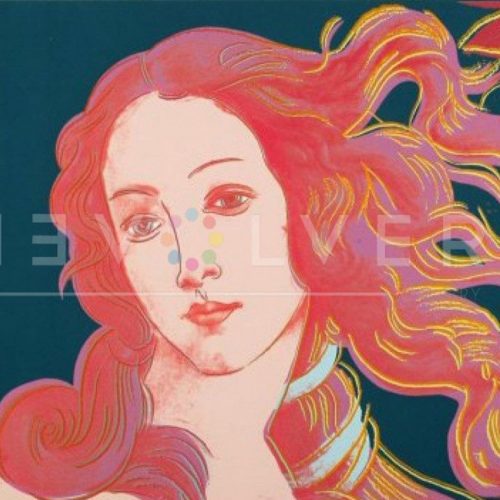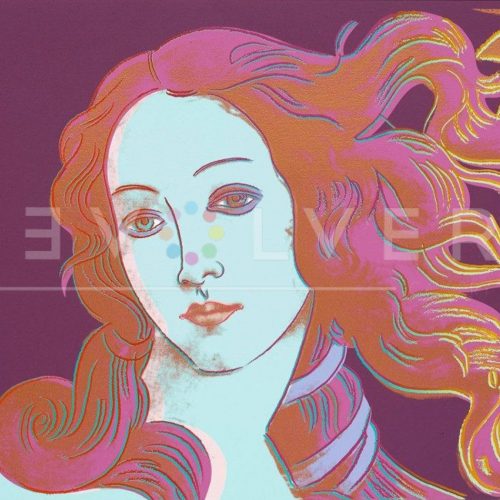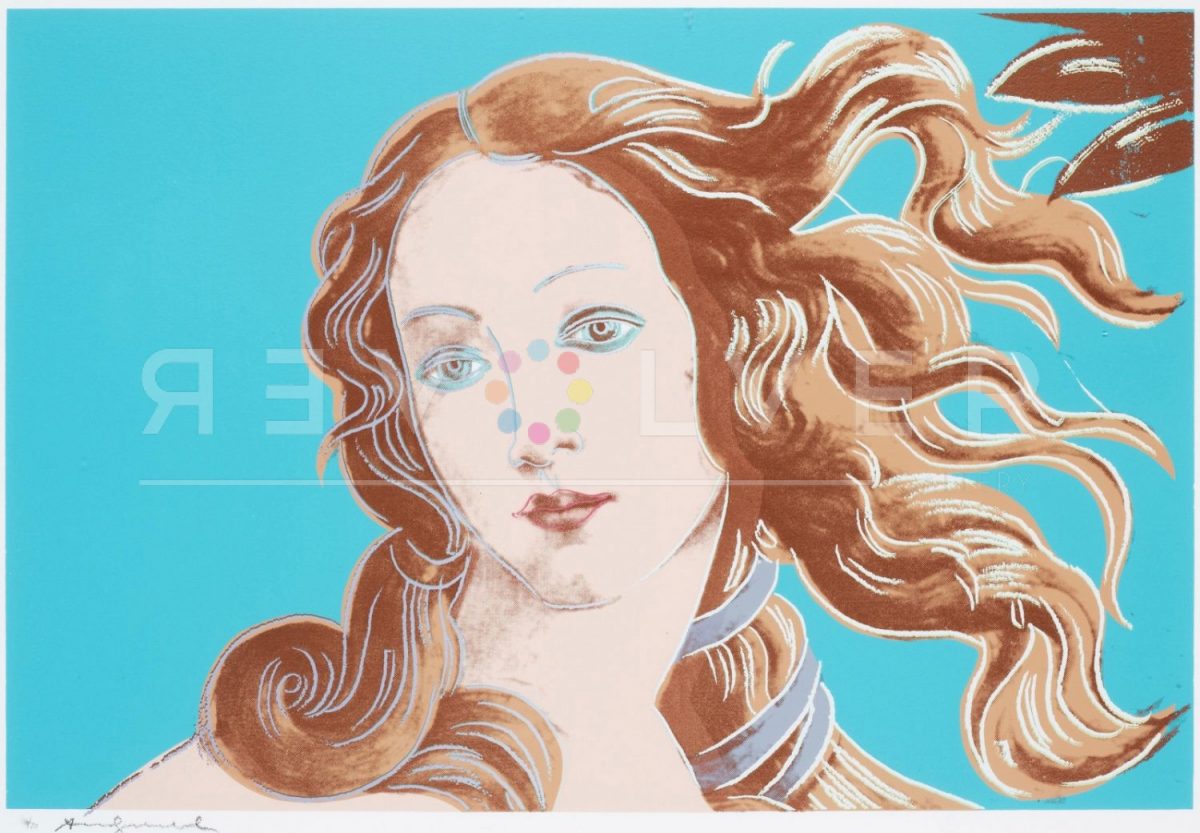
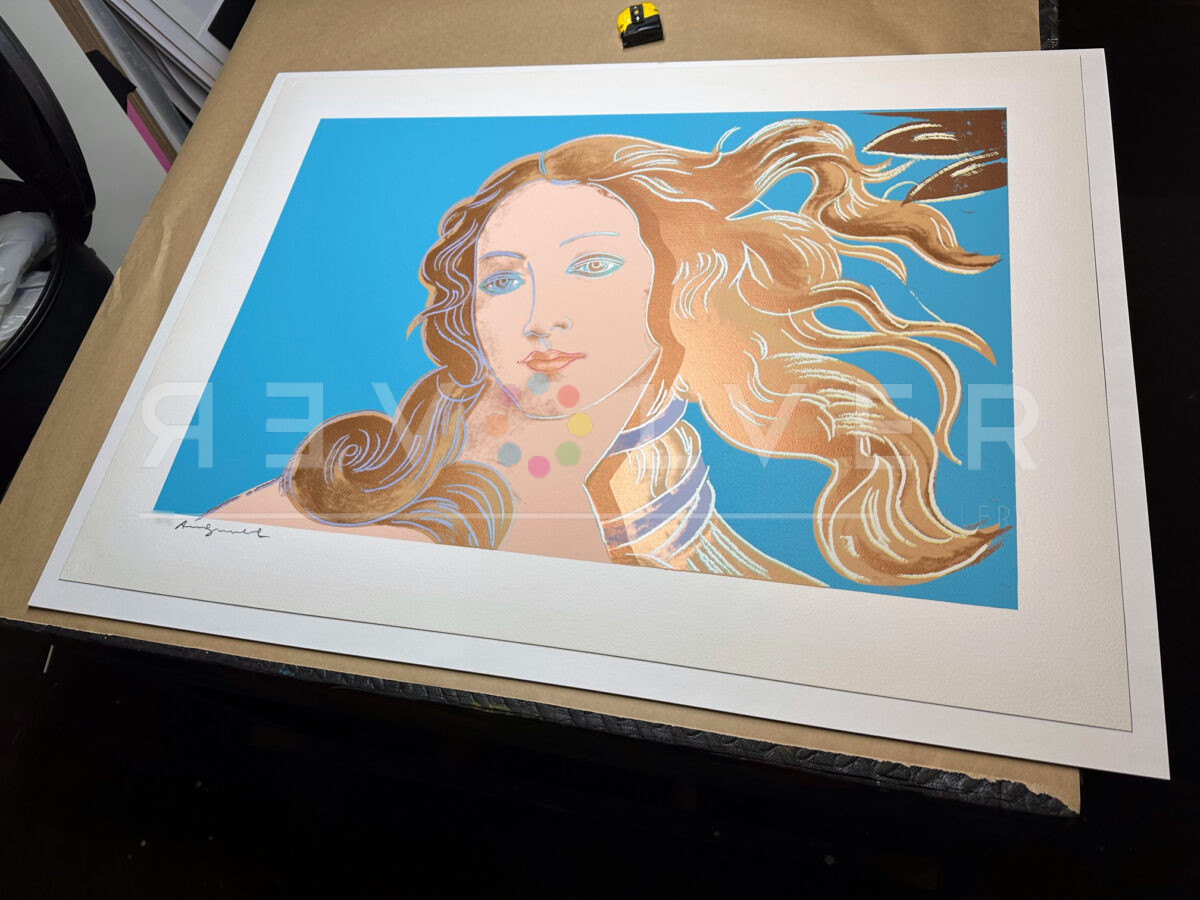
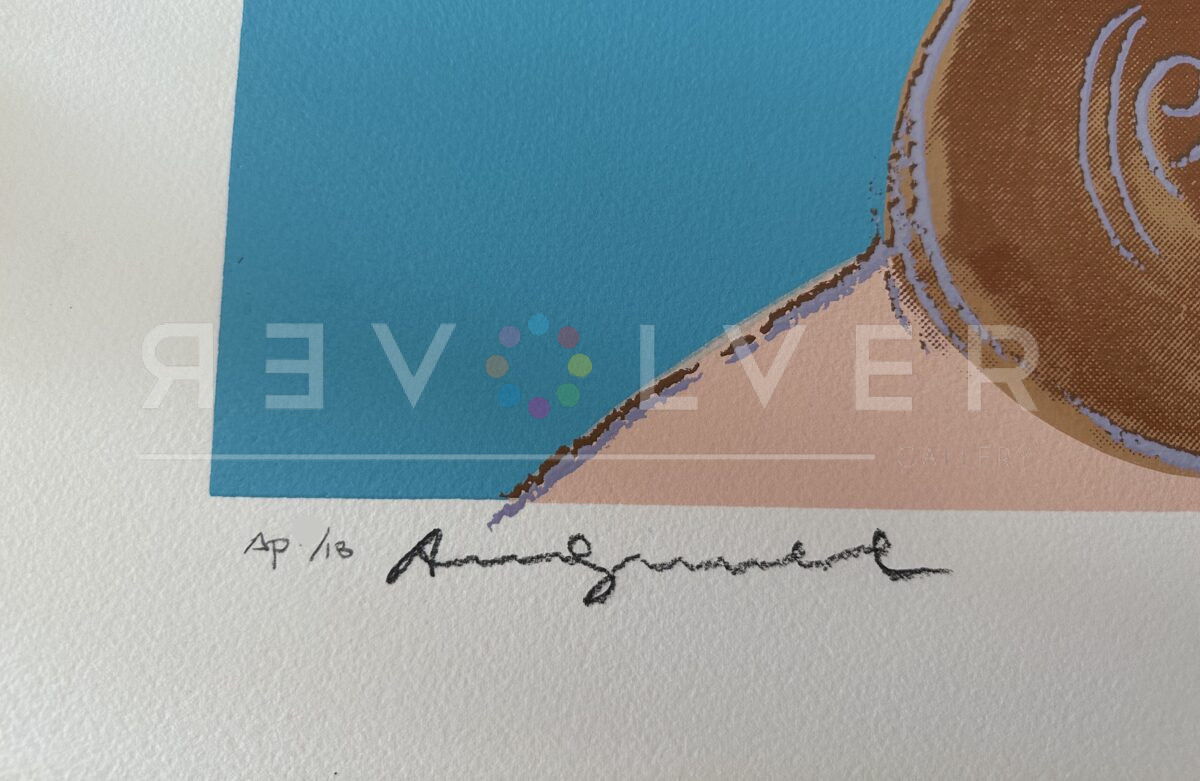
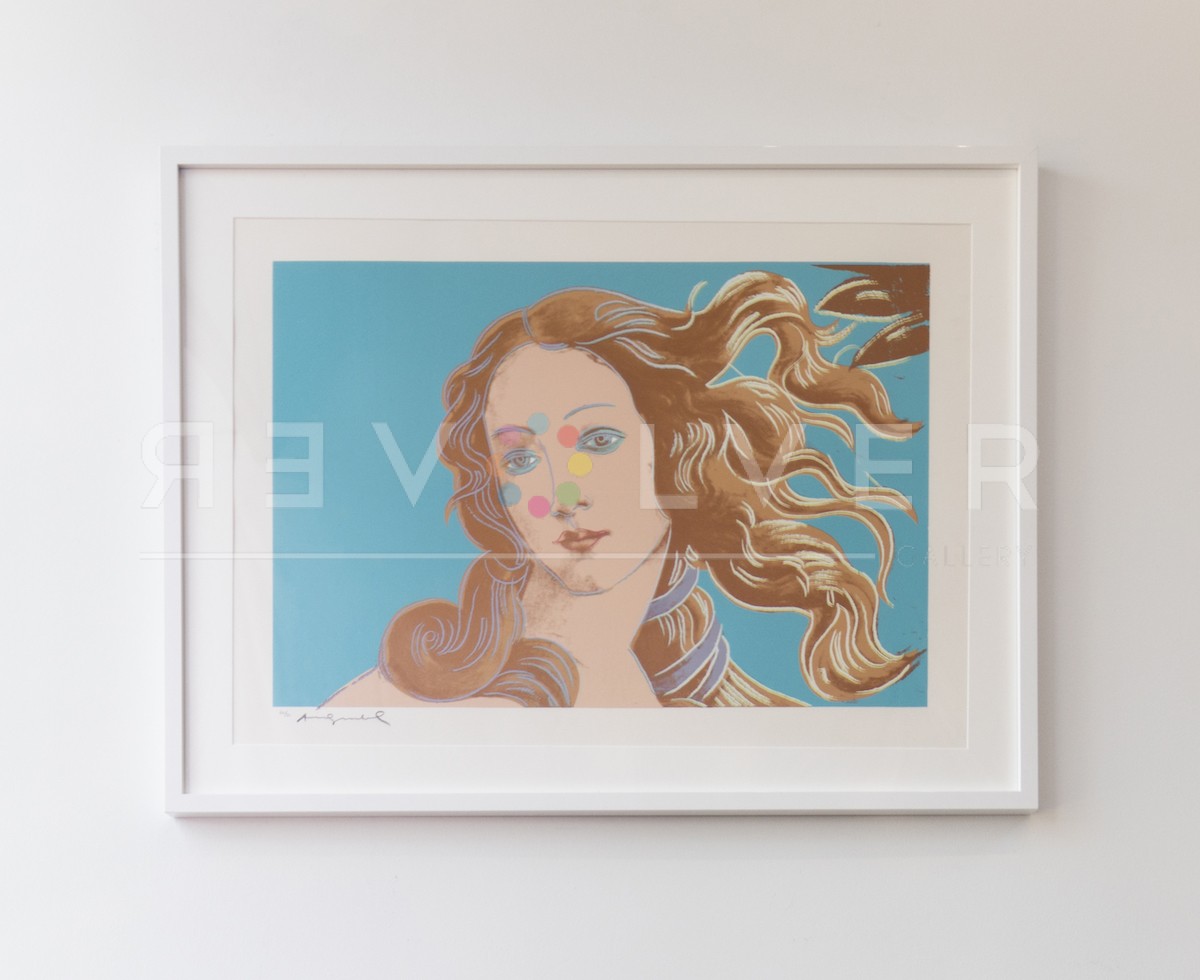
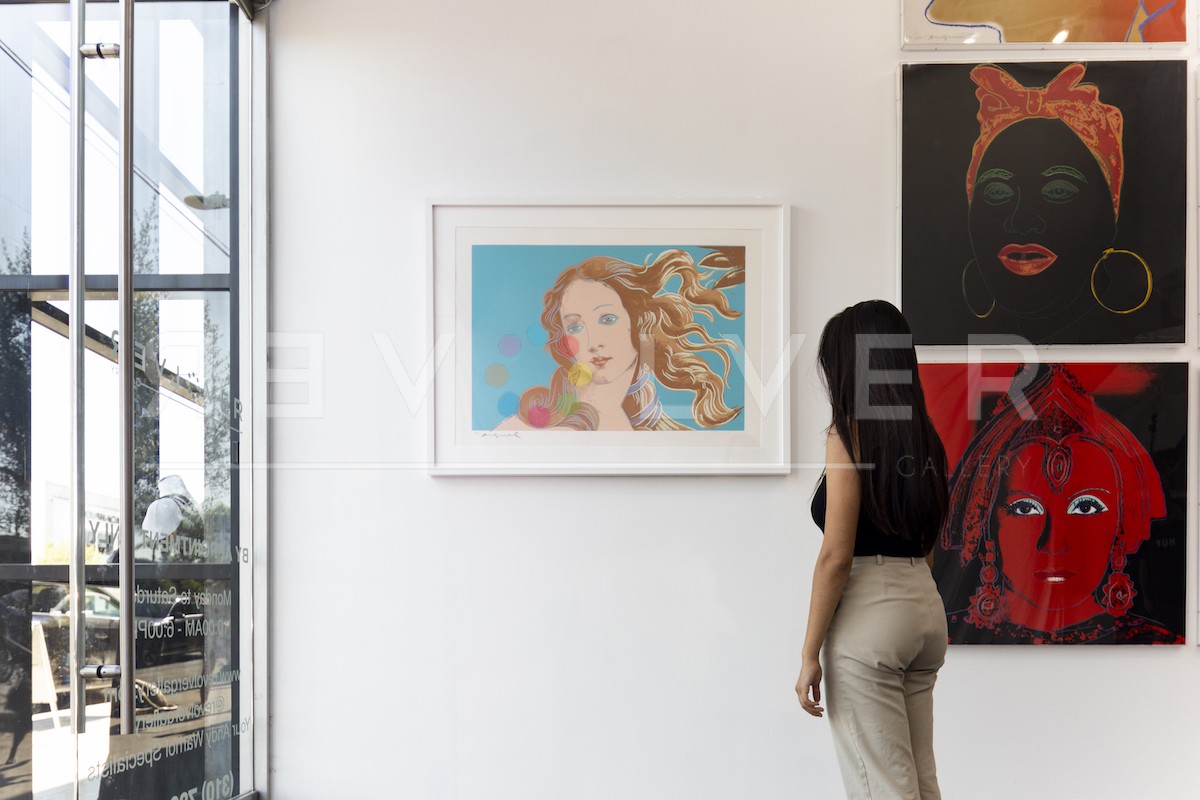
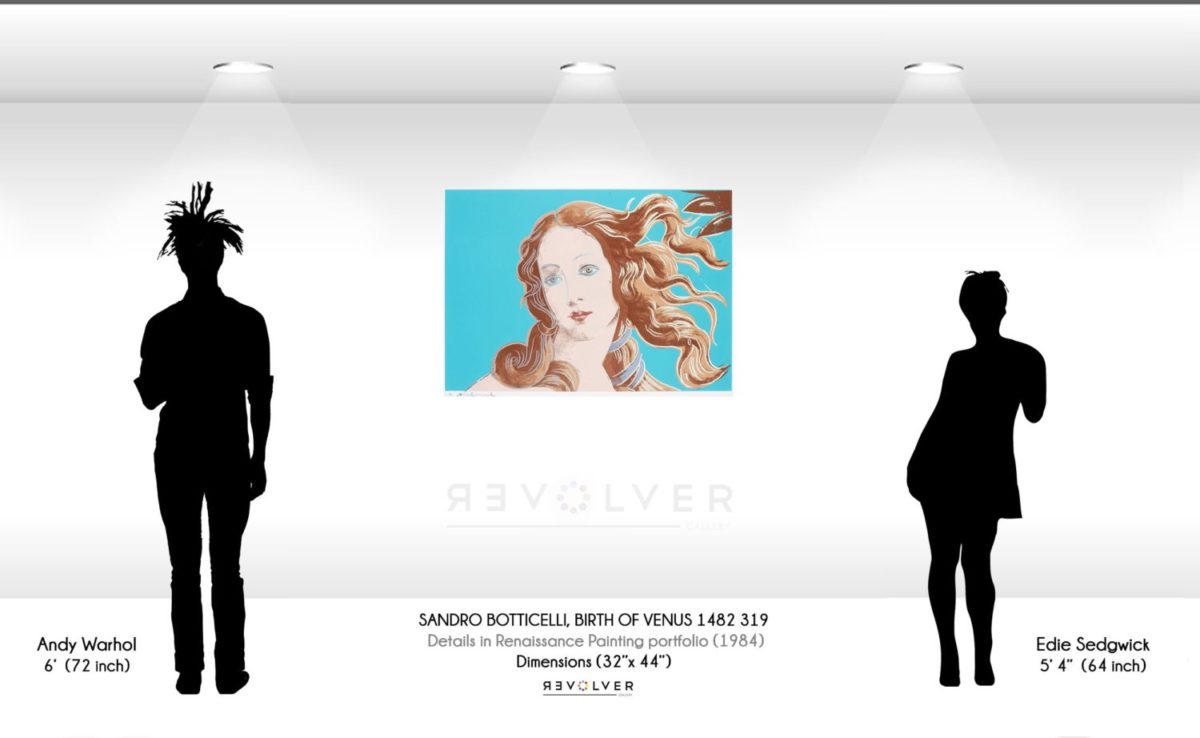
Birth of Venus 319 by Andy Warhol is a screenprint from the artist’s Birth of Venus series (Details of Renaissance Paintings) from 1984. In the 1980’s, Warhol’s career saw a revival of financial success, partly due to his affiliations with younger artists and assistants.
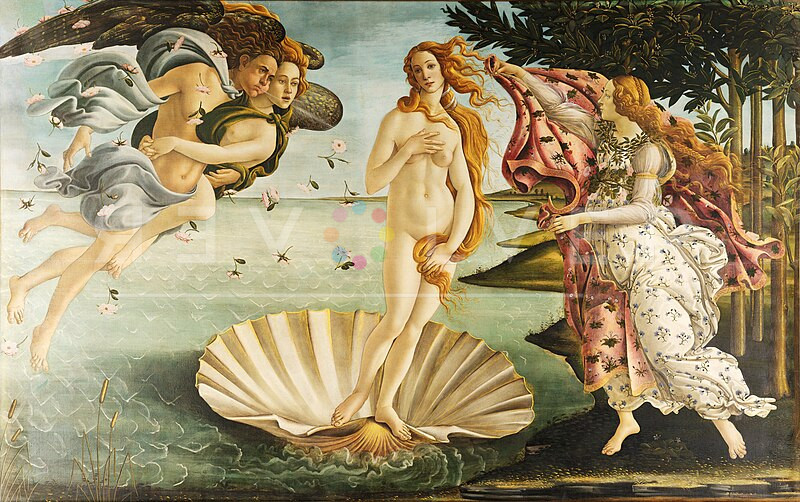
During this time, he composed a portfolio of prints based on world-famous Renaissance paintings. Warhol became captivated by influential historic icons such as Queen Elizabeth II, Albert Einstein, and Beethoven. With his background in fine art, it came as no surprise that Warhol turned his attention to the Old Masters. The Details of Renaissance series reimagines works like Piero della Francesca’s Brera Madonna, Paolo Uccello’s St. George and the Dragon and Leonardo Da Vinci’s The Annunciation. In Birth of Venus 319 Warhol breathes new life into Botticelli’s depiction of the Roman goddess rising from the sea, transforming her into a Pop celebrity.
Rather than show the full scene, Warhol chose to concentrate on Venus’ face alone. In doing so, Warhol treats the goddess of love and beauty as he would Jane Fonda or Debbie Harry. In characteristic Pop Art fashion, the flattened background and loud colors function to commercialize the subject. Each portrait uses a unique color scheme while the line work around Venus’ eyes alters her expression from print to print. (See Birth of Venus 318 and 316).
In 1963, the Metropolitan Museum of Art exhibited Da Vinci’s Mona Lisa in New York for the first time. The fervent excitement surrounding the painting’s arrival fascinated Warhol. Not long after, he completed Thirty Are Better Than One, re-envisioning Da Vinci’s crowned jewel by repeating the portrait thirty times. The experience likely shaped Warhol’s creation of the Details of Renaissance portfolio two decades later. If a revered painting like the Mona Lisa could become a commodity, why not the Birth of Venus?
Birth of Venus 319 displays the goddess against a backdrop of bright blue, the movement of her copper-red hair emphasized with delicate white lines. Additionally, Warhol used a pale blue shade to line her face and eyes, producing a certain effect on her features. With her near-translucent skin and serene expression, this version of Venus appears ethereal and fragile. Her remoteness suggests that Warhol may have been ruminating on the mystifying nature of beauty itself. “Some people think it’s easier for beauties,” Warhol commented, “but it actually can work out a lot of different ways…I always hear myself saying ‘She’s a beauty!’ or ‘He’s a beauty!’ or ‘What a beauty!’ but I never know what I’m talking about. I honestly don’t know what beauty is.”
It is no coincidence that Warhol chose to focus on masterworks of the Renaissance. Warhol saw Pop Art itself as a sort of rebirth, a revolutionary change in artistic perspective that was a product of its time. Just as the Italian Renaissance signified a transition to a more modern, westernized age of culture and art, the Pop Art movement ushered in a cultural revival that favored a new, nontraditional way of thinking.
“By 1960, when Pop Art first came out in New York, the art scene had so much going for it that even all the stiff European types had to finally admit we were a part of world culture,” Warhol said. Birth of Venus 319 represents the fulfillment of Warhol’s vision for Pop. In his view, the movement expanded beyond American culture and touched the world. By painting masterworks and making them distinctly Warholian, the artist claimed his rightful place in art history.
Photo credit: Sandro Botticelli, The Birth of Venus (c. 1484–1486). Tempera on canvas. 172.5 cm × 278.9 cm (67.9 in × 109.6 in). Uffizi, Florence