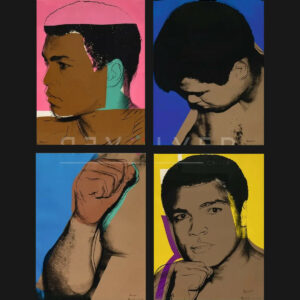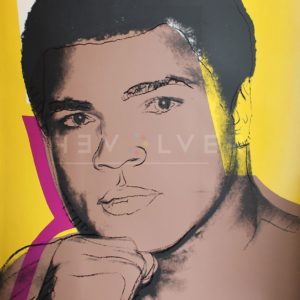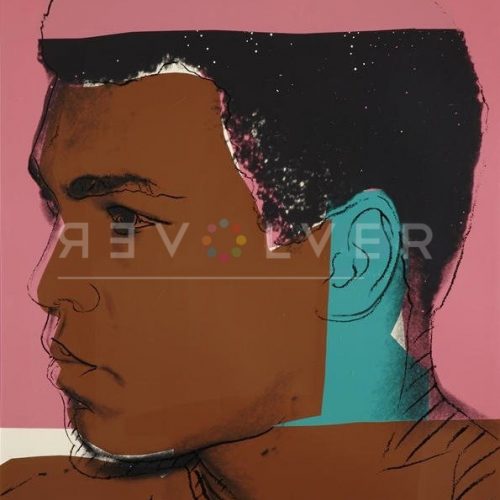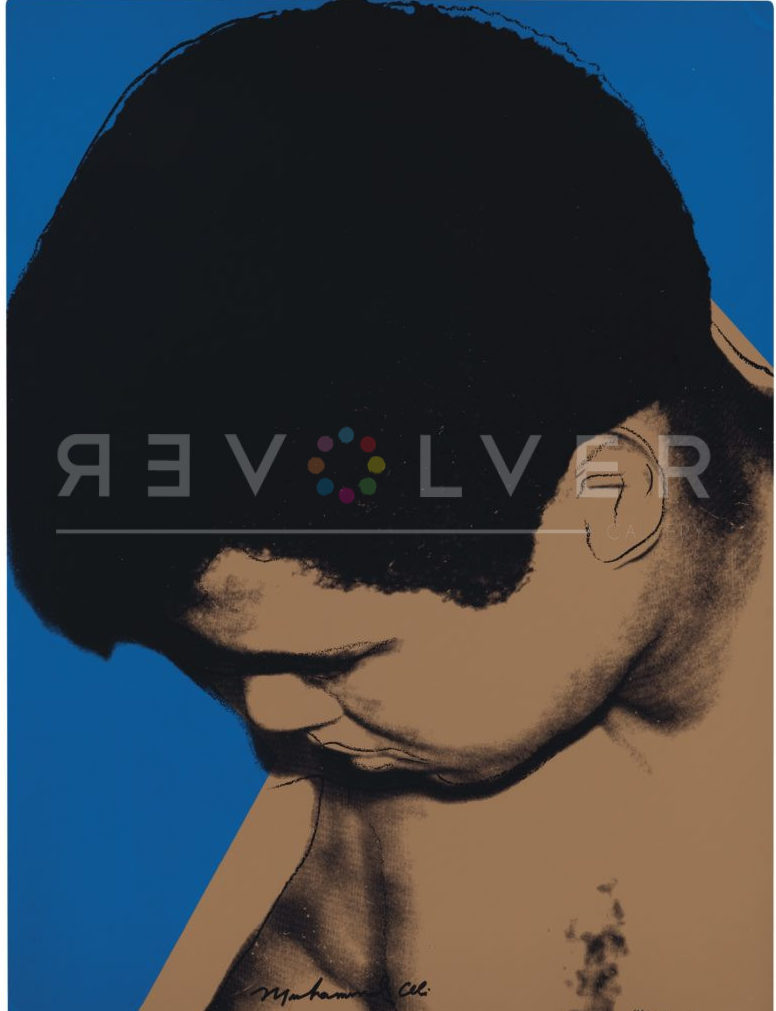
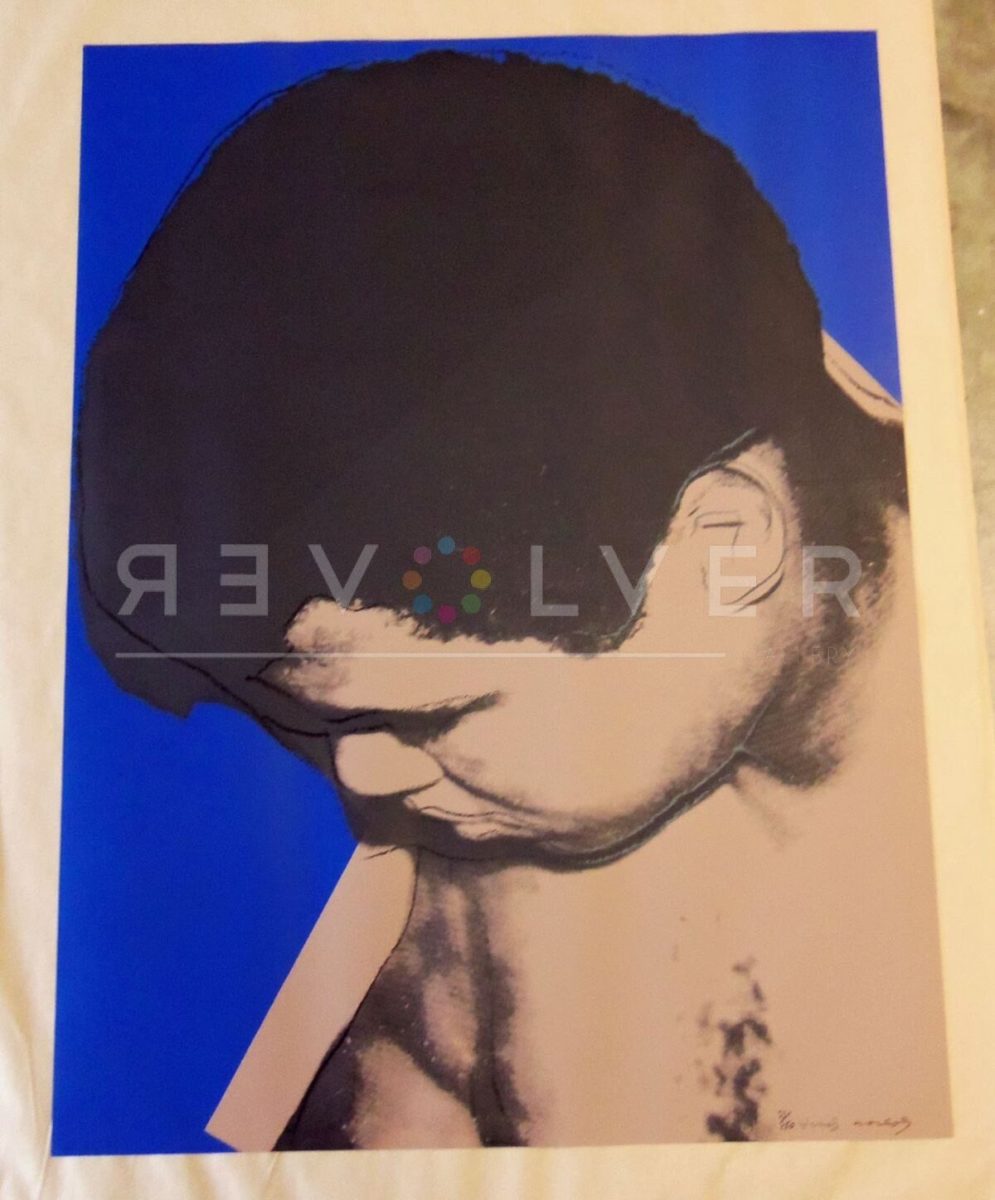
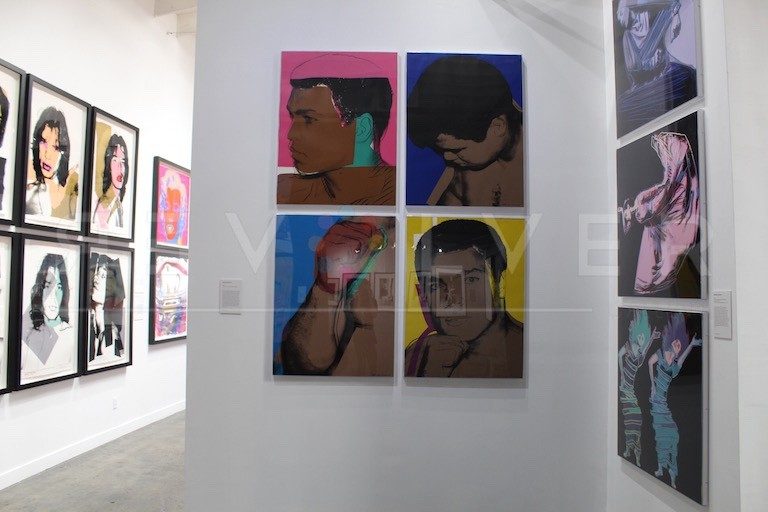
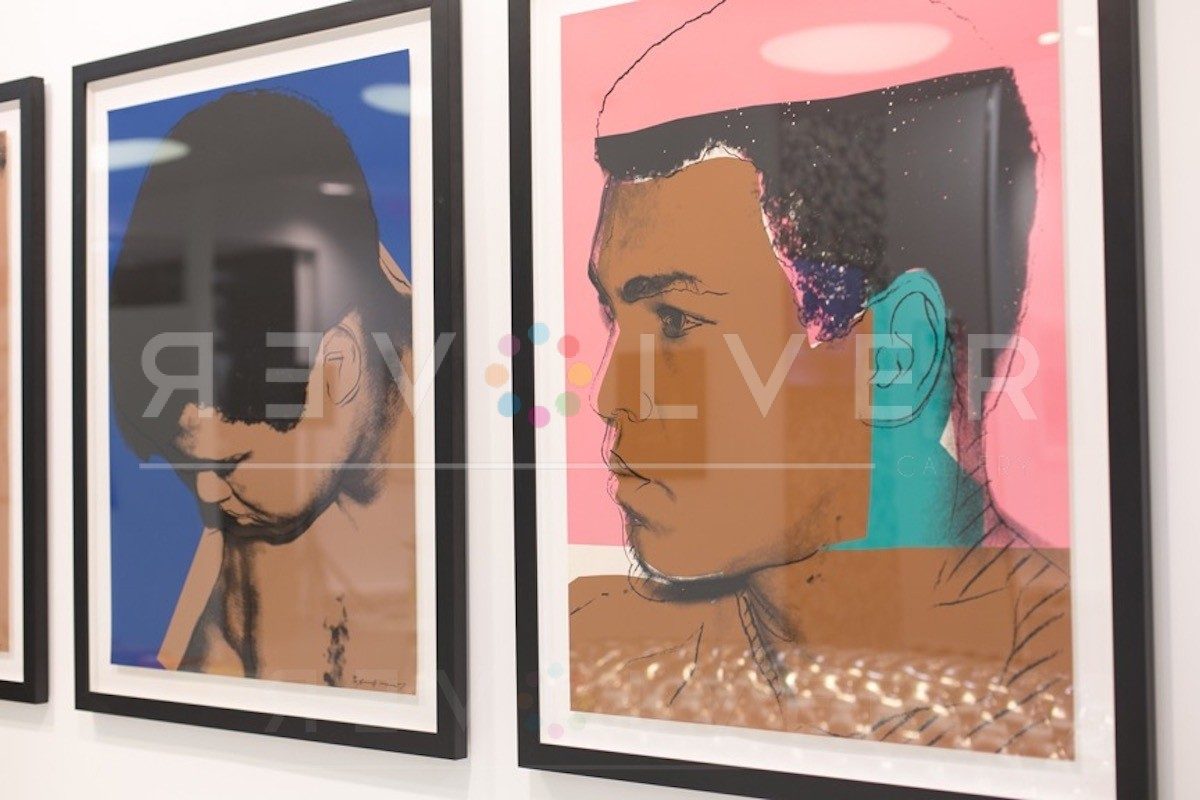
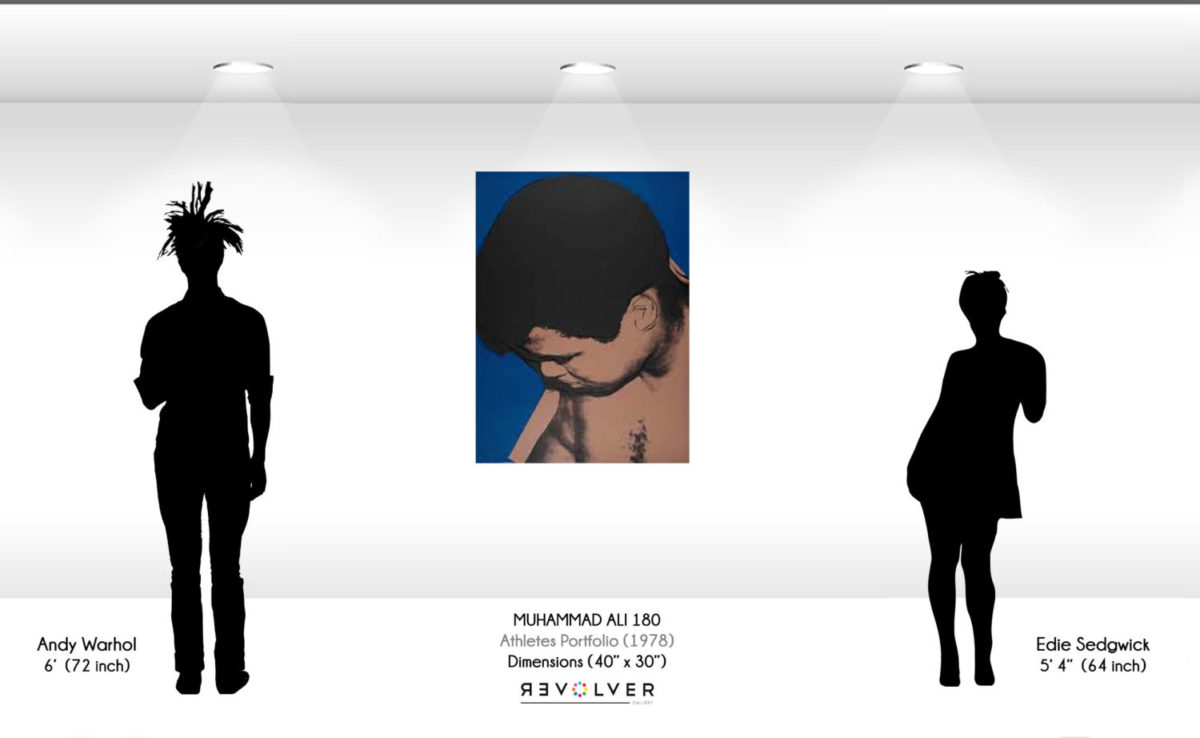

Muhammad Ali 180 by Andy Warhol is one of four portraits from Warhol’s Muhammad Ali series created in 1978. The series is part of Warhol’s larger Athletes portfolio. Each portrait in the series captures Ali from different perspectives, such as the angles of his face to his clenched fist. The Athletes series takes a unique shift in subject matter differing from the material and influences explored by Warhol prior to creating the series.
Andy Warhol, who was heavily interested in commercial commodities and pop culture, never focused on athletes and sports prior to the series. However, at this time, sports figures started to become more prominent in pop culture, similar to the likes of actors and musicians. With their growing influence and fame, Warhol saw an opportunity to explore athletes as a subject, seeing them as a balance between symbolic celebrity figures and commercial brands. He even proclaimed that athletes during the time were the movie stars of yesterday. Writing in his diary, he remarked: “I said that athletes were better than movie stars and I don’t know what I’m talking about because athletes are the new movie stars” (1977).
Art collector and sports fan Richard Weisman commissioned Warhol to make the series in 1977. Weisman wanted Warhol to create a series that honored a variety of notable athletes. Alongside Muhammad Ali 180, the series featured athletes such as Chris Evert, Jack Nicklaus, and Kareem Abdul-Jabbar. Weisman was aware of Warhol’s unfamiliarity with sports and athletes of the time, so he selected the athletes for him. Warhol took polaroid photographs of the athletes for the series. He then transferred and screen-printed the photographs with acrylic paint on to canvas, creating the large 40×30 inch portraits.
The portraits depict Ali at the height of his career during the 1970s. Recognized for his extreme talent, Warhol made sure to capture the essence of the Ali’s skills as a boxer. Muhammad Ali 180 shows the athlete with his head looking downward, displaying the side top view of his head in the portrait. Warhol’s decision to portray him from this angle reflects one of Ali’s prime reflexes as a boxer. Muhammad Ali 180 depicts the “unseen” counter punch, as Ali often kept his hands low during fights. However, Warhol decides not to feature Ali’s hands and instead focuses on his head at gaze. In Muhammad Ali 181, Warhol focuses on his fist; the expert fighter appears fragmented throughout the series.
For Muhammad Ali 180, Warhol sticks to solid colors that reflect Ali’s complexion. He uses a lightly hued brown for his skin and an onyx-black shade for his hair. Meanwhile, shadows create depth and accentuate his features. The two neutral shades used to depict his figure contrast against the royal blue background, creating a satisfying balance. Warhol uses subtle black lines to trace Ali’s features, adding further detail and depth to his figure.
The Athlete series embodies the excellence and talent of Ali and other athletes at the time. Muhammad Ali 180 and other prints detail a candid perspective of the boxer in his element and in action. Ultimately, it is a classic Warhol screenprint, employing the style of famous portraits like Mick Jagger and Queen Elizabeth.
Photo Credit: Andy Warhol with Muhammad Ali at Ali’s training camp in Deer Lake on August 18, 1977. Photo by Victor Bockris.