

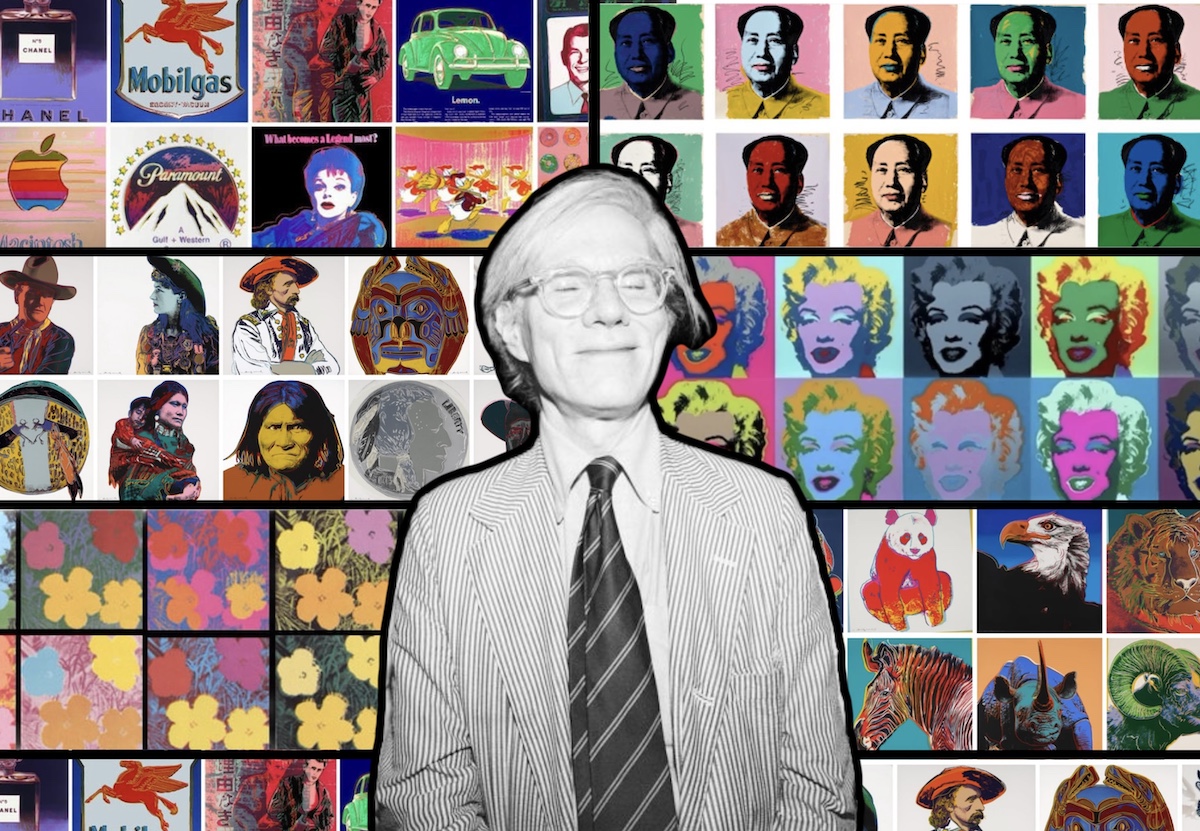
Many have described Andy Warhol as a “mirror of his age.” He captured the essence of his time and reflecting it back to the world through his artworks. This is perhaps most apparent when examining the content of his published portfolios. To fully appreciate the significance of Warhol’s portfolios and their investment potential, one should look at the trajectory of his career, his evolving methods, and the deep-seated fascinations that animated his practices and artistic output.
Editor’s note: This article was updated in October 2025 to reflect Revolver Gallery’s current Warhol inventory and recent portfolio sales. Three portfolios — Queen Elizabeth II, Cowboys and Indians, and Skulls — have been added to this article replace sold works.
Early Experiments in Printmaking


Warhol published his first editioned print in 1962, called Cooking Pot. It resembled an advertisement, depicting a common household good. In the following years, prints of various subject material followed: from the Birmingham Race Riot to Liz Taylor and images of Campbell’s Soup cans printed on shopping bags. It wasn’t until 1966, however, that his shift into printmaking began to truly take shape and transform his career. By that time, his painting sales were dwindling and many artists were exploring prints as a new avenue for income.
In 1966, Warhol ventured into the first project that resembled the portfolios he would come to specialize in. This first step consisted of three prints of Jackie Kennedy, based on publicity photographs from Life Magazine. The works were part of the “11 Pop Artists I” portfolio, published by Original Editions in New York City. The collection also featured pieces by renowned artists like Roy Lichtenstein, Allen Jones, and James Rosenquist. Though the works were published separately, unlike portfolios, the Jackie series of artworks represents the first inkling of Warhol’s movement towards organizing his artworks into such groups.
Factory Additions and the Iconic Portfolios
In 1967, Warhol took a decisive step by establishing Factory Additions, his in-house publishing enterprise. This venture marked a new phase in his career, beginning with a suite of ten varied color scheme screenprints of Marilyn Monroe, a portfolio that revisited and reimagined some of the most iconic paintings from his early career. This shift was not just a change in medium but a strategic move that intertwined art with business. With the Marilyn portfolio, Warhol presented 10 striking prints all at once, to be bought, sold, and displayed together.

The initial success of the Marilyn Monroe portfolio set a precedent, leading to the creation of other renowned series such as Campbell’s Soup I and II, and Flowers, all published by Factory Additions. Each portfolio was a meticulous and deliberate endeavor, showcasing Warhol’s deep engagement with the medium of screenprinting. In this process, screenprinting served dual purposes: it was both the means of creation and an integral part of the message conveyed by his art.
The Business of Making Portfolios
Both strategic and philosophical considerations drove Warhol’s decision to publish artworks in portfolios. Strategically, portfolios allowed Warhol to showcase the breadth of his creativity, presenting a series of works that could be appreciated individually yet gained greater depth when viewed together. Philosophically, these portfolios embodied Warhol’s fascination with mass production and his desire to blur the lines between high art and commercial art. By producing artworks in editions, Warhol democratized his art, making it accessible to a wider audience and challenging traditional notions of art’s exclusivity.

Warhol’s approach to conceiving a complete portfolio was as varied as his subjects. Each portfolio began with a central idea, inspiration, or commission, from which Warhol expanded, adding artworks that offered different perspectives or interpretations. This method allowed for a dynamic exploration of themes, from celebrity culture and consumerism to political commentary, art history, and personal introspection. Sometimes Warhol would take his own photographs of subjects, using them as source material for his portfolios rather than readymade images or portraits. For example, In portfolios like Mick Jagger and Ladies and Gentlemen, Warhol knew he wanted to create compilations of various portraits, and photographed his subjects accordingly.
Portfolios as Cultural Milestones
For collectors, acquiring a complete Warhol portfolio means embracing this complex interplay of artistic appreciation, democratization, seriality, and the vicissitudes of mechanical reproduction. Yet the variation within each portfolio is also a hallmark of Warhol’s ingenuity. He played with color, composition, and scale, ensuring that each print, while part of a larger collection, stood on its own as a unique piece of art. This paradox of diversity within unity is what makes Warhol’s portfolios so captivating and enduring.
Each of Warhol’s portfolios is akin to a unified work of art, coalescing into a narrative that offers insights into Warhol’s creative process and interests. Beyond the exploration of images, Warhol wove stories imbued with ideas, subtly resonating with the worldview of his era. In their layered complexity, these grouped artworks reflect a dialogue with the broader cultural and theoretical discourses of the time. Thus, to own a complete Warhol portfolio is to hold a segment of art history – a series of prints that collectively embody the full breadth of Warhol’s artistic vision and narrative.
8 of our Complete Portfolios for Sale at Revolver Gallery
At Revolver, we are always acquiring more Andy Warhol artworks. Today, we have more than 20 complete portfolios in our collection, ranging from the beginning to the end of his prolific career. Each authenticated work in these sets is an important fragment of the artist’s identity and an integral piece of his exploration of eclectic themes.
Let’s take a closer look at 8 different portfolios currently for sale at Revolver. Investigating these complete portfolios allows for a deeper appreciation of their significance in the grander context of Warhol’s oeuvre. At Revolver, Warhol’s legacy is alive on every wall, tangibly captured in larger-than-life prints and poised to become an effervescent reminder of his artistic genius in a new owner’s home.
1. Campbell’s Soup Cans II
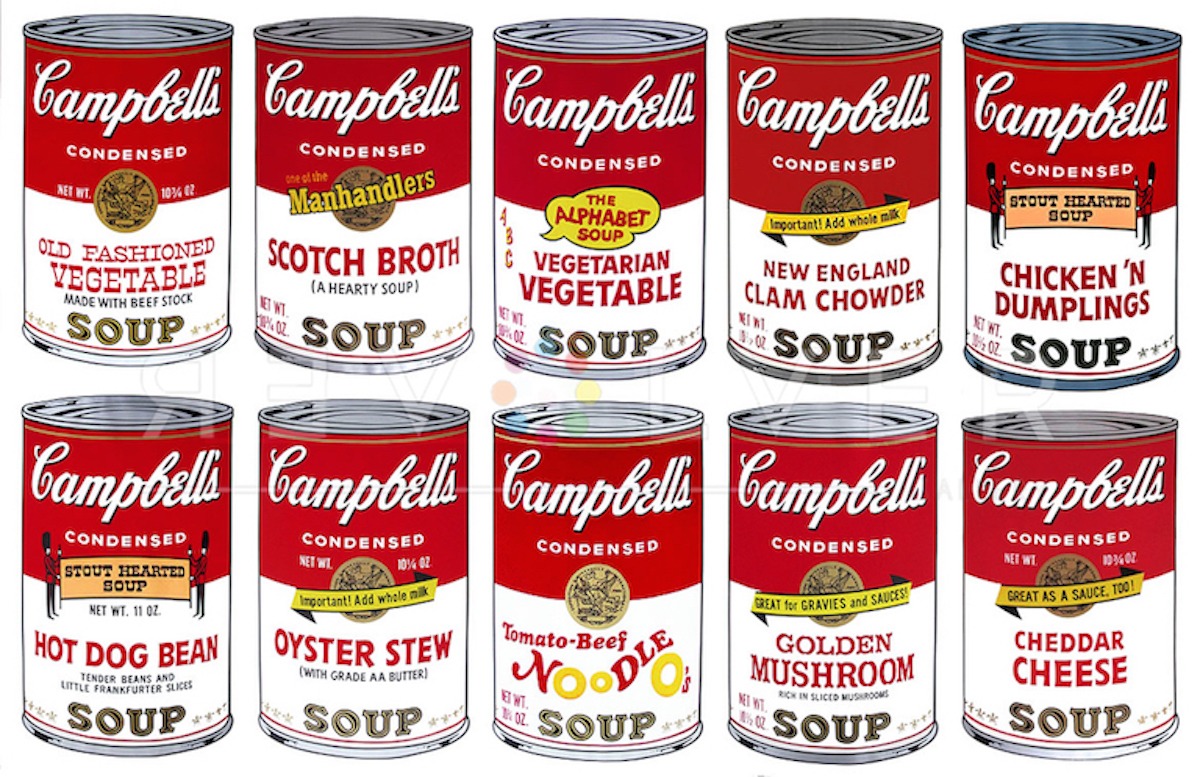
Of all the complete portfolios currently at Revolver, few are more classic than the Campbell’s Soup II portfolio. Made in 1969, this portfolio is the third complete iteration of the Campbell’s soup motif. It began with the monumental 32 Campbell’s Soup Cans paintings that first propelled him to recognition when he unveiled it in 1962. Despite its smaller quantity, the Campbell’s Soups II portfolio maximizes its Warholian qualities tenfold, being mass-produced in an edition of 250. It is further distinguished by Warhol’s addition of cheeky catchphrases and whimsical lettering, infusing the nostalgic set with his Pop Art tastes.
Campbell’s Soup II is also a prime example of Warhol’s vision for the democratization of art. Not only is the portfolio a thematic repeat of his earlier Campbell’s works, which showcases his understanding of serialization as an act of creating accessibility, but it also portrays a common can of soup as a piece of art, altering the perception of art to include everyday objects and appealing to the masses. With a simple but clever take on his favorite soup brand, Warhol solidified Campbell’s Soup II as an exemplary token of his interest in consumerism, Americana, and artistic appropriation, making it the perfect portfolio for collectors who want to own something that fully embodies Warhol and the foundation of his iconic career.
2. Electric Chair
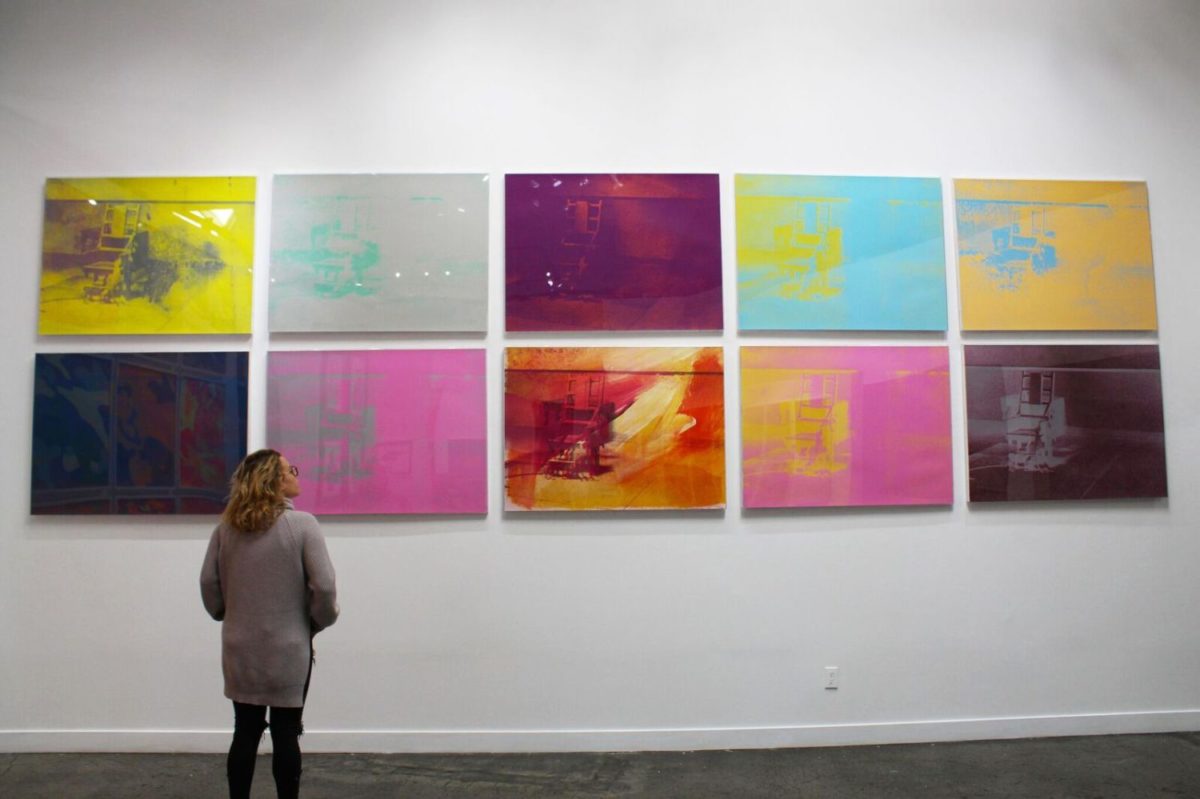
Warhol’s Electric Chair portfolio is for those who are captivated by the artist’s ventures into darker, existential themes. This 1971 portfolio is associated with his Death and Disaster series, a commentary on the most morbid aspects of media and American society in a 10-screenprint array. The idea to depict such gruesome imagery was spurred by the rise in media dissemination covering violence, which consequently made tragic events and images more accessible to inform and haunt the masses. Believing in collective desensitization towards violence proportionate to the rise in its media coverage, Warhol created his Death and Disaster series as he watched these cultural values shift. Electric Chair is a piece of this puzzle.
Warhol’s first application of the image of the electric chair was with paintings in 1963 when New York performed its last prisoner executions, a subject of popular discourse to this day. When revisiting the concept in 1971, Warhol created dreamlike renditions of the stark imagery which evoke both his signature Pop Art style and the suggestion that weighty subjects are often discussed with a tendency towards abstraction rather than with the gravity of their reality. Through his serialized approach to this portfolio, Warhol also echoed the nature of repetitive imagery in the media and the normalization of violence that produces a detachment from the severity of the subject. It points out that while media dissemination is part of a democratic society, it also has the potential to have the reverse effect and make us complacent and complicit in ignoring tragedy.
Electric Chair is one of Warhol’s most continuously relevant portfolios when considering its ability to provoke meaningful dialogue and its reflection of persistent socio-political topics as well as the heightened proliferation of digital media since its creation.
3. Queen Elizabeth II
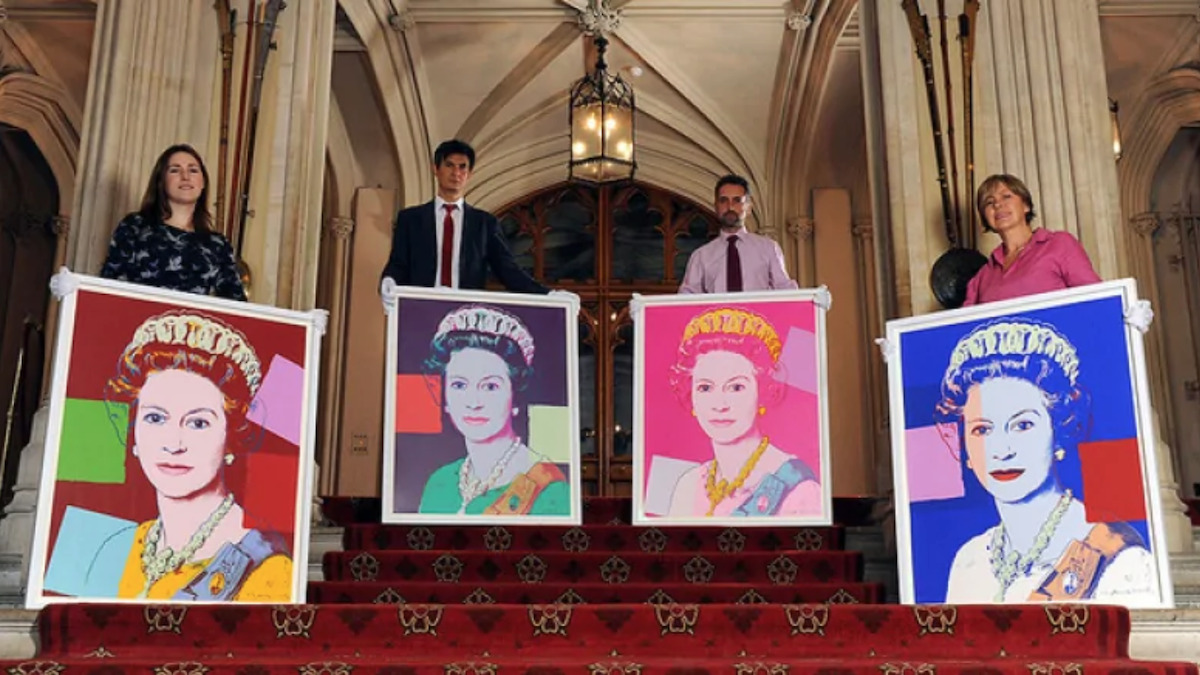
Queen Elizabeth II of the United Kingdom is a set of four screenprints created by Andy Warhol in 1985 as part of his Reigning Queens series. The portfolio, which also included monarchs from the Netherlands, Denmark, and Swaziland, reflects Warhol’s fascination with power, fame, and representation. Based on a 1975 photograph by Peter Grugeon, the four colorways—red, purple, pink, and blue—transform the official image of Queen Elizabeth II into a dazzling Pop Art statement. Through sharp outlines and luminous hues, Warhol captures both the formality of monarchy and the immediacy of mass-media imagery, turning one of the world’s most photographed figures into a contemporary icon.
In this series, Warhol translated centuries of royal portraiture into the language of modern consumer culture. The Queen’s tiara, jewels, and insignia shimmer beneath flattened planes of color, suggesting a bridge between heritage and spectacle. Rather than depict the monarch as distant and untouchable, Warhol presents her with the same bold intimacy he gave to Marilyn Monroe and Liz Taylor. His treatment of color—turquoise skin, violet shadows, and vivid pink backdrops—redefines the conventions of royal imagery while emphasizing the visual glamour that sustained her global presence. The artist’s use of silkscreen also heightens this dialogue between uniqueness and repetition, making the ruler of a constitutional monarchy part of the same visual universe as Hollywood’s brightest stars.
Upon completion, Warhol’s European dealer sent photographs of the finished portraits to Buckingham Palace. The Queen’s secretary replied that Her Majesty was “most pleased and interested to see them.” Decades later, the Royal Collection acquired four of the diamond-dust “Royal Edition” prints to commemorate her Diamond Jubilee, confirming their historical importance. Today, Queen Elizabeth II stands among Warhol’s most sought-after portfolios. It unites luxury, celebrity, and legacy, offering collectors a synthesis of Pop Art innovation and royal tradition. Positioned between the solemn gravity of Electric Chair and the athletic dynamism of Muhammad Ali, this portfolio reveals Warhol’s extraordinary range—from mortality to majesty.
4. Muhammad Ali
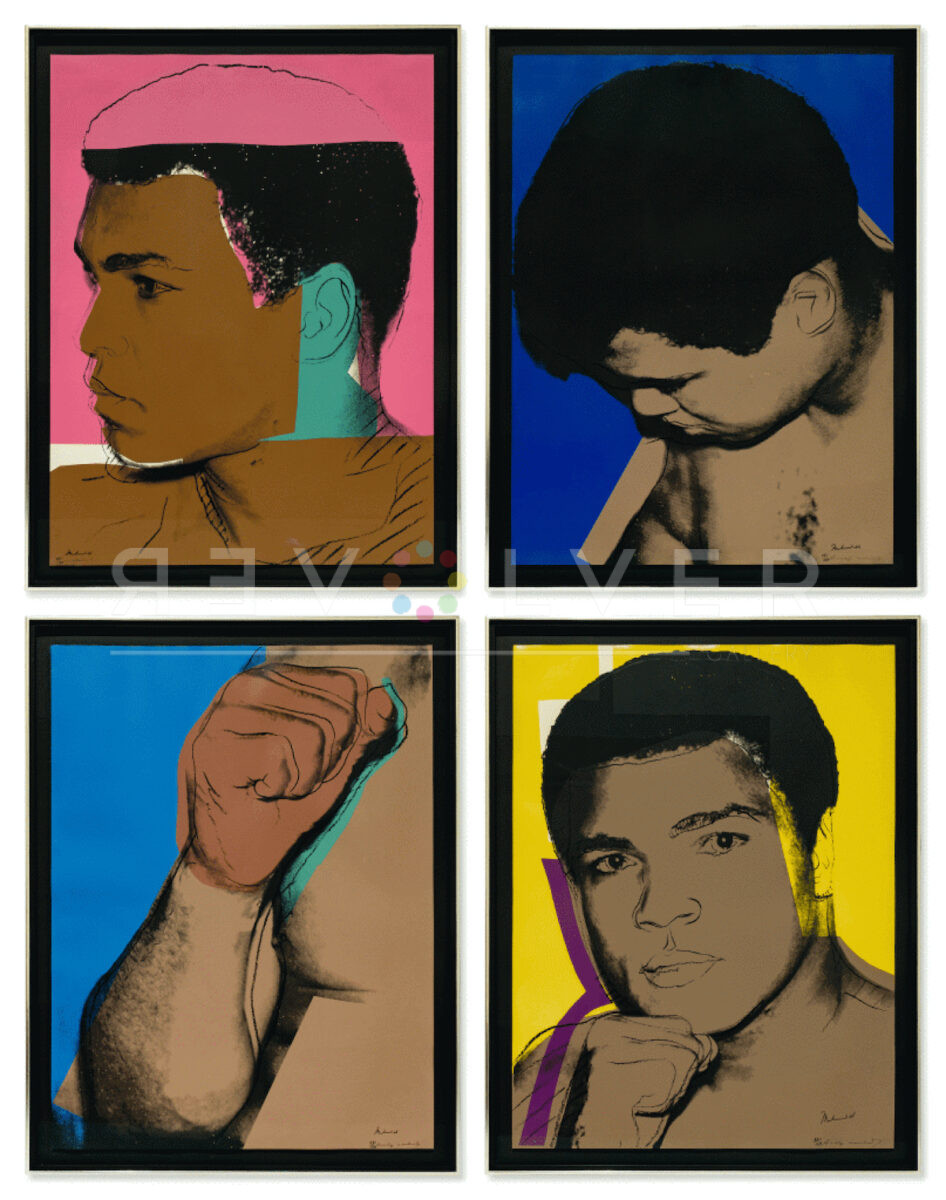
If the Queen Elizabeth II portfolio explores the grandeur of inherited royalty, Warhol’s 1978 Muhammad Ali series turns to a different kind of crown—one earned through charisma, strength, and sheer will. This set of four screenprints portrays the three-time heavyweight boxing champion and activist Muhammad “The Greatest” Ali. It grew out of Warhol’s Athletes series, which placed 10 different star athletes on a Pop-Art pedestal. The Ali portfolio housed in Revolver Gallery is especially rare, double-signed by Muhammad Ali and Andy Warhol; only about 16 such examples are known to exist.
In the Athletes series, Warhol anticipated a cultural shift. As televised sports grew, athletes began to mirror the idolization once reserved for movie stars. Today, that prediction feels even sharper, as professional athletes regularly move into brand deals, movie cameos, and television presenter jobs. Like his film star portraits, Warhol’s images of athletes offered subjects that audiences instantly recognized. The Muhammad Ali portfolio embodies this shift and reflects Warhol’s keen understanding of the zeitgeist.
To create the basis of the screenprints, Warhol photographed the sports hero with his Polaroid camera when he traveled to Ali’s training compound in 1977. Warhol’s eye for detail comes alive in these prints, demonstrated through the series of poses in each image, through which Warhol captures a different aspect of Ali’s essence. One depicts his strong side profile, another showcases his powerful gaze directly at the camera lens, while a third portrays a contemplative chin-down pose. The final print focuses solely on Ali’s hand, a source of wonder for the world, positioned in a striking Orthodox stance. Muhammad Ali pays homage to the many dimensions of the boxer: a lover of peace, a thoughtful advocate for freedom, and a fighter—in the ring for the title of champion, and out of the ring for humankind.
5. Cowboys and Indians

Where Ali personified modern heroism, Cowboys and Indians reaches further back, tracing the nation’s deeper mythology through a cast of heroes, symbols, and myths that shaped its collective imagination. It is a portfolio that reflects America’s fascination with its own past, blending folklore, film, and historical iconography into a vibrant Pop Art panorama. Created in 1986, this late-career series finds Warhol revisiting his lifelong interest in fame and representation, but through the lens of national identity. Printed by Rupert Jasen Smith in New York, the portfolio transforms the myths of the American West into dazzling, cinematic images that reveal as much about modern culture as they do about history itself.
In Cowboys and Indians, Warhol pairs familiar heroes—John Wayne, Annie Oakley, General Custer, and Teddy Roosevelt—with stylized representations of Native American subjects, including Geronimo, Sitting Bull, and the Northwest Coast Mask. Through this juxtaposition, he exposes how American culture has romanticized the frontier while overlooking its realities. The works are not historical reconstructions but reflections of popular imagination — the West as seen through movies, advertising, and folklore. Warhol’s bold colors and flattened compositions lend these figures both glamour and distance, showing how repetition and stylization turn history into mythology. What emerges is a mirror of America’s self-image: heroic, simplified, and perpetually reproduced.
As with Myths and Ads, Warhol’s Cowboys and Indians investigates how mass media elevates certain stories while erasing others. By blending pop culture with patriotic iconography, the portfolio questions the line between celebration and satire. Today, it stands as one of Warhol’s most complex and culturally resonant late series — a meditation on fame, nationhood, and collective memory. Balancing allure and unease, Cowboys and Indians remains a favorite among collectors for its vivid imagery and sharp social commentary, a timeless portrait of how America constructs its heroes.
6. Skulls

If Cowboys and Indians examines collective identity, Andy Warhol’s Skulls portfolio strips it away, turning inward to confront a universal theme: mortality. Published in 1976, this series draws upon the art-historical tradition of vanitas, in which still lifes remind viewers of life’s transience. Through a sequence of four screenprints based on photographs taken by his assistant Ronnie Cutrone, Warhol transforms the image of a human skull into an object of vibrant, almost hypnotic beauty. Each print — rendered in vivid combinations of red, yellow, purple, and blue — turns death itself into a Pop Art spectacle, fusing existential tension with aesthetic allure.
Though it draws on the still life and vanitas traditions, Warhol’s approach is uniquely modern. Rather than painting with oils, he used silkscreen and photography to create a mechanical meditation on impermanence. The skull, lit dramatically from one side, casts a shadow that seems to move from print to print, echoing the passage of time. This play of light and darkness recalls the moment of self-reckoning that followed Warhol’s near-fatal shooting in 1968. Where earlier works celebrated icons of mass culture, Skulls replaces glamour with reflection, demonstrating that the themes of mortality and fame were never far apart in Warhol’s imagination.
Like Gems (1978) and Space Fruit (1979), Skulls belongs to Warhol’s late still-life period, where he elevated everyday objects into reflections on value, existence, and time. Yet among these portfolios, Skulls stands apart for its emotional resonance. Beneath the bold color and repetition lies a profound equality—a reminder that beneath all fame and fortune, we share the same human fate. Both haunting and elegant, Skulls captures Warhol’s ability to transform even death into an image of startling vitality and enduring significance.
7. Martha Graham
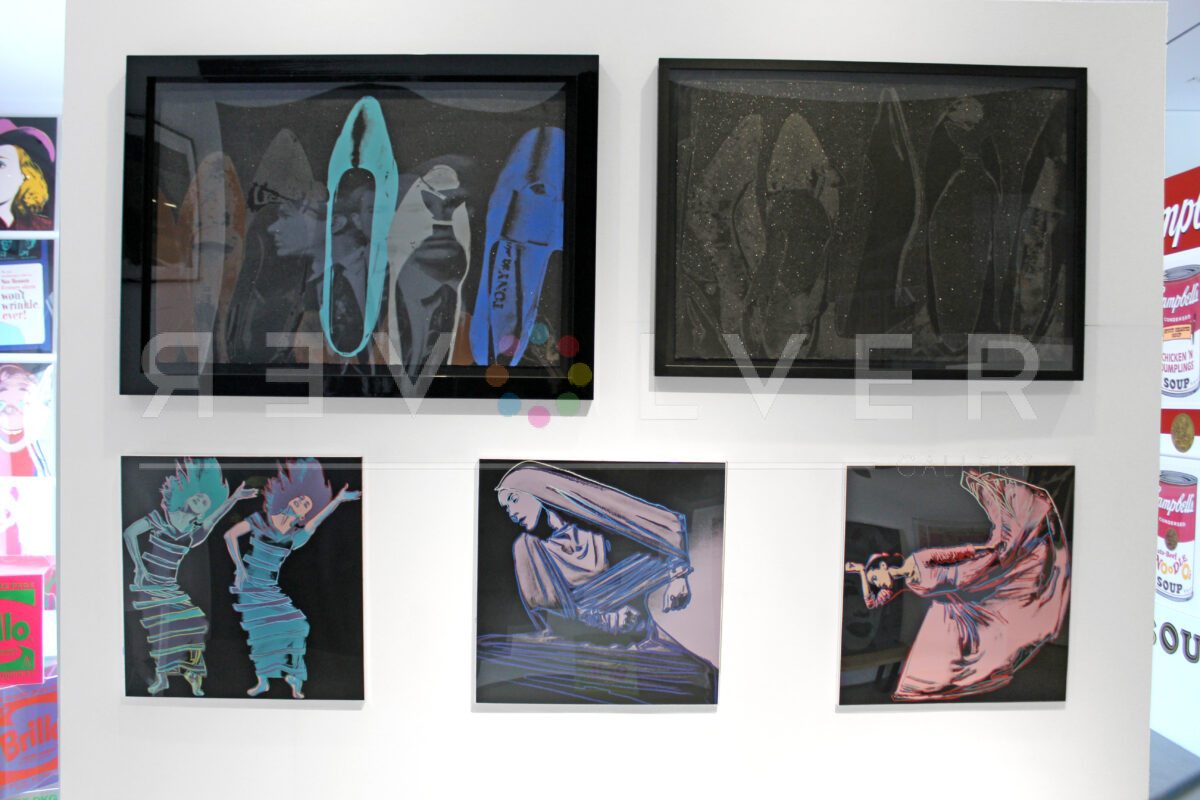
Warhol valued other art forms as much as he did his own, using film, music, and others as inspiration for his works. He showcased this multidisciplinary approach in a three-screenprint portfolio bursting with neon hues that centered on Martha Graham, the founder of a renowned American contemporary dance studio and the mother of modern dance.
Warhol created the portfolio in 1986 to mark the sixteenth anniversary of Graham’s institution, The Martha Graham Dance Center of Contemporary Dance. Graham was a visionary choreographer who sought to capture raw humanity in her dance. Her new technique elevated dance to a form of social and political inquiry, mirroring societal complexities and challenging the norms through her subject matter and style. For her accomplishments and outstanding contribution to society, Graham was honored with the highest civilian distinction, the Presidential Medal of Freedom, in addition to many other accolades.
Warhol’s portfolio portrays Graham’s powerful essence, full of life and dynamism imbued through emotional expressions, fluid lines, and grand dance poses; each of the three screenprints is titled and designed to commemorate one of Graham’s most well-known dances. In Martha Graham, Warhol bridges the gap between the transcendent nature of Graham’s accomplishments and her mainstream fame and notoriety, marking the portfolio with his democratic art philosophy.
Warhol’s years-long friendship with Graham often found him in the audience at the dance legend’s performances, making this portfolio all the more personal to him. Like Graham herself, The Martha Graham Complete Portfolio is a national treasure that speaks to making art from the heart. No doubt, it would be a meaningful investment for collectors who are artistic connoisseurs, and who wish to own a piece of the legacy that forged a revolutionary style of movement and transformed dance into a fierce mechanism for social and political advocacy.
8. Camouflage
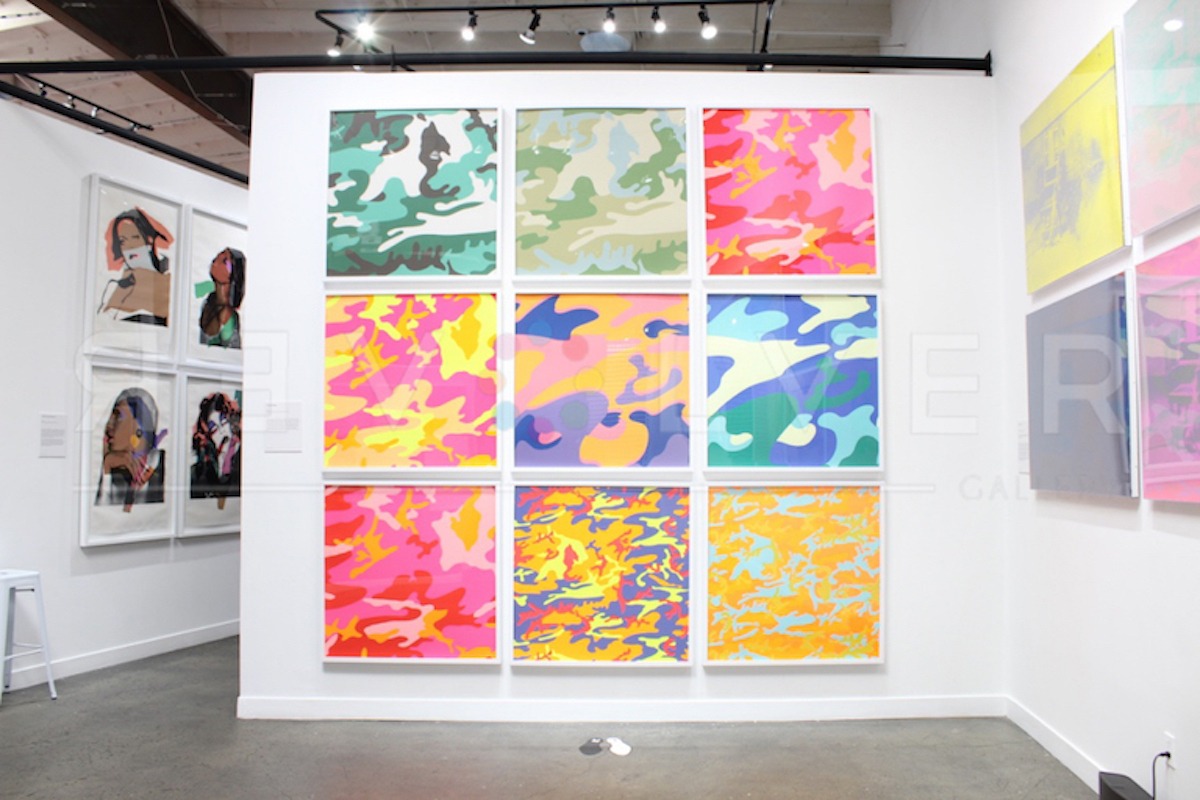
If any portfolio embodies Warhol’s ability to manipulate the cultural pulse, it’s his Camouflage portfolio (1987), also housed at Revolver. Camouflage stands as one of the last portfolios that Warhol created. He died before he could sign the works, so Fred Hughes, the Executor of the Andy Warhol Estate, signed them and stamped each with a certificate of authenticity.
The idea for the portfolio came to Warhol when he noticed his assistant Jay Shriver pushing paint through a camouflage-covered mesh to create abstractions. Intrigued, Warhol bought camo fabric from an army surplus store and adapted the pattern into vivid, colorful Pop Art. The transformation was striking: a print once meant to conceal became an eye-catching design. Warhol’s Camouflage anticipated the pattern’s rise from military uniform to high-fashion symbol.
Extending the theme, Warhol collaborated with designer Stephen Sprouse to create a camo-pop line. He also used the motif for some of his most notable self-portraits (Camouflage Self-Portait, 1986) as well as Joseph Beuys In Memorium, a 1986 portrait of the artist and activist. In another series, he cloaked the Statue of Liberty in the camouflage pattern, fusing a patriotic icon with a pattern of concealment.
These experiments highlight Warhol’s fascination with perception and identity. By layering camouflage over faces, even his own, he suggested that fame conceals as much as it reveals. The tension between visibility and disguise resonated deeply with Warhol, who lived in constant proximity to celebrities while cultivating his own enigmatic persona.
In Camouflage, Warhol turned a functional military symbol into a playful, critical, and stylish Pop image. The portfolio showcases his sensitivity to trends and his instinct for cultural recontextualization. For collectors, its origins, timing, and rarity make it one of Warhol’s most distinctive late works. It’s an emblem of both Pop Art’s boldness and Warhol’s enduring genius.
Why Warhol’s Portfolios Remain the Pinnacle for Collectors
These 8 portfolios are only a small piece of the Andy Warhol artworks housed by Revolver. Overall, Warhol’s portfolios intrigue serious collectors with their historical significance, the opportunity to engage with Warhol’s vision in its totality, and their lucrative investment potential. A portfolio represents a complete chapter in Warhol’s artistic journey, providing a comprehensive piece of the depth of his work and the themes of an era he sought to capture. Indeed, for many collectors, owning one of Warhol’s portfolios, complete with matching edition numbers, isn’t just a smart investment—it’s one of the most prestigious achievements in the art world.
In essence, Andy Warhol’s complete portfolios are more than just suites of prints; they are cultural artifacts that capture a slice of the zeitgeist of an era and a specific moment in the artist’s life and career. They stand as a testament to Warhol’s genius in bridging the gap between historical reverence and contemporary art. For collectors and art enthusiasts alike, these portfolios offer an unparalleled opportunity to delve into the heart of Pop Art, exploring its themes, its evolution, and its enduring impact on the art world.
Do you own a complete portfolio by Andy Warhol? For many, a Warhol portfolio might be the perfect next step to elevate one’s art collection. For a comprehensive view of Warhol’s portfolios, click here.